There is a particular kind of honesty that emerges when a performance refuses to decorate its own conditions. At Open Space, a venue whose name reads as a declaration of vulnerability, NOTHING POLITICAL unfolds with the quiet confidence of something that already anticipates misunderstanding.
The title does its work early. It disarms, irritates, provokes a mild suspicion. In a city still vibrating from the aftershocks of the 2024–25 protests, to call anything “nothing political” feels either naïve or strategic. This piece, shaped collectively by Nikusha Bakradze, Magda Lebanidze, Tamri Okhikian, Davit Khorbaladze, Sandro Samkharadze, and Sopho Zeragia, moves elsewhere. It occupies a register where language withdraws at the very moment reality becomes too charged to hold directly.
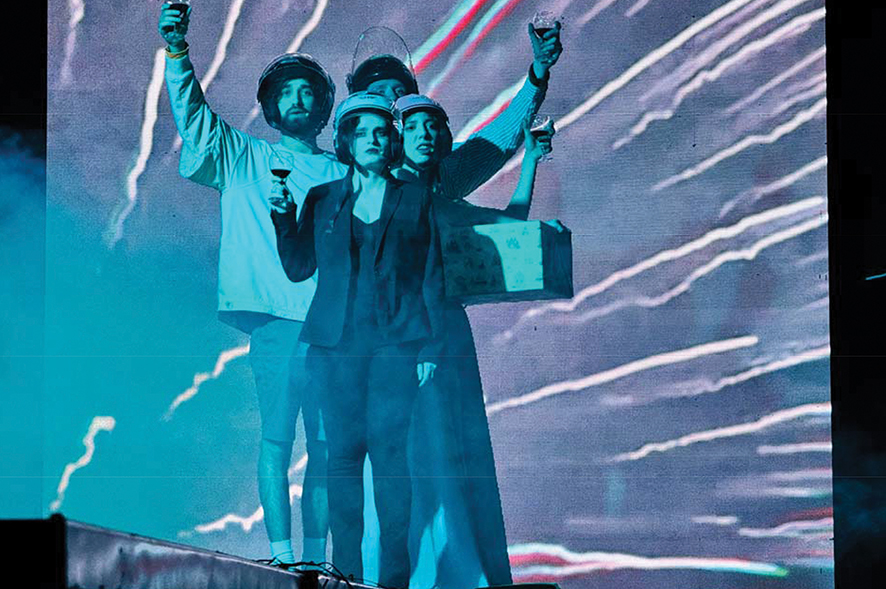
What unfolds resists conventional narrative expectations. There is no arc, no central protagonist stabilizing attention. The performance assembles a field of fragments—recordings, images, half-erased recollections, composed through a shared authorship that includes performers, a director, a composer, a playwright, and a visual artist working without rigid hierarchy. The result feels like memory under pressure. Authority disperses across the stage. No single voice claims interpretive dominance; no gesture settles the others. A dense polyphony takes shape, each participant carrying a portion of the whole, while the whole remains perpetually incomplete.
The Open Space platform intensifies this condition. The scenography remains stripped, the environment exposed. Performers stand in direct proximity to the audience, their presence unbuffered. Within this framework, the work of composer and visual collaborators becomes sharply legible: sound destabilizes action; images fracture memory. The visual language extends into structure itself. Memory appears as contested terrain. Fragments circulate in damaged, displaced, sometimes incompatible forms. The audience encounters erosion as an active process.
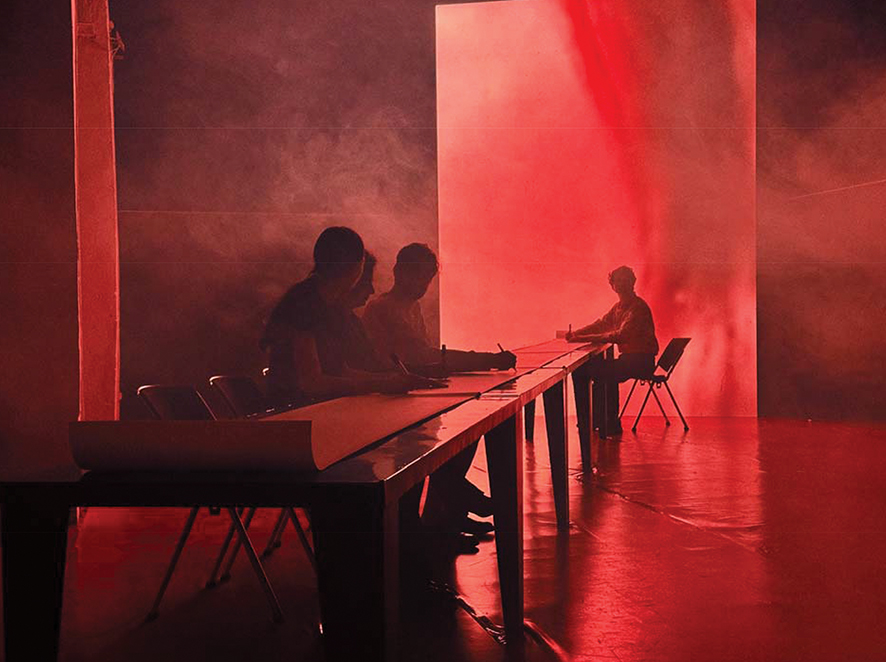
This approach resonates with a broader post-Soviet anxiety around disappearance: whose stories remain, whose vanish, and under what conditions. Emotion circulates through this unstable system with quiet intensity. Love and hatred occupy adjacent states, sliding into one another without warning. The performers inhabit these tensions from within. The effect accumulates through proximity. A glance, a pause, a repeated phrase: each element gathers weight.
Production becomes part of the narrative architecture. Under producer Ana Gurgenidze, with international support from Nutsa Burjanadze and Tamar Laliashvili, the piece carries the marks of a project that operates across multiple contexts. It speaks locally while maintaining an awareness of its transnational visibility.
What stands out most clearly is the work’s resistance to explanation. In a cultural environment saturated with instant interpretation, NOTHING POLITICAL withholds clarity. It offers material and leaves meaning in suspension. This demand can feel exacting. Some viewers will continue searching for a clearer statement, a more legible position. Others will recognize in this withholding a form of precision. The piece preserves the contradictions from which it emerges.
Open Space proves to be the right environment for such a gesture. Its lack of theatrical insulation produces direct contact with the material. There is nowhere to hide: from the performers, from the fragments they carry, from the uneasy recognition they produce. In the end, NOTHING POLITICAL reveals itself as deeply, insistently political through its structure: through the distribution of authorship, through its treatment of memory, through its refusal of resolution.
Crucially, all of this remains anchored in specific people: Bakradze, Lebanidze, Okhikian, Khorbaladze, Samkharadze, Zeragia, whose presence keeps the work grounded. The evening concludes without closure. The world remains open.
Review by Ivan Nechaev