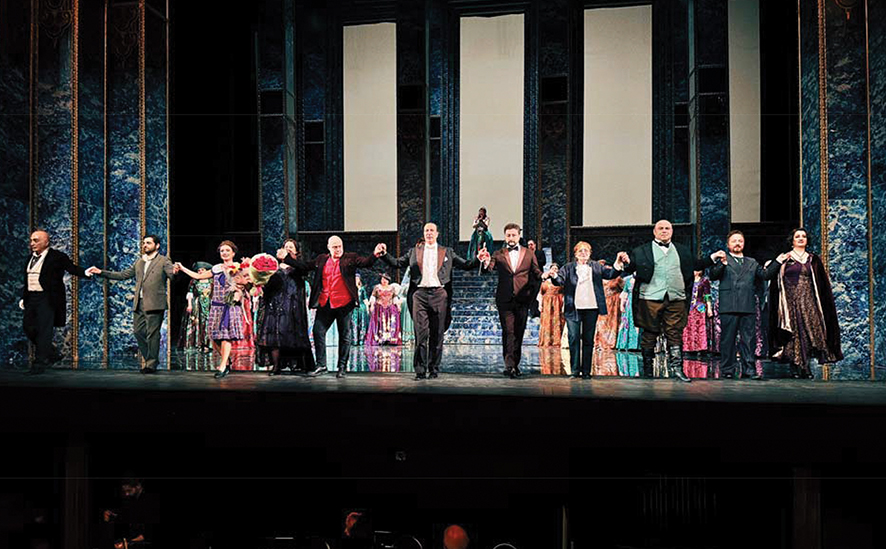
At the Tbilisi Opera and Ballet Theater, Don Giovanni unfolds with a curious steadiness, as if the work had entered a phase of self-observation. The familiar machinery remains intact: recitative, aria, ensemble, but the evening places unusual emphasis on how these parts recur, align, and accumulate. The opera begins to read less as a sequence of dramatic peaks and more as a patterned circulation of gestures.
Wolfgang Amadeus Mozart’s score, often treated as a vehicle for theatrical momentum, here reveals a quieter rigor. Rhythmic profiles settle into consistent proportions. Cadences arrive with punctual clarity. The transitions between speech and song carry a sense of administrative order, as if each musical unit were filing into place. Listening shifts toward duration and spacing: how long a phrase holds, how quickly a response follows, how repetition builds its own logic.
In this environment, the title figure, sung by Giorgi Lomiseli, moves through the opera with an almost procedural calm. The vocal line stays centered, dynamics measured, articulation clean. Encounters unfold as a series of operations: approach, exchange, continuation. The effect accumulates across the evening. Each scene adds another instance to a growing archive of similar actions, and the character begins to take shape through recurrence rather than transformation.
The surrounding roles register this pattern in different ways. Anna Kharaidze’s Donna Anna sustains a narrow dynamic field, her phrases carrying a continuous thread of tension that resists dispersion. Irina Taboridze’s Donna Elvira maintains a steady presence across appearances, her vocal color anchoring a line of persistence that threads through the opera’s shifting situations. Ramaz Chikviladze’s Leporello approaches the Catalogue Aria with an almost clerical clarity: the list unfolds item by item, each entry placed with careful timing, the accumulation itself becoming the point. Matteo Macchioni’s Don Ottavio extends his lines with controlled breath, shaping phrases that hover within the orchestral texture.
Under Alvise Casellati, the orchestra maintains a lucid surface. String articulation remains crisp, allowing internal voices to emerge. Wind lines trace harmonic turns with understated precision. The overall sound holds together through balance and proportion, drawing attention to alignment.
What gradually comes into focus is a particular image of desire: one governed by iteration. Scenes echo earlier scenes. Gestures return with slight adjustments. The opera’s social field takes shape through these repetitions, each character negotiating position within a structure that continues to reproduce itself. The drama resides in the persistence of the pattern as much as in any single event.
The final sequence gathers these elements into a concentrated frame. Harmonic tension thickens, sustained through measured crescendos and extended chords. The arrival of judgment follows the established trajectory, closing the system with a sense of formal completion. By the end, Don Giovanni lingers as a study in continuity: a work that organizes itself through repetition, where each return carries the weight of everything that came before.
Review by Ivan Nechaev