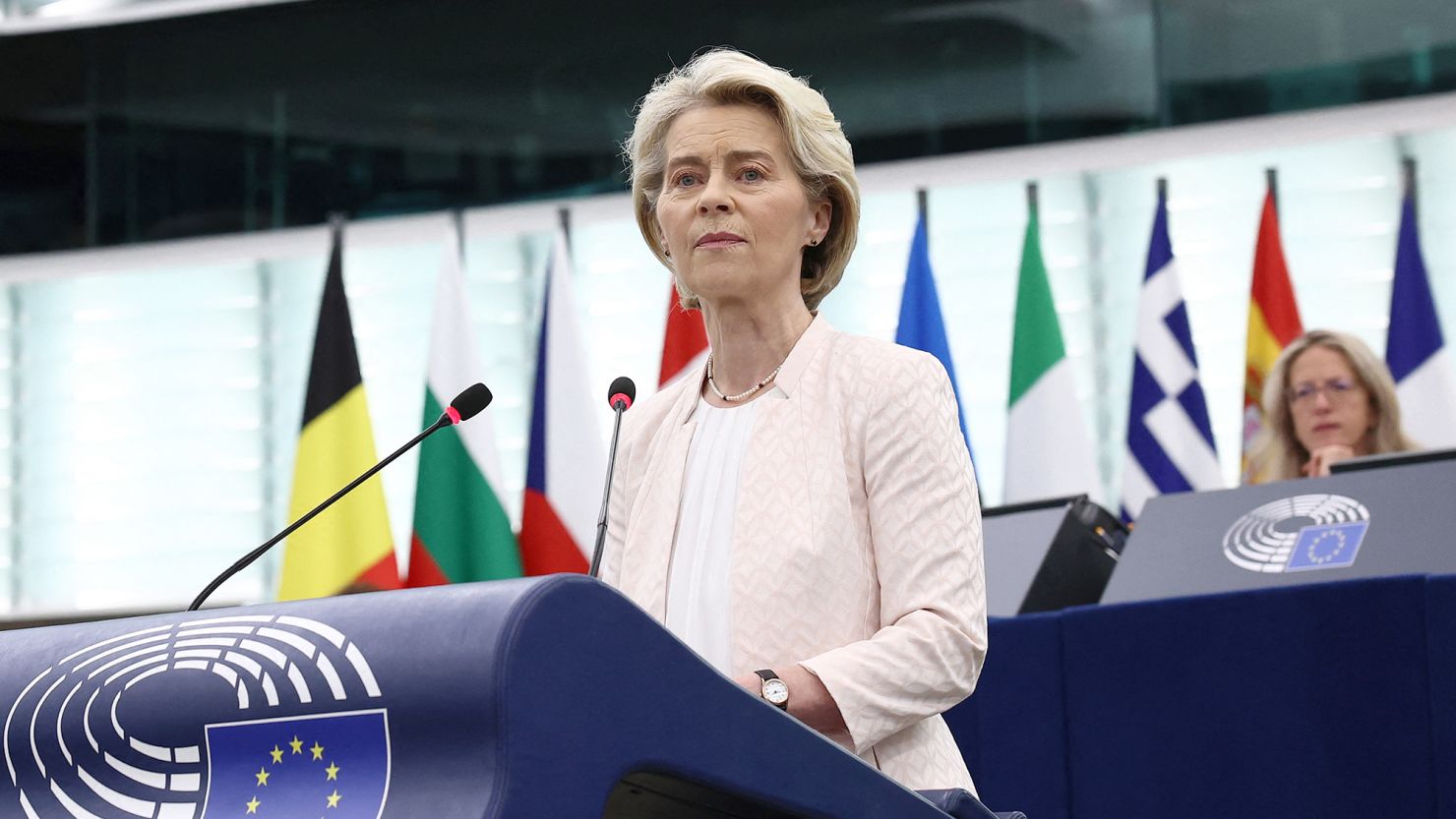
European Commission President Ursula von der Leyen has responded to a joint letter from Georgian opposition leaders expressing concern over recent political developments in Georgia and calling for stronger sanctions against the ruling Georgian Dream party.
In her written reply, von der Leyen reaffirmed the European Union’s commitment to the Georgian people and their European aspirations, while sharply criticizing recent developments in the country.
“Allow me to underline that the European Union will continue its efforts for the democratic, stable and European future of the Georgian people. We continue to call on all political actors in Georgia to work towards this objective,” she wrote.
Addressing recent events, the Commission President stated that the EU has reacted firmly to what it described as negative developments in Georgia. She reiterated calls on the Georgian authorities to release “all journalists, activists and individuals who have been unjustly detained.”
Von der Leyen also expressed concern over alleged election irregularities, violence against peaceful protesters, the adoption of what she described as repressive legislation, and the instrumentalization of the judicial system.
“These actions contradict the core values and principles of the European Union,” the letter states.
Von der Leyen claims that the European Commission has already taken concrete measures in response. These include the suspension of bilateral financial assistance to the Georgian government and the downgrading of political contacts.
She further noted that, based on a Commission proposal, the EU Council partially suspended the Visa Facilitation Agreement with Georgia, affecting holders of diplomatic and service passports issued by Georgian authorities.
Von der Leyen emphasized that Georgia’s EU accession process is “effectively suspended,” referencing conclusions adopted by the European Council in June and October 2024.
In the Commission’s latest Visa Suspension Mechanism report, published on December 19, 2025, Brussels concluded that Georgia has further regressed in key areas including governance, rule of law, visa alignment and anti-corruption standards — criteria that underpin visa-free travel.
Citing what she described as the “systemic and deliberate nature” of this backsliding, von der Leyen said the Commission has initiated further steps under the revised visa suspension mechanism.
Under the new rules, the first stage targets holders of diplomatic, service and official passports. However, she warned that visa-free travel could eventually be suspended for the wider population if democratic regression and human rights violations continue.
While EU member states have not reached consensus on sanctions, discussions remain ongoing regarding accountability for individuals deemed responsible for democratic backsliding and human rights violations.
“All decisions related to EU sanctions are adopted unanimously by member states in the Council,” von der Leyen noted.
She concluded by reaffirming the EU’s support for democratic principles, human rights and the rule of law in Georgia.
“Rest assured that the European Union remains firmly supportive of the Georgian people and their aspirations towards a European future,” the letter reads.
The opposition leaders had earlier urged the European Commission President to strengthen sanctions against Georgian Dream and its founder Bidzina Ivanishvili.
In their letter, they claimed that one EU member state is “systematically blocking” efforts to impose substantial sanctions against Ivanishvili and what they described as his Kremlin-linked network.
“While we hope that this resistance will be overcome in time, the revised Visa Suspension Mechanism currently offers a real path forward,” the opposition letter stated.
The document was signed by Zurab Girchi Japaridze, Nika Gvaramia, Nika Melia, Levan Khabeishvili, Elene Khoshtaria, Giorgi Vashadze, Irakli Okruashvili and Givi Targamadze.
Image: Frederick Florin/AFP/Getty Images