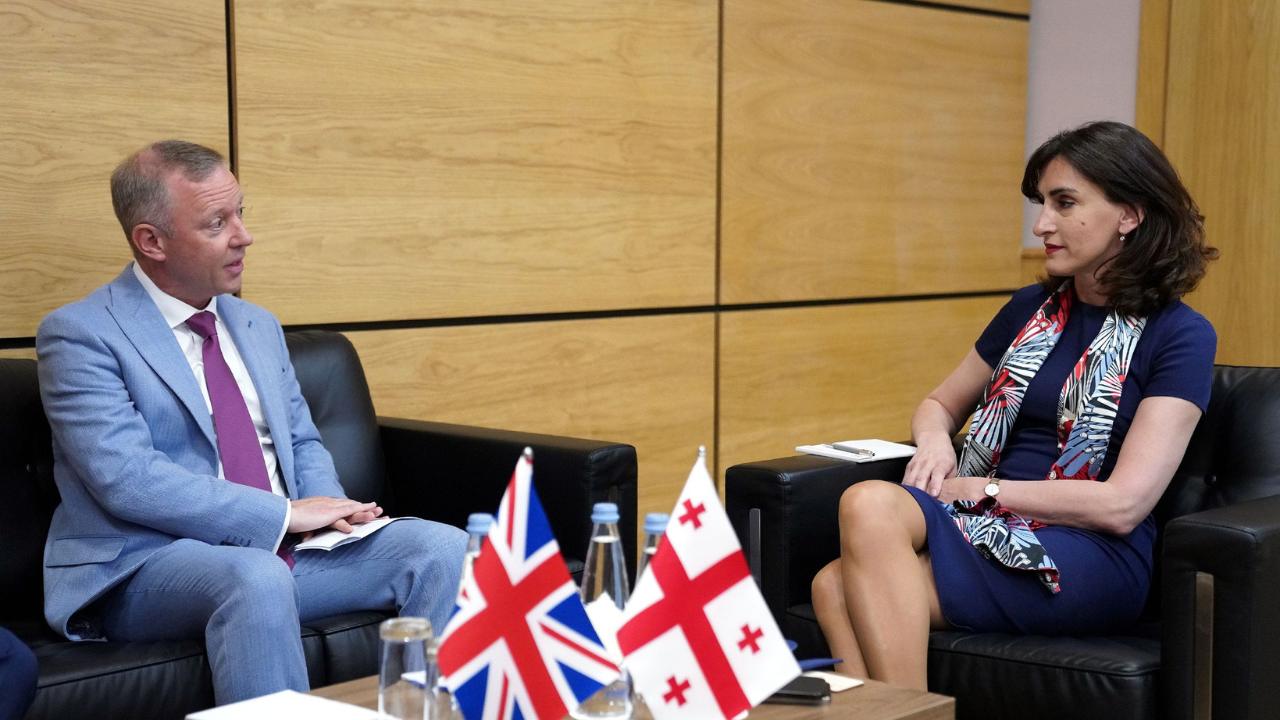
The United Kingdom’s Ambassador to Georgia, Gareth Ward, has been summoned to Georgia’s Ministry of Foreign Affairs following London’s decision to impose sanctions on two pro-government Georgian television channels, Imedi and POS TV.
Georgian officials say the ambassador was called in to provide clarification regarding the legal grounds for the sanctions.
“We have communicated with the British side. Tomorrow, I expect the UK ambassador to come to the Ministry of Foreign Affairs. We will demand an explanation as to what forms the basis of such a decision to sanction Georgian television companies,” Georgia’s Foreign Minister Maka Bochorishvili said in an interview with Rustavi 2 on Wednesday.
Bochorishvili stressed that sanctions require a “very solid legal foundation,” particularly when they concern media outlets and issues related to freedom of expression. She described the British government’s decision as “astonishing” and said it was regrettable to see Georgia having to defend its national interests “without any grounds” against what she characterized as attacks.
“If the purpose of sanctions is to defeat Russia, then sanctioning Georgian television companies is cynical,” the minister said. “How can we seriously consider that the West — in this case, the United Kingdom — sees the path to victory over Russia in sanctioning two Georgian TV stations?”
On February 24, the United Kingdom imposed sanctions on Imedi and POS TV under its Russia-related sanctions regulations. The measures include asset freezes, a prohibition on trust services, and director disqualification sanctions.
UK government says Imedi and POS TV have deliberately disseminated misleading information about Russia’s full-scale invasion of Ukraine. London stated that such actions amount to supporting or promoting policies or activities that destabilize Ukraine or undermine its territorial integrity, sovereignty, and independence.
Specifically, the UK alleges that the broadcasters have regularly promoted narratives portraying the Ukrainian government and President Volodymyr Zelensky as illegitimate, depicting Ukraine as a “puppet” of the West, describing the country as corrupt, and suggesting that Ukraine and Western states are attempting to destabilize Georgia.
The development adds a new layer of tension to already sensitive relations between Tbilisi and Western partners, as debates continue over media standards, disinformation, and Georgia’s broader geopolitical positioning amid Russia’s war against Ukraine.