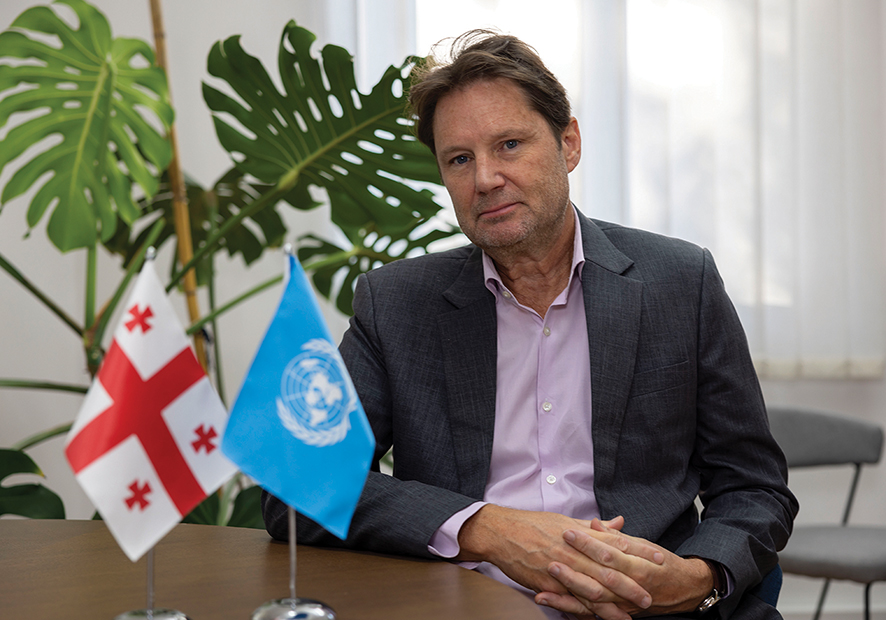
As Georgia enters a new phase of its development journey, the United Nations Development Program (UNDP) is launching a new five-year Country Program that focuses on inclusive economic growth, digital transformation, climate resilience, and stronger institutions. In this interview with Georgia Today, UNDP Resident Representative in Georgia Douglas Webb discusses how the organization supports Georgia’s European aspirations, empowers entrepreneurs and young people, strengthens climate action, and works with partners across government, civil society, and the private sector to ensure that development benefits communities across the country.
As Georgia pursues EU membership, how does UNDP ensure its programs remain aligned with national priorities and EU standards while adapting to changing circumstances?
UNDP’s role in Georgia is straightforward: we support the country’s own development priorities and help safeguard the progress it has achieved over the years.
At the same time, we work to strengthen resilience so Georgia can respond confidently to new political, social, economic, and climate challenges.
European Union integration is an aspiration enshrined in Georgia’s Constitution, and that is also closely aligned with the Sustainable Development Goals. As we begin a new five-year cycle of our work, contributing to the new UN Sustainable Development Cooperation Framework, this direction will continue to shape our programs, which are agreed with the government and developed together with our donors, partners, and stakeholders.
In practice, this means working side by side with public institutions, businesses, civil society, communities and development partners to assess challenges and co-create solutions. Some respond to immediate needs; others lay the groundwork for long-term reforms. Our focus is always the same: to help Georgia move forward in a way that is sustainable, inclusive, resilient and aims to advance human rights.
Entrepreneurship, digitalization, and women’s empowerment are key priorities of your new five-year Country Program. How are you helping rural communities and women-led businesses access finance, digital tools, and business support?
We place people and communities at the centre of everything we do. When people have access to knowledge, finance, technology, and enabling institutions, they can shape their own future and contribute to shared prosperity.
Promoting digital transformation and sustainable entrepreneurship are important areas of our work, particularly for those who often lack opportunities, such as internally displaced persons, refugees, rural women, minority groups, and people living in remote regions.
Let me share a few concrete examples:
Together with Sweden and the Bank of Georgia, we supported more than 200 women-led startups and growing businesses across the country through our Women Entrepreneurs Development Program.
Beyond financing, these entrepreneurs gained access to mentoring, networks, and practical business skills that help them compete and grow.
With funding from the German Government and in partnership with CARE Caucasus, we support refugee entrepreneurs, most of them from Ukraine, to launch and expand their businesses in Georgia. The results are striking. Participating businesses achieved a 50 percent profit margin and a 552 percent return on investment, demonstrating how targeted support can unlock strong economic potential while helping with social and economic integration.
With the European Union, we help Georgian small and medium-sized enterprises expand into European markets, strengthen competitiveness, and open new trade opportunities.
Over the past decade, our partnership with the European Union under the ENPARD program has empowered hundreds of rural entrepreneurs. We help improve rural development governance in line with the EU’s Common Agricultural Policy, creating a more transparent and future-ready framework that supports farmers and rural communities.
With Norway’s support, our Diversity Venture initiative champions equality in business by supporting entrepreneurs from minority groups. Since 2023, more than 65 entrepreneurs have received tailored training, mentoring, and grant assistance to build or expand their ventures.
With the support of the Green Climate Fund and technical expertise from Seoul National University, we helped establish GECSA (Georgian Climate Services for Agriculture), a digital platform that provides farmers with climate data and advice to make informed, climate-smart decisions. This initiative brings together national institutions and farmers’ organizations to strengthen resilience in agriculture.
Each of these initiatives addresses a different barrier, such as access to finance, markets, skills or information. But together they contribute to a broader goal: inclusive growth and prosperity for all.
Climate change, biodiversity loss, and disasters are urgent issues. How does UNDP ensure that your environmental initiatives benefit everyone, especially women and marginalized groups who often face the greatest risks?
Climate solutions are not abstract policies discussed in conference rooms. They are practical, visible actions and changes in institutional behaviours that protect lives today and create conditions for people to live and thrive tomorrow.
Reducing emissions, reshaping our economies, and accelerating the shift to renewable energy are not merely tick-boxes on an ambitious wish list. These are part of a clear and necessary strategy to safeguard our future.
Georgia is increasingly exposed to climate risks. Floods, landslides, droughts and other hazards have intensified over the past decade, affecting every region and sector of the economy. At the same time, timely climate action and low-carbon growth can reduce these risks and strengthen the economy.
A recent Country Climate and Development Report by the World Bank shows that climate adaptation could raise Georgia’s GDP by 3-4 percent, while well-financed net-zero action could deliver up to 0.5 percent GDP gains by 2050. Labour mobility and upskilling policies could reduce national poverty by 0.6 percentage points by 2030; without them, poverty may rise in regions such as Imereti and Mtskheta-Mtianeti. Achieving net zero could also increase jobs in agriculture and energy by 21 percent, although some low-skilled workers may face income losses. This makes skills development essential for a fair transition. Greater energy efficiency and reduced fossil fuel imports can also support low-carbon growth without raising energy costs or poverty.
Addressing these challenges requires joint action by government, businesses, civil society, and citizens.
Our role is to provide expertise and resources, help test practical solutions, and support nationally led climate action that benefits everyone.
For example:
With support from the Green Climate Fund, Sweden, and Switzerland, we are helping Georgia establish a comprehensive national early warning system covering 11 river basins and seven major climate hazards, including floods, flash floods, droughts, avalanches, landslides, mudflows, and strong wind. The goal is clear: timely information and coordinated response to save lives and protect communities.
Since 2019, we have implemented 32 adaptation measures that directly protect more than 55,000 people in 16 communities from floods and other hazards. Working with the Ministry of Infrastructure, we helped translate engineering plans into durable protection works, including riverbank reinforcements, drainage systems, and resilient crossings. Local residents, including women, older people and vulnerable groups, actively participated in mapping risks and planning solutions. In Kobuleti, for instance, consultations with older residents helped shape landslide maps that now guide safer land use.
Together with the EU, the World Health Organization, and the United Nations Economic Commission for Europe, we support Georgia in strengthening air quality monitoring systems to better protect public health.
In partnership with the EU, we promote circular economy solutions. Georgia generates up to 1.1 million tons of waste each year, yet only 1.48 percent is recycled, well below the EU average. While policies are in place, implementation remains a challenge. Over the next few years, we will focus on practical solutions that improve waste management, encourage responsible production and consumption, and embed and normalize circular practices into daily life.
With Denmark, we support Georgia’s green and just transition, ensuring that climate action benefits people and local economies. In Khobi and Poti, community-based projects range from youth environmental education to innovative e-waste collection systems.
Climate action must also be fair. Together with Germany, we are strengthening environmental justice by building legal expertise and public awareness. In 2025, in partnership with the Georgian Bar Association, we trained more than 400 lawyers, mediators and minority representatives to advocate for environmental rights.
All these efforts will continue throughout the new cycle of our country program in Georgia. As before, one principle will guide our work: climate solutions must protect those most exposed to risk and ensure that the transition to a greener future is inclusive, equitable, and nationally owned.
Some regions in Georgia are still affected by conflict and social divisions. What approaches will UNDP take to bring communities together, strengthen social cohesion, and at the same time create resilient livelihoods and environmental solutions?
UNDP stands alongside people everywhere whose lives have been disrupted by conflict and war. We are focusing on what matters most: safety, dignity, opportunity, and hope.
In conflict-affected and divided communities, we work to keep essential services running while creating economic and social opportunities for people. We support local initiatives, from education and healthcare to livelihoods and small business development. We address urgent needs, encourage community leadership, and create safe spaces for dialogue and cooperation.
Our partnership with the European Union, Denmark, Germany, Norway, local authorities, and civil society organizations helps us reach communities most affected by conflict. I’ve referred to our assistance to refugees, primarily from Ukraine, in rebuilding their lives and contributing to Georgia’s social and economic fabric.
Our approach is to connect social cohesion, economic opportunity, and environmental action. Trust grows when people work together on shared priorities, whether responding to climate challenges, developing green businesses, or preserving historic heritage. And with trust comes reciprocity and resilience.
Digital tools and data-driven policies can make governance more efficient. How will UNDP make sure that these innovations actually improve transparency, accountability, and access to public services for both urban and rural communities?
Georgia has a strong track record of reforms that made public services more accessible and institutions more transparent. Digital transformation is now pushing this effort to the next level. Technology is no longer just a technical upgrade; it is a powerful enabler of smarter decisions, faster services, and greater public trust.
At UNDP, we focus on practical, people-centred innovation. The goal is not digitalization for its own sake, but solutions that make everyday life easier, strengthen accountability, and ensure that progress works for everyone, whether in a large city or a remote village.
With support from the European Union, Switzerland, Denmark, the Green Climate Fund, and other partners, we help design accessible digital tools that allow decision-makers to act earlier, target support more precisely, and base policies on solid evidence.
Here are a few examples:
A Digital Needs Assessment Portal now enables municipalities to collect and analyse data on children’s needs, helping local governments allocate resources more fairly and transparently.
Advanced air quality modelling tools are strengthening environmental monitoring and providing reliable data for public information and policymaking.
A mobile application delivers real-time climate data and practical advice to farmers, helping them protect their crops and livelihoods.
A blockchain-based platform and an interactive digital game engage communities in sustainable e-waste management, increasing transparency and participation.
Nine new e-learning modules, covering topics from soil management to pest control, support blended learning for students and agricultural extension officers. More than 25,000 users have accessed these tools, expanding the reach of knowledge and training.
Across all these initiatives, our priority remains clear: to ensure that digital innovation strengthens public trust, improves service delivery, and brings tangible benefits to communities across Georgia.
Many young people in Georgia are not in school or work. What practical steps will UNDP take to equip them with skills, entrepreneurial opportunities, and sustainable jobs, especially in areas outside agriculture?
UNDP invests in young people as leaders, innovators, and partners in shaping Georgia’s future. Our role is to open doors, amplify voices, and turn challenges into opportunities.
Every time I meet young Georgians, I am inspired by their vision, energy, and determination to build a better future for themselves and their country. From climate activists and scholars to youth with disabilities advocating for their rights, they have the power to drive positive change. All they need is an environment that helps them thrive.
Speaking of practical steps, vocational education and training remain at the heart of our efforts, providing young people with practical skills and pathways to employment. Switzerland is our main partner in this work, with strong support from the European Union and Denmark. We strengthen systemic partnerships between government, education institutions, and the private sector to ensure lasting impact.
Some recent highlights include:
Six public agricultural vocational colleges and 25 municipal extension centers were modernized with digital tools and blended learning approaches.
Over 16,000 rural residents gained access to up-to-date agricultural skills, with women representing around 40 percent of participants.
More than 400 graduates of agricultural vocational training entered employment, and over 9,000 farmers adopted improved practices.
Georgia’s first online rural development course was launched, strengthening evidence-based policymaking and public engagement.
New accredited programs in solar energy and energy efficiency expanded pathways to green jobs.
In Poti, we partnered with local vocational colleges to equip people with the skills needed specifically by local companies to advance a more sustainable port economy.
This work will continue throughout the new five-year program cycle. Young people from rural areas and disadvantaged communities will remain our priority. Equal future, equal opportunities.
How will UNDP measure success in areas like entrepreneurship, digitalization, and climate action? Are there specific targets or indicators you’ll be watching closely?
Measuring results is central to how we work. Our new Country Program Document includes a strong monitoring framework that tracks both immediate outputs and long-term development outcomes.
We look at a broad set of 55 indicators, from poverty and employment trends to the capacity of public institutions, the share of women in decision-making, reductions in greenhouse gas emissions, and the effective implementation of green policies. These indicators help us understand not only what we deliver, but how it improves people’s lives.
We also use tools such as UNDP’s Human Development Index to monitor broader development trends, including inequalities and climate vulnerabilities.
Ultimately, our success is measured by Georgia’s progress. If the country continues moving towards a greener, more inclusive, and more sustainable future, with stronger institutions and more opportunities for its people, then we know our work is making a real difference.
Georgia’s social, political, and environmental situation can change quickly. How does UNDP plan for unexpected challenges, and what makes your programs flexible enough to adapt when needed?
For us, flexibility is not an afterthought. It is built into every stage of our work. We continuously review risks, monitor data, and consult with local and international development partners, allowing us to adjust activities, redirect resources, or scale up support where it is most needed.
Georgia indeed operates in a dynamic environment, where political shifts, economic pressures, climate risks, and regional tensions can quickly change priorities. But this is the essence of development: understanding evolving needs, assessing challenges, and designing solutions that remain relevant, effective, and responsive.
You’re supporting local authorities, civil society, and the private sector. How do you make sure these partnerships and local capacities remain strong even after the 2026–2030 program ends?
UNDP prioritizes national ownership. Our projects are designed and delivered together with Georgian partners, aligned with national strategies, and integrated into existing systems. When solutions are locally led, institutionally embedded, and financially viable, they do not end when a program cycle ends.
Our ultimate goal is not to create dependency, but to help build strong institutions, confident communities, and lasting partnerships that will drive Georgia’s development.
Interview by Katie Ruth Davies