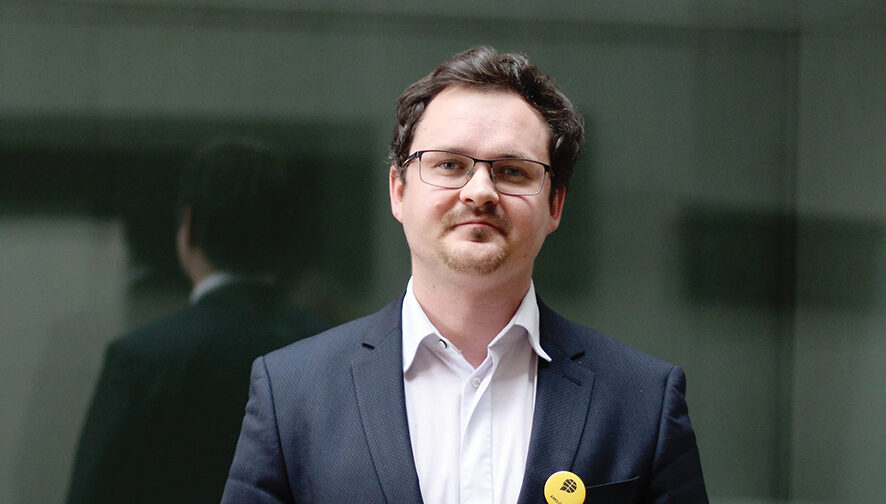
Pavel Havlícek, a Czech political analyst with the Association for International Affairs, speaks to RFE/RL’s Georgian Service about what Viktor Orbán’s fall and Péter Magyar’s rise mean for Hungary at home and abroad.
After 16 years of entrenched rule, Budapest now faces not just a change of government, but the dismantling of a deeply embedded political system. Havlícek argues that the shift will be most visible domestically, in the courts, media, and state institutions shaped under Orbán, but will also extend outward, with a likely reset in relations with the European Union and traditional allies such as Poland.
He also outlines what this change could mean for Ukraine, and for Orbán’s inner circle, some of whom may now face investigation or exile. At the same time, he cautions that the process ahead will be difficult, with entrenched networks of political, economic and media power unlikely to disappear overnight.
What does it actually change? Magyar comes from the center-right and is a former Fidesz member. How different will his policies be from Orbán’s?
There are a number of areas where we will see not just change, but a completely different attitude. This will be most visible in the domestic sphere, where 16 years of Orbán’s rule became deeply embedded in society and public life. It is therefore no surprise that the first names mentioned for replacement were the heads of courts and government media boards.
Beyond that, and of particular interest internationally, we are likely to see a process of normalization with the EU and with Hungary’s traditional allies, most notably Poland. It is logical that Magyar’s first international visit will be to Warsaw. Poland, and particularly Prime Minister Donald Tusk, will be key for rebuilding bilateral ties, and this marks a significant shift.
Even more importantly, Magyar intends to play a moderately positive and constructive role within the EU and its institutions, including, in the longer run, engagement with the eurozone. This could mean an end to many of the conflicts we have seen in recent years and potentially unlock the frozen EU funds. That trade-off would also have very concrete implications for Ukraine, particularly regarding the €90 billion loan that Orbán has so far blocked.
What does this change for Ukraine, and to what extent?
Magyar is cautious on Ukraine. He has said he is against fast-tracking Ukraine’s EU integration, for example by 2027. But what matters is that he will be willing to “play ball,” unlike Orbán, who repeatedly used vetoes to block anything resembling support for Ukraine.
Even something as simple as constructive silence could prove to be a game-changer, particularly when it comes to EU sanctions packages against Russia. Orbán was very active in blocking these. Magyar, by contrast, is unlikely to hesitate in allowing them to pass.
We can also expect him to cooperate on approving the €90 billion loan to Ukraine, although he will almost certainly have his own counter-demands.
But it’s not a coincidence the Kremlin refused to congratulate him and that a conflict is imminent.
What now for Orbán and Foreign Minister Szijjártó? How likely is it that they could end up in Moscow alongside figures like Yanukovych or Assad? And how likely are criminal proceedings, given the recent leaks about Russian ties?
This is perhaps the most intriguing part of the story. Already on election night, Magyar spoke about “traitors,” and about those who manipulated society and turned Hungarians against one another, making clear that this would not be tolerated going forward.
He later claimed that Szijjártó had barricaded himself inside the foreign ministry, reportedly destroying documents related to sanctions on Russia. If that is even partially true, then we are likely to see investigations, and potentially prosecutions. Some individuals could well end up facing jail time, while others, Szijjártó included, might choose to leave the country. He might still be Budapest-based but my expectation is that this is not for too long and he will need to fly, either to Moscow, Minsk, or one of the Gulf states, even if this is hot ground right now too.
There will need to be a strong elite rotation, with an element of repression/punishing people for all the corruption and nepotism put in place. Most likely, this will also touch people in the high-level offices (say the director of MOL, media foundation Keszma, MCC and other government think-tanks and propaganda mouth pieces, and the like). However, it will be important to hold justice right and not to overdo it (leading to repression), even if this might be very much demanded by the citizens. In general, though, there is no appetite to protect the “traitors,” and everybody knows who they are.
Interview by Vazha Tavberidze