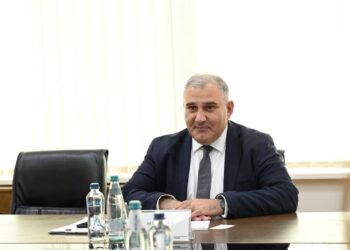
Shalva Papuashvili has published an open letter addressed to Pawel Herczynski on the occasion of Europe Day, criticizing the European Union’s current policies toward Georgia and accusing Brussels of political interference and deepening divisions.
In the lengthy statement shared on social media, Papuashvili congratulated the ambassador on Europe Day, while arguing that the date should serve as a moment to reflect on “what Europe truly represents” and on the future of relations between Georgia and the European Union.
The Speaker repeatedly referenced the 1950 Schuman Declaration by French statesman Robert Schuman, describing it as a vision centered on peace, unity and mutual respect. He contrasted that vision with what he called the EU’s current “offensive rhetoric” and “politically motivated” actions toward Georgia.
Papuashvili criticized Herczynski’s Europe Day message from last year for allegedly overlooking the anniversary of the end of World War II and instead focusing on political disagreements with Georgia. He stressed the contribution of Georgians to the defeat of fascism during the war, noting that around 300,000 Georgians lost their lives.
“Setting apart Europe Day from Victory Day does not work for us,” Papuashvili wrote, expressing hope that EU representatives would honor Georgian victims of World War II during Europe Day events.
The Parliament Speaker also accused European institutions of attempting to interfere in Georgia’s domestic affairs through European Parliament resolutions, political pressure and criticism of the Georgian government. He claimed that current EU policies have created divisions instead of promoting unity.
Papuashvili further argued that Georgia should not be “directed” toward Europe, claiming the country is already part of European civilization and describing Georgia as a “co-creator” of European culture and identity. He criticized what he described as attempts to impose ideological uniformity on Georgia during its European integration process.
The letter also revisited disagreements between Tbilisi and Western partners over relations with Russia following the start of the full-scale war in Ukraine. Papuashvili claimed some European actors attempted to pressure Georgia into entering “economic warfare” with Russia without offering security guarantees or economic support, warning such a move could have destabilized both Georgia and the wider region.
In another section of the letter, Papuashvili accused EU officials of failing to condemn radicalism and violence in Georgia. He referred to last year’s attack on the Presidential Palace by protesters and criticized what he described as silence from European officials regarding the incident.
Concluding the letter, the Speaker called on the European Union to halt what he described as hostile rhetoric and to return to dialogue based on “peace, cooperation, and unity grounded in respect for nations and their identities.”
Relations between Georgia’s ruling party and several European institutions have become increasingly strained over the past year amid disputes surrounding foreign policy, democratic standards, and controversial legislation adopted by the Georgian government.