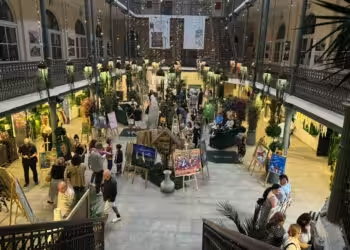

Unarchived Semiotics presented the group exhibition Cartography of Monochrome Feelings at Art Foundation Anagi during March 14 – April 8, 2026. The exhibition approached the relationship between body and space through an intimate, monochrome visual language. Graphic imprints and various techniques of 10 multigenerational artists functioned as cartographic elements, examining territory, spatial presence, and physical–emotional experience as interrelated fields.
Author of the concept and curator: Mariam Shergelashvili
Participating artists: Khatuna Abashidze, Mari Babaevi, Irina Gabiani, Liza Kvantaliani, Gio Sumbadze, Mari Kalabegashvili, Nika Khabelashvili, Saba Khechoshvili, Sali Khizanishvili, Nina Tsotsoria.
Below is the interview with art historian, curator and founder of the platform Unarchived Semiotics Mariam Shergelashvili
1. The exhibition has an institutional framework while maintaining an experimental character. How would you define its position between the academic structure of the foundation and curatorial free expression?
In my work often academic structure is opened with free experimentation. This exhibition has the same conceptual method to operate in between soft opposition of the institutional structure and experimental practice. In this process I tried to approach mutually generative conditions. The foundation, grounded in research-based and collection-oriented methodologies, provides a historical and cultural framework. However, through this initiative and collaboration with unarchived_semiotics, the space was reconfigured into an open platform where experimentation is itself a working method between 10 different artists’ works and its curatorial dialogue in the space.
In this sense, the exhibition resists the rigidity of what Tony Bennett describes as the “exhibitionary complex,” where knowledge is less reconstructional and representative. Instead, it proposes a more fluid field of relations. It’s negotiated through spatial and perceptual interaction. The institutional frame remains present, it is subtly destabilized, allowing the exhibition to function as a site of expression and perception instead of pure representation.


Opening of the show. AFA. 2026
2. The platform Unarchived Semiotics often engages with non-mainstream and introspective conceptual minimalistic practices. How does this exhibition relate to your broader curatorial and research trajectory?
Unarchived Semiotics emerges from an interest in forms of conceptual visual contemporary art and philosophical discourses. It focuses on processes that are fragmentary, subjective, and often difficult to categorize within dominant art historical narratives.
This exhibition continues that trajectory by foregrounding introspection as a methodological tool. However, it does not remain within purely subjective experience. It explores intersections between inner states and external conditions. The works collectively articulate a semiotic field where signs are unstable, open-ended, and relational.
In this regard, the exhibition aligns with post-structuralist approaches to meaning, where signification is always deferred. It is less about producing definitive interpretations and more about activating a network of associations between body, space, and perception.
3. The relationship between body and space is not directly represented but emerges through subtle, sensory and symbolic interactions. How does this relationship function?
The body–space relationship in this exhibition operates through what could be described as an affective and semiotic field. The body is not depicted as an object; It is implied through traces, gestures, and spatial displacements.
This approach resonates with phenomenological perspectives, where perception is understood as embodied and relational. Space here is not a neutral container. As an active participant space shapes and is shaped by bodily experience.
The viewer becomes an integral part of this system. Rather than occupying a detached observational position, the viewer navigates the exhibition as a co-experiencer. Through movement, proximity, and attention, the viewer reconstructs the relationships between works, effectively becoming part of the cartographic process itself.
 Exposition view. Cartography of Monochrome Feelings. AFA. 2026
4. Monochrome appears as more than a formal decision – it becomes a structure of memory and emotional intensity. How did you conceptualize monochromatic language in this exhibition?
While working for particular concepts, I often see the pallets, gestures and atmospheric tones of the entire exhibition. In this particular project, Monochrome was conceived as a reduction strategy that allows for an intensification of perception. By limiting the visual palette, the exhibition minimizes distraction and builds subtle variations in form, texture, and rhythm.
However, beyond formalism, monochrome functions here as a mnemonic device. It operates as an inscribed surface onto which experiences are often fragmented or repressed. In this sense, monochrome aligns with what Georges Didi-Huberman describes as the “survival of images,” where visual traces carry temporal and emotional residues.
It also introduces a certain vision: the absence of color does not signify neutrality; It opens a space for projection. The viewer is invited to complete the image through their own perceptual and emotional engagement.
 Exposition view. Cartography of Monochrome Feelings. AFA. 2026
5. The exhibition follows a cartographic logic, where individual works form a spatial dialogue. How did you construct this scenographic system, and what role does space play as an active agent?
I approached the exhibition as a relational map, because I wasn’t interested in telling a fixed story. I wanted to construct a field where each work could function as an intersection, connected through proximity, contrast, and resonance.For instance, Saba Khechoshvili’s transformation of daily movement into minimalist traces reflects an attempt to map subjective experience, while Gio Sumbadze’s imaginary cartographies explore memory and disorientation in his graphic series of “Cities of Nowhere”; Nina Tsotsoria, in a different way, starts from structured geometry but allows it to open into something more effective and less controlled. What interested me was how these different approaches could speak to each other without being unified stylistically.
At the same time, I was thinking a lot about space itself , how it can operate and activate. Khatuna Abashidze’s transparent arches, for instance, don’t just sit in space, they actually reframe how we move through it; and the works by young female artists Liza Kvantaliani and Mari Babaevi bring the body into this spatial dialogue, that is not something stable, but something fragmented, projected, constantly shifting. This continues in Irina Gabiani’s conceptual works, where the boundary between body and thought becomes almost indistinguishable; However, in Nika Khabelashvili’s etchings, the space feels distant, slightly withdrawn, still charged with tension.
What I find also important is that there are also moments of withdrawal, like in Sali Khizanishvili’s works, where space turns inward, becomes introspective, and then this shift again toward relational meaning in Mari Kalabegashvili’s piece, where a very intimate object opens into a broader public dimension.
So overall, I wasn’t trying to create a unified narrative, but rather a system of relations. Space becomes something that organizes these connections, through distance, alignment, even interruption. Space guides how the viewer moves and thinks. In that sense, the exhibition is closer to a cartography or even a kind of spatial dramaturgy: meaning doesn’t sit inside individual works, it emerges between them, in the way they interact and in the way the viewer navigates that field.
 In front of the “Playground”, installation by Saba Khechoshvili. From the curatorial guided tour about the exhibition “Cartography of Monochrome Feelings”. AFA, 2026
6. In your curatoria concept we read that “The exhibition frames the image as a “space of agreement” between control and vulnerability”. How do you interpret this tension within contemporary social and cultural contexts?
Control and vulnerability are not oppositional states, they are interdependent conditions. In contemporary society that is marked by surveillance, digital mediation, and socio-political instability, these dynamics become increasingly intertwined.
The exhibition approaches this tension and extends it. Without explicit political statements the entire show emphasizes subtle experiential conditions. The fragility of materials, the openness of forms, and the ambiguity of meaning all contribute to a sense of vulnerability. At the same time, the structured spatial relationships and conceptual rigor introduce elements of control. The “space of agreement” emerges as a negotiated zone where these forces coexist. It reflects a contemporary condition in which stability is provisional, and subjectivity is continuously shaped by both internal and external pressures. The exhibition does not resolve this tension, it somehow allows the viewer to inhabit it.
Detailed concept of the show and represented works is available online: