There is a peculiar discipline to the stage at the Movement Theater; a discipline that resists theatrical excess and instead builds meaning through duration, pressure, and the gradual reconfiguration of the body. Ana Gogishvili’s The Woman in the Dunes, adapted from Kobo Abe, settles into this space with a kind of austere confidence, allowing the material to unfold as a condition one inhabits.
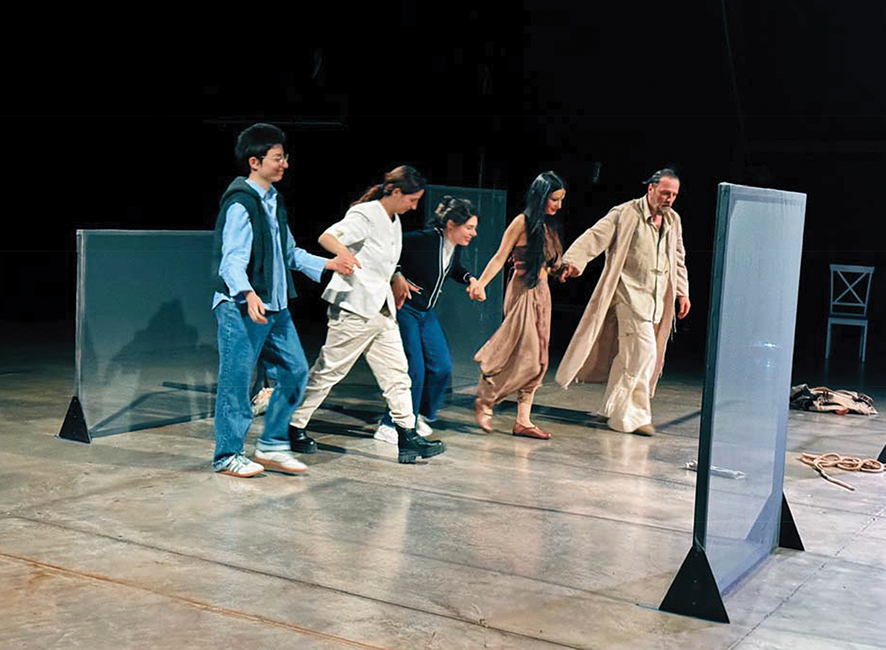
From the outset, the stage refuses illusion in any conventional sense. The environment, constructed through a spare combination of physical texture, light (by Kato Japaridze), and a persistent field of digital imagery, functions as a closed system rather than a setting. The AI-generated visuals behave like an atmosphere that continuously recalibrates perception. At times they resemble granular movement, at others a kind of abstract flow, as if sand itself had been translated into a digital substrate. This visual layer, developed in tandem with Gogishvili’s direction, operates with enough autonomy to feel like a second logic running parallel to the performers.

At the center are Anano Iashvili and Giorgi Tsertsvadze, whose performances avoid psychological exposition in favor of incremental physical adjustment. Iashvili’s presence is particularly controlled: her movements are economical, almost pre-programmed. She establishes a rhythm early on, a pattern of labor, pause, and recalibration, that gradually becomes the temporal structure of the entire piece.
Tsertsvadze, by contrast, begins with a more legible sense of resistance: his gestures are larger, his timing less settled, his body still oriented toward an outside that the stage steadily erases. What is striking is how this difference dissolves. Over the course of the performance, his physical vocabulary narrows, aligns, and eventually syncs with the system Iashvili has already internalized.

Kakha Bakuradze’s choreography is built on repetition, though not the kind that accumulates into spectacle. Instead, each cycle appears slightly adjusted; shortened, redirected, stripped of excess, until movement begins to resemble function. Digging, carrying, stabilizing: these actions are never mimed in a literal sense, yet their logic is unmistakable. The body becomes a site of adaptation, where intention is gradually replaced by necessity.
The production’s most conspicuous intervention is technological. AI-generated visuals and animation are active participants, occupying a status comparable to that of the actors. This decision places the work within a recognizable contemporary lineage, in which digital systems are granted a kind of performative agency. The question, as always, is whether these systems structure the experience or merely decorate it. When they function as environments, conditions that shape perception and action, they may approximate something of Abe’s closed, self-regulating world.

What emerges is a performance less concerned with entrapment as a dramatic situation than with adaptation as a temporal process. Resistance does not disappear; it becomes procedural, absorbed into the very actions that sustain the environment. By the final sequences, it is difficult to locate any clear boundary between agency and compliance. The performers continue to move, to adjust, to maintain; but the question of whether these actions constitute struggle or acceptance is left deliberately unresolved.
Gogishvili’s staging avoids overt philosophical statements, and this restraint proves decisive. The work does not attempt to explain its own condition. Instead, it sustains it, patiently, sometimes uncomfortably, until the audience begins to register its logic on a sensory level. Time stretches, variation diminishes, and attention shifts from what is happening to how it continues to happen.
Review by Ivan Nechaev