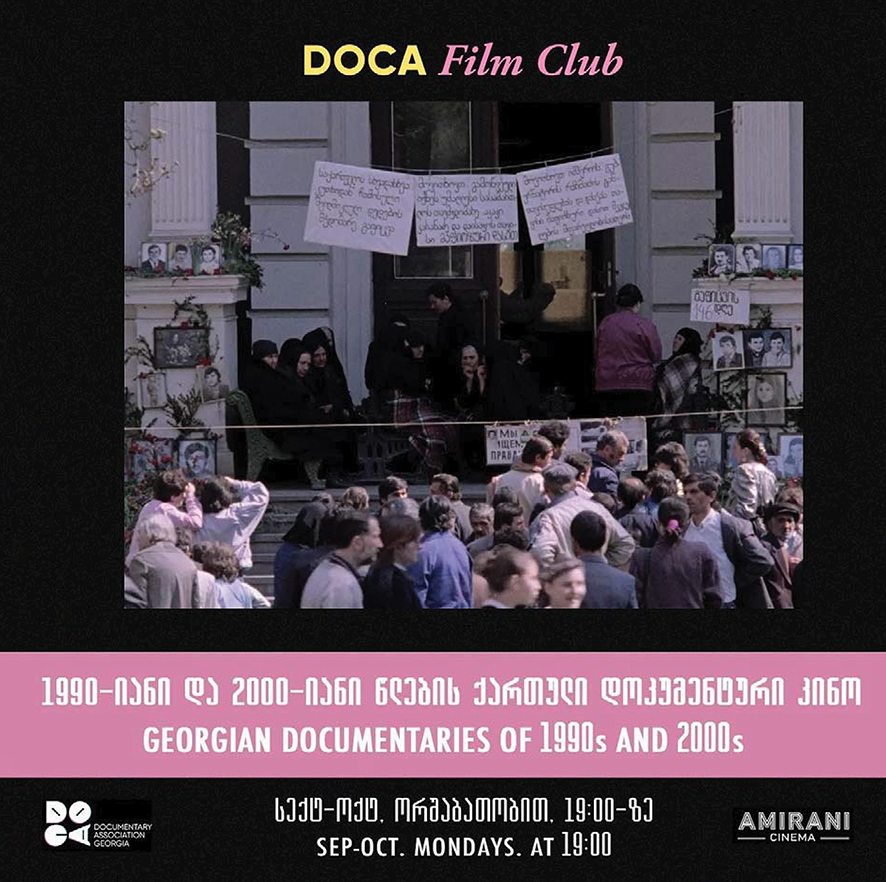
Every Monday evening this autumn, Amirani Cinema will transform into something closer to an archaeological site than a movie theater. The new season of the Doca Film Club (September–October 2025) revisits a body of work that has been screened too rarely, discussed too cautiously, and archived too unevenly: Georgian documentary cinema of the 1990s and 2000s. The program, researched by Lika Glurjidze and Luka Bedoshvili, is less a festival than a collective séance, an attempt to summon back the fragmented voices of a society negotiating trauma, war, migration, and the slow erosion of certainties that accompanied the collapse of one empire and the unfinished construction of another.
The choice of Amirani Cinema—Tbilisi’s post-Soviet architectural hybrid, equal parts relic and survivor—is significant. To screen these films in a venue adapted for wheelchair users, with English subtitles carefully affixed, is to insist that these stories matter not only to Georgians old enough to remember the blackouts of the 1990s, but also to a younger, international audience that may find in them eerie echoes of contemporary dislocations.
A shattered prologue: Visual Archive
The season opened with a set of shorts that functioned almost like a newsreel shattered into fragments. The Way Home (1990), dedicated to philosopher Merab Mamardashvili, was less a documentary than a requiem for intellectual life in a society on the brink of implosion. Alongside it, Aleksandre Zhghenti’s Do We Need the Soviet Union’s Football Championship? (1991) captured, with a peculiar irony, the absurd persistence of Soviet cultural rituals even as the very state disintegrated. These films, when placed next to the blunt Privilege Without Privilege, did not narrate history but rather registered its implosion—short, jagged impressions, like torn-out diary pages rather than completed reports.
The youth question
Omar Gvasalia’s Meet Our Children (1988) and Levan Kitia’s companion feature Track plunge into the atmosphere of late-Soviet adolescence. The skateboards and casual chatter of Georgian youth are not incidental: they are prophetic signs of a generation about to confront a radically unstable landscape. Seen from 2025, these images of teenagers rehearsing freedom feel almost unbearably fragile, as if their laughter carried within it the foreshadowing of economic collapse, separatist wars, and forced emigration.
America as both promise and trap
The double program of America in One Room (2007) and Of Course, America (2009) brings the 1990s émigré narrative into sharp focus. Kandelaki’s chronicle of a Georgian prisoner in the United States is an inversion of the classic immigrant dream: escape becomes incarceration, America is no longer a haven but a cell. Furtskhvanidze and Smit’s Of Course, America moves more subtly, sketching the bureaucratic and affective labyrinths of illegal migration. Together, these films dismantle the mythologies of the West that haunted the Georgian imagination after independence—while also exposing the deep psychic costs of departure.
Feminine counter-archives
The program pivots with two evenings devoted to women’s voices. The short films of the early 1990s—I Am and My Nabadi, Niniko, Women, Mandilosnebi—are attempts to inscribe female experience into a visual field otherwise dominated by male war narratives. They are fragile, even tentative works, but collectively they form a mosaic of resilience and everyday survival.
A week later, the retrospective of Lia Jaqeli’s films (The Invisible, All Important, I Don’t Know) sharpens this focus. Jaqeli, both philologist and filmmaker, emerges as one of the most incisive documentarians of Georgia’s marginalized lives. Her attention to women, minorities, and those trapped in the interstices of society feels strikingly contemporary, yet also painfully ignored in her time. To view Jaqeli now is to recognize how the grammar of Georgian documentary might have looked had her sensibility become central rather than peripheral.
Landscapes of disappearance
The final week stages a double confrontation with absence. Aleksandre and Rati Rekhviashvili’s The Endings (2009) is a film of almost liturgical stillness: elderly villagers moving through snow, rituals performed as though time itself has frozen, traditions persisting in the vacuum left by emigration and death. Its minimalism is radical—words are nearly absent, music and gesture dominate, as if language itself had become inadequate to describe the persistence of life in abandonment.
Paired with it, Nostalgia (1999) by Tato Kotetishvili and Ineke Smits revisits the civil war’s intimate devastations, showing how history dismantles friendship, love, and memory from within. If The Endings offers the visual poetry of rural decay, Nostalgia documents the interior ruin of urban souls.
A politics of spectatorship
This season of Doca is not only a program but also an argument: that Georgia’s most urgent contemporary dilemmas—migration, memory, marginalization—were already being filmed with startling clarity thirty years ago. The decision to provide English subtitles extends the reach of these films beyond local nostalgia. It insists that these images belong within a global conversation on how post-Soviet societies metabolize collapse and renewal.
At 10 GEL a ticket (five for students and Doca members), the screenings are less a commercial venture than a civic ritual. The modest price echoes the club’s implicit ethos: that cinema here functions as a democratic archive, a place where memory is distributed rather than privatized.
The return of the postponed
There is also the ghostly fact that this program was meant to be shown last November but was delayed by Georgia’s political turbulence. To watch it now, in a society once again entangled in protest and repression, is to realize that the archive never lies dormant. Each frame carries an afterlife, an accusation, and a warning.
The Doca Film Club season, in its quiet Monday-evening cadence, proposes a form of cultural work more radical than any blockbuster premiere: to sit with the ghosts of the 1990s and 2000s, to let them breathe again in the darkened auditorium of Amirani, and to ask—without the comfort of closure—what these fragments demand from the present.
By Ivan Nechaev