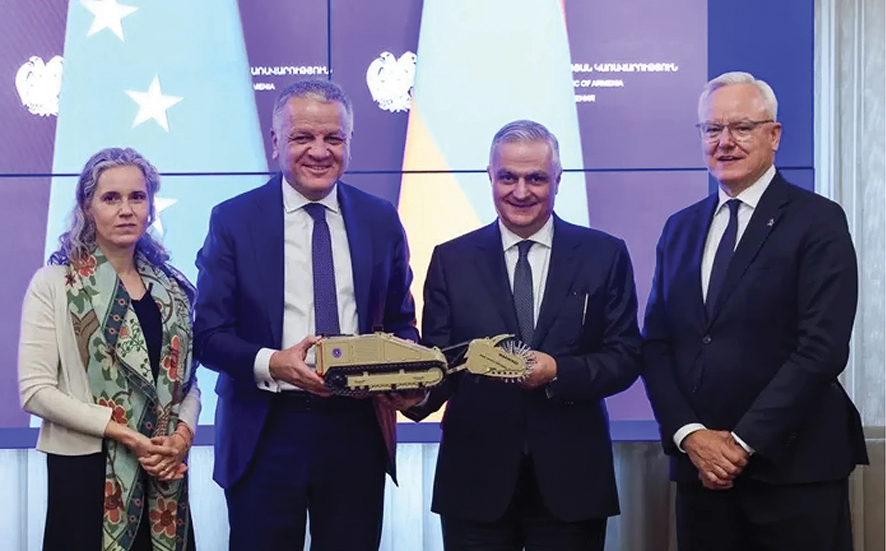
The European Union has delivered a modern Croatian-manufactured demining machine to Armenia, marking the first step in a new initiative aimed at improving border safety, supporting infrastructure development, and helping conflict-affected communities recover.
The equipment, handed over on 8 July in Yerevan, is the first of two planned machines that will strengthen Armenia’s humanitarian demining capabilities. The project is being implemented in cooperation with the Armenian Humanitarian Demining and Expertise Center, with the aim of reducing risks from unexploded ordnance and preparing land for future development.
“By strengthening Armenia’s mine clearance capacity, the EU is further contributing to Armenia’s resilience and regional peace, as well as human security and normalization of life in border areas,” the EU Delegation to Armenia said in a statement, describing the initiative as a contribution to regional security and infrastructure development.
The EU’s support comes as Armenia seeks to improve connectivity and economic links while addressing the long-term consequences of conflict. Thousands of hectares of land in Armenia and the wider South Caucasus region remain affected by mines and unexploded ordnance, limiting agricultural activity, infrastructure construction, and the safe return of communities to affected areas.
Speaking at the official handover ceremony, EU Ambassador to Armenia Vassilis Maragos highlighted the connection between humanitarian demining and future investment projects, saying that clearing contaminated land is a necessary first step for infrastructure development.
“Connectivity projects require clearing the areas through which they will pass,” Maragos told reporters. “Demining will be the first essential step to allow these important construction works to move forward.”
The ambassador also announced that the EU plans to support the construction of three new border crossing points in Armenia. The locations have not yet been disclosed, but EU officials said that land clearance will be required before construction can begin.
The demining initiative forms part of the EU’s broader engagement with Armenia, which has expanded in recent years through programs supporting resilience, economic development, security, and institutional cooperation. In 2023, the EU launched the European Union Mission in Armenia (EUMA), a civilian monitoring mission aimed at contributing to stability along Armenia’s borders.
The EU has also increased economic cooperation with Armenia through initiatives under the Global Gateway strategy, which seeks to support sustainable infrastructure, transport links, digital connectivity, and energy cooperation.
For Armenia’s economy, improved border infrastructure and safer land access could have significant benefits. The country’s transport networks are central to regional trade ambitions, particularly as Armenia seeks to diversify economic partnerships and strengthen connections with European and neighboring markets.
The World Bank notes that transport connectivity remains an important factor for Armenia’s long-term growth, given the country’s landlocked position and dependence on efficient trade routes. Agriculture and rural development are also closely linked to land safety, as communities near former conflict zones often face restrictions on using potentially hazardous areas.
Through the new demining partnership, the EU aims not only to remove immediate humanitarian risks but also to create conditions for future investment, infrastructure expansion, and economic activity in Armenia’s border regions.
By Team GT