
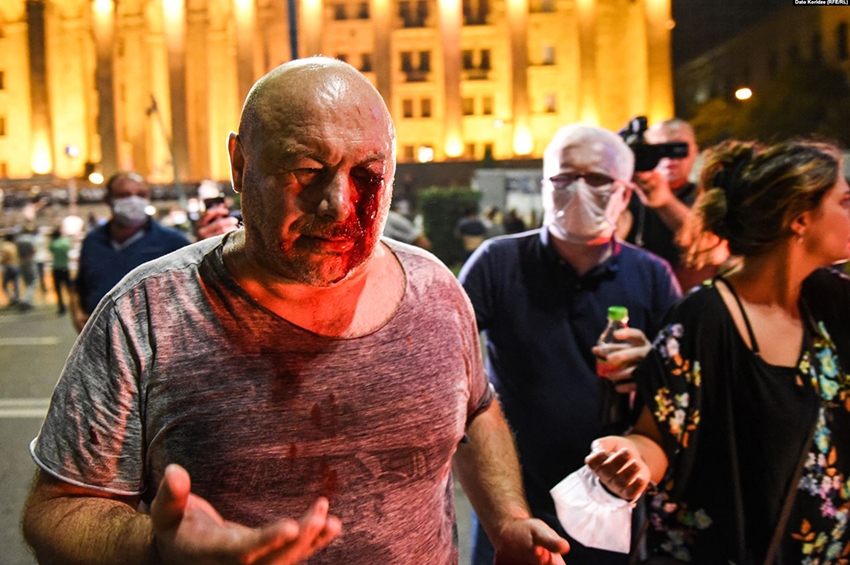
The European Court of Human Rights has delivered a landmark Grand Chamber judgment in the case Tsaava and Others v. Georgia, finding that Georgian authorities used unjustified force in the violent dispersal of mass protests outside the Georgian Parliament on the night of 20–21 June 2019.
The Court ruled that Georgia violated several provisions of the European Convention on Human Rights, including the prohibition of inhuman or degrading treatment, freedom of expression, and freedom of assembly. The judgment, issued unanimously, found that 24 of the 26 applicants were subjected to inhuman or degrading treatment, and that the authorities failed to conduct an effective investigation into the events for more than five years.
It also found violations of freedom of expression for 14 applicants and freedom of assembly for 11 applicants, while determining that there had been no breach of Article 38, which concerns cooperation with the Court.
The case concerns one of the most politically charged episodes in recent Georgian history.
On 20 June 2019, nearly 12,000 people gathered outside Parliament in Tbilisi after a Russian MP, Sergey Gavrilov, was allowed to sit in the Georgian Speaker’s chair and address an international parliamentary assembly in Russian. The incident provoked widespread outrage in a country that continues to endure Russian military presence on its territory following the 2008 war.
As the demonstration grew, the government deployed around 5,000 police officers. Late in the evening, clashes escalated when some protesters attempted to move toward the Parliament entrance. The authorities responded with tear gas, water cannons, and widespread use of rubber bullets. Many of those bullets were fired at close range and in some cases aimed at protesters’ heads, resulting in dozens of serious injuries and several cases of permanent eye damage. Journalists covering the demonstration were also struck despite being clearly identifiable as members of the press.
In reviewing the events, the Grand Chamber found that the police used an unjustified degree of force, particularly through the indiscriminate firing of rubber bullets as a general crowd-control method. The Court emphasized that the authorities did not issue a clear and audible dispersal order or warn protesters that rubber bullets were about to be deployed. It also highlighted significant shortcomings in Georgian legislation regulating the use of such projectiles, noting the absence of adequate safeguards, clear rules, and proper supervision.
The judges concluded that there was no evidence that the injuries sustained by protesters and journalists were an inevitable result of their own actions and that the police had acted in a manner incompatible with the principles of necessity and proportionality. Journalists, the Court stressed, should have been allowed to report safely and freely, and obstructing their work constituted a violation of their rights.
The Court further condemned the prolonged failure of Georgian authorities to carry out an effective investigation. More than five and a half years after the protest’s dispersal, domestic investigations have produced no meaningful findings regarding the ill-treatment of protesters or the identification of officers who used or ordered excessive force. No high-ranking officials have been held accountable. This failure, the Court ruled, represents a breach of the state’s procedural obligations under Article 3 of the Convention.
Although the Court acknowledged that the authorities may have had some grounds to disperse the demonstration—given its location directly in front of Parliament and the attempts by some protesters to force entry—the judges found that the manner of dispersal was unlawful and disproportionate. The use of rubber bullets without warning, the absence of a dispersal order, and the targeting of upper-body areas all contributed to the Court’s finding that the state’s response was not justified. The result was a set of violations of freedom of expression and assembly, as the applicants were prevented from participating peacefully in a political protest or, in the case of journalists, from carrying out their professional duties.
In its judgment, the Grand Chamber also issued general measures, instructing Georgia to reform its legal and regulatory framework governing the use of rubber bullets. These measures include adopting clear rules on when such projectiles may be used, implementing strict safeguards to prevent misuse, and ensuring proper training and accountability mechanisms within the police force. These requirements are binding and will be monitored by the Committee of Ministers of the Council of Europe.
The events of 20–21 June 2019, widely referred to in Georgia as “Gavrilov Night,” had significant political consequences, contributing to changes in parliamentary leadership and fueling opposition movements that accuse the Georgian Dream government of authoritarian tendencies and a drift toward Moscow. The Court’s ruling adds new international weight to longstanding domestic criticism of police conduct and the government’s failure to ensure accountability. It also comes at a moment when Georgia is facing renewed scrutiny from European institutions over recent legislative initiatives that restrict freedom of assembly.
Human rights groups and the applicants’ representatives have welcomed the judgment as overdue recognition of the violations suffered by protesters and journalists more than five years ago. The Georgian government is expected to respond formally to the ruling in the coming days, and its implementation will likely become a test of Georgia’s commitment to human rights standards at a time of heightened political tension and growing concern over democratic backsliding.