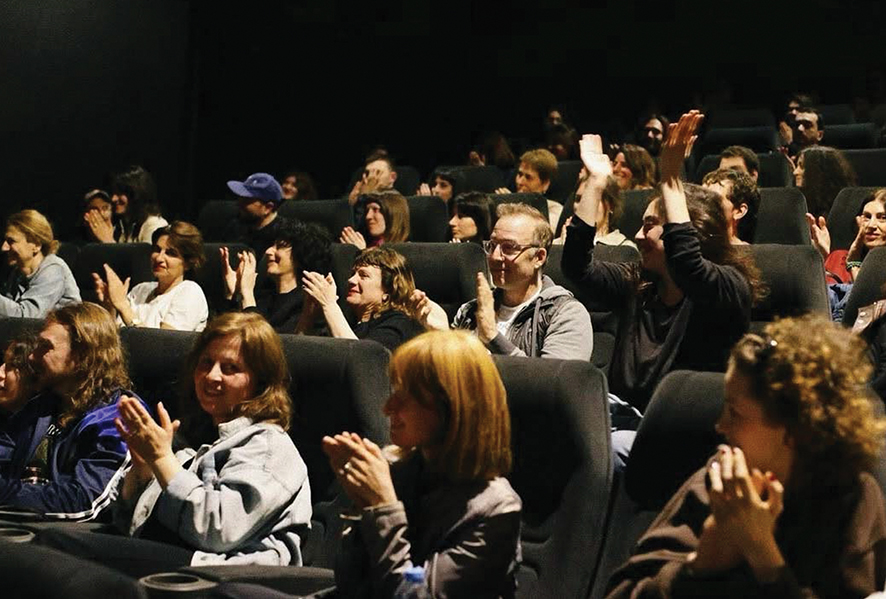
There is no shortage of films about Georgia. There are, however, surprisingly few opportunities to follow what Georgian filmmakers are making right now. This is what makes the New Georgian Films 2026 program at Amirani Cinema particularly valuable. Organized by DOCA Film Club, the series offers something increasingly rare: a sustained look at contemporary Georgian moving-image culture as it is being created, debated, and reimagined in real time.
Rather than focusing on premieres alone, the program brings together documentaries, hybrid works, animation, and video art, creating a broader picture of how filmmakers and artists are responding to the social, political, and cultural realities surrounding them. Seen as a whole, the season feels less like a collection of screenings and more like an ongoing conversation about contemporary Georgia.
The curatorial approach is notable for its breadth. Films already presented in the program have ranged from Ketevan Vashagashvili’s 9 Month Contract, an intimate exploration of surrogacy and maternal sacrifice, to Kote Kalandadze’s Nobody in Sight, a portrait of addiction, loneliness, and social marginalization. Rusudan Gaprindashvili’s How to Talk with Lidya shifted the focus beyond Georgia itself, examining the algorithmic realities of migrant labor in contemporary Europe, while Alexandre Koridze’s Comfort Limit addressed one of the most sensitive and politically charged developments in recent Georgian history: the arrival of Russian migrants following the full-scale invasion of Ukraine.
What unites these works is not a common subject matter but a shared commitment to observing lives that often remain outside official narratives. The films resist easy conclusions. They favor complexity over certainty, paying close attention to individual experiences while remaining alert to larger social transformations.
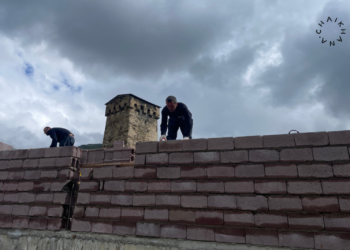
The second half of the program continues this expansive approach. Upcoming screenings move between archival memory, displacement, regional identity, animation, and experimental image-making. Maka Gogaladze’s I Was Thinking of You revisits the turbulent 1990s through archival footage from Kutaisi. The Kartli Kingdom explores life inside a decaying former sanatorium that has become home to families displaced by the conflicts of the 1990s. Marlene Edoyan’s A Fire There offers an intimate portrait of young people coming of age in an Armenian village in southern Georgia. The season will conclude with programs dedicated to contemporary Georgian animation and video art, highlighting forms of storytelling that are often overlooked by mainstream film culture.
Perhaps the most important aspect of the initiative is its accessibility. Every screening is presented with English subtitles, making the program available not only to Georgian audiences but also to the city’s international residents, visiting researchers, journalists, diplomats, artists, and anyone interested in understanding the country beyond headlines and political analysis.
At a time when discussions about Georgia are often dominated by geopolitics, elections, and protests, New Georgian Films 2026 offers another perspective. It invites viewers to encounter the country through the stories its filmmakers choose to tell: stories of work, migration, memory, family, identity, uncertainty, and resilience.
In that sense, the program functions as more than a film series. It is one of the most compelling introductions to contemporary Georgia currently available on a cinema screen.
By Ivan Nechaev