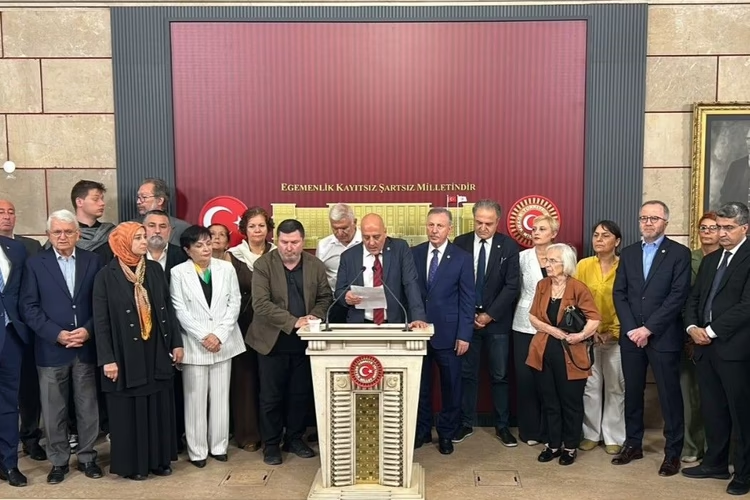
Turkish lawmakers representing 10 political parties have called on Ankara to recognize passports issued by the de facto authorities in Georgia’s Russian-occupied region of Abkhazia and to establish direct sea and air links between Turkey and the region.
The parties include the Good Party, New Path, Democracy and Progress Party, New Welfare Party, Future Party, Peoples’ Equality and Democracy Party, Democrat Party, Workers’ Party of Turkey, Labour Party, and New Party. Together, they hold 206 seats in the Turkish Parliament, accounting for approximately 34% of its membership.
The lawmakers held a press conference on Wednesday as part of a campaign launched by members of the Abkhaz diaspora in Turkey in late June under the slogan “Let’s End the Isolation of Abkhazia.”
Ahmet Şık, an MP from the Workers’ Party of Turkey, delivered a statement during the briefing, saying that Turkey and Abkhazia were connected by historical, family, and social ties. He also pointed to the presence of a large North Caucasian diaspora in Turkey, formed largely as a result of the Russian Empire’s conquest of the North Caucasus in the 19th century.
There are estimated to be more than 500,000 ethnic Abkhaz living in Turkey, nearly twice the population of Abkhazia itself.
In their statement, the MPs reportedly cited international practices regarding passports issued by Northern Cyprus and Taiwan as precedents for facilitating travel with documents issued by entities with limited international recognition.
The campaign received a platform in the Turkish Parliament in late July, when Selçuk Özdağ, deputy chair of the New Path party, held a press conference advocating similar demands.
Dmitry Marshaniya, a member of Abkhazia’s de facto parliament, welcomed the initiative and described it as unprecedented.
“In my memory, this is the first time Turkish politicians have spoken so unanimously on the Abkhaz agenda. This is an important signal, and it must be taken seriously,” Marshaniya wrote on Telegram. He also invited the Turkish lawmakers to visit Abkhazia.
Marshaniya said the issues raised in Ankara were among those that the Abkhaz side has consistently brought up at the Geneva International Discussions.
Abkhazia’s de facto authorities have repeatedly called for international recognition of passports issued in the region as valid travel documents, as well as for a legally binding non-use-of-force agreement with Georgia.
Another member of the de facto parliament, Inar Gitsba, described recognition of the documents as an issue of “freedom of movement and external mobility,” calling it a fundamental humanitarian matter requiring a solution.
Former de facto Interior Minister Aslan Kobakhiya also welcomed the initiative and thanked members of the Abkhaz diaspora in Turkey for their efforts to end what he described as Abkhazia’s international isolation.
Georgia had not issued an official statement on the initiative at the time of publication.
Georgian independent media outlet Netgazeti reported that the joint statement could not be found on the official website of the Turkish Parliament.
Abkhazia is internationally recognized as part of Georgia but has been outside Tbilisi’s control since the armed conflict in the early 1990s. Russia recognized the region as an independent state following the August 2008 Russia-Georgia war and maintains a military presence there. Georgia and most of the international community regard Abkhazia as a Russian-occupied territory.