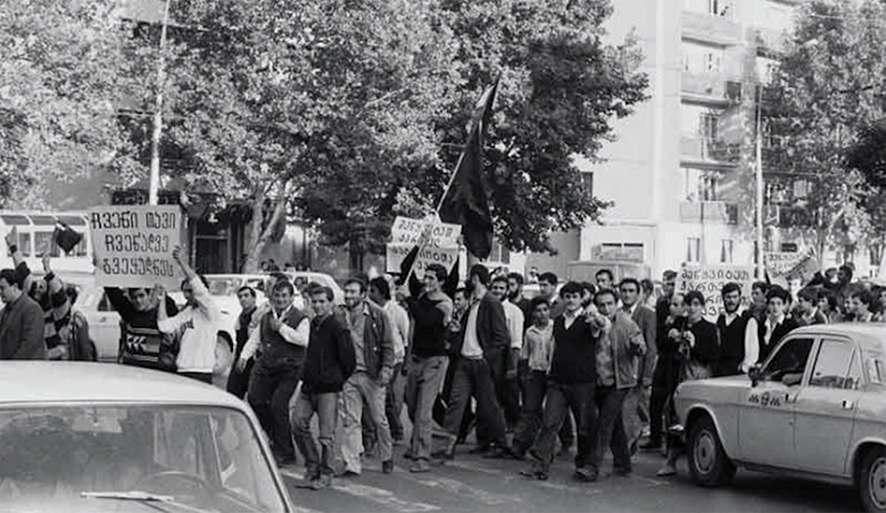
April 14, 1978, is a supreme red-letter day for Georgia. That was the day when almost the entire Georgian youth took to the streets to defend the nation’s right to keep the native Georgian tongue as the state language of the country, as enshrined in the supreme law of the land. The massive demonstration swept across the country almost immediately after news spread that the Soviet regime intended to dethrone our beloved mother tongue in line with an initiative by Mikhail Suslov, the Kremlin’s chief ideologist, to introduce a constitutional change that threatened to strip Kartuli (Georgian) of its official status as the state language.
The bad news from Moscow came like a bolt from the blue, but immense, nonviolent public protests compelled the unrestrained Soviet leadership to back down. As a result, the constitutional status of the Georgian language was preserved. Since then, in honor of that unbelievable triumph over the grim communist regime, April 14 has been celebrated annually in Sakartvelo as Deda-Ena (Mother Language) Day.
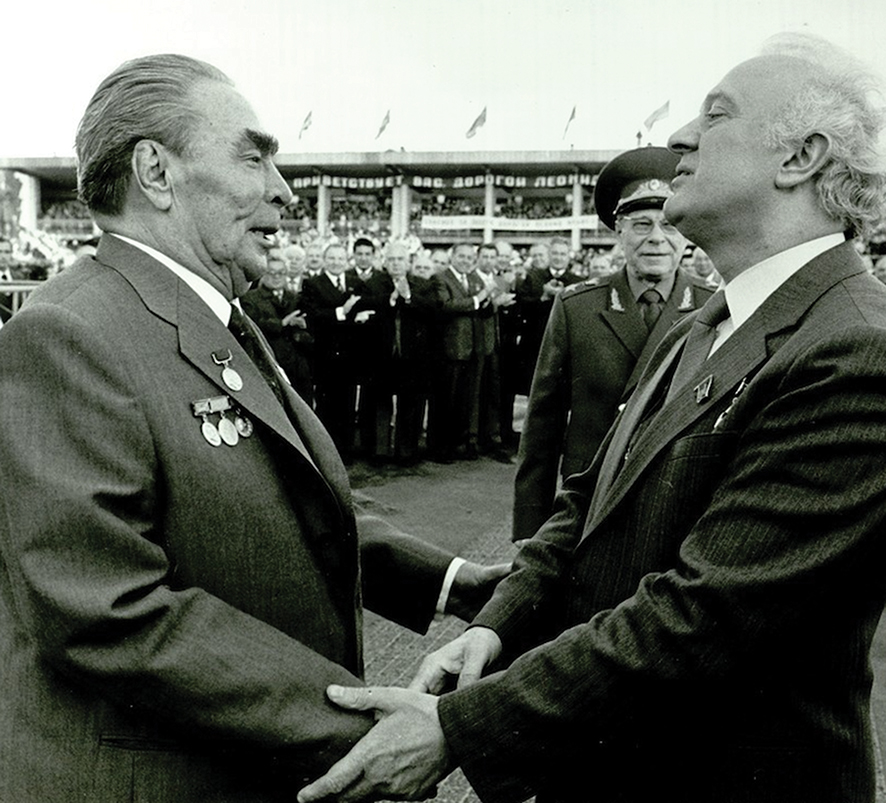
To understand what prompted Moscow to amend the constitution, as formal and symbolic a document as it was, it is worth recalling the political climate in the USSR nearly half a century ago. At the time, a period officially described by historians as the Era of Stagnation, Leonid Brezhnev was at the helm of the Soviet Union. Seeking to refresh and consolidate his political power, he pursued a series of administrative innovations, one of them being the adoption of a new Soviet constitution.
His ideological ambition was to establish Russian as the single official language of the Soviet people, thereby diminishing the role of the national languages as official instruments of statehood and making the other peoples of the Soviet Union less nationally individual and culturally distinctive. In reality, and ironically, it was Suslov, the central ideological figure of the Communist Party, widely known as the Grey Cardinal, who did much of the thinking and acting for Brezhnev. His goal was to establish Russian permanently as the language of interethnic communication across the country that covered one-sixth of the world’s landmass.
In a word, gradual Russification was on the agenda. Preference would be given to Russian speakers, administration would increasingly function in Russian, government paperwork would shift to Russian, courts would operate in Russian, and universities would educate young men and women in the Russian language. Meanwhile, the constitution of the Georgian Soviet Socialist Republic explicitly stated that Georgian was the state language of the republic, and that provision was expected to disappear.
Legally, the matter might have sounded technical, but politically it had the potential to trigger a national tragedy with the gravest possible consequences, including bloodshed, because the issue was never merely linguistic. It encompassed the entire spectrum of national life: our literary tradition stretching back to the fifth century and earlier; poetry, the pinnacle of our artistic and creative thinking; an educational heritage spanning millennia; our national identity, the perennial drama of our existence; and, finally, our historical memory, which is impossible to erase as long as this nation continues to exist. All of this had transformed our Deda-Ena into the symbol around which all other national aspirations revolved.
Deeply wounded by the proposed change, tens of thousands of students, intellectuals, and ordinary citizens rallied in downtown Tbilisi. Remarkably, however, the demonstration did not assume a purely anti-Soviet character. The protesters demanded only one thing: that Kartuli remain the state language. Nothing more.
What mattered most was the suddenly awakened sense of national freedom and independence, which today clearly invites comparison with the way many Georgians feel in the middle of the third decade of the 21st century, nearly half a century after that flagrantly arbitrary decision by the Kremlin.
It is hardly surprising that the Georgian Communist leadership underestimated public feeling. They were overly confident in the permanence of the Soviet system of government. Within hours, the demonstrations had spread far beyond the universities, and local party officials became deeply alarmed.
The First Secretary of the Georgian Communist Party, Eduard Shevardnadze, proved wise enough to understand that suppressing the demonstrations by force could provoke a far broader crisis. According to a widely circulated account, he asked the second secretary, Gennady Kolbin, Moscow’s appointee, effectively the Kremlin’s viceroy in Georgia, to contact Mikhail Suslov and inform him of the rapidly deteriorating situation.
The story goes that an infuriated Suslov abruptly ended the conversation, muttering that they should “go ahead and do whatever damned thing they want.” Thus, Sakartvelo retained the constitutional provision it had fought to preserve, reinforcing its national identity. It was not a victory over the Soviet system as a whole, but it was a significant concession by what Ronald Reagan would later call the “evil empire.”
Why did it happen? Because all the variables were in place. On the Soviet side there was economic stagnation, a growing dissident movement, mounting strains in Eastern Europe, and rising nationality issues elsewhere. On Georgia’s side there was remarkable national unity, limited and clearly defined demands, enormous public participation, and the Kremlin’s reluctance to create martyrs.
Historical lessons matter, don’t they?
By Nugzar B. Ruhadze