Georgia’s restaurant industry is entering the peak summer season with cautious optimism, and noticeable concern.
According to representatives of the country’s hospitality sector, restaurants are serving 20–25 percent fewer visitors than they did at the same time last year. While declining tourist numbers inevitably affect revenues, industry leaders argue that this year’s slowdown is not the result of a single crisis. Instead, it reflects the convergence of several global forces that increasingly shape international travel: geopolitical instability, climate volatility, and changing patterns of air connectivity.
“The number of tourists visiting restaurants is down by 20–25 percent compared to last year,” said Kote Gabritchidze, president of Georgia’s Restaurant Association. “Half of our foreign guests traditionally come from Russian-speaking countries, the former Soviet republics. At the same time, the weather has been disastrous for the industry. May practically didn’t exist because of the cold, and June brought almost continuous rain.”
The regional geopolitical situation has also altered the composition of visitors. According to Gabritchidze, tourists from Israel and Iran, normally visible in Georgia’s hospitality sector, have almost completely disappeared amid the recent conflict in the Middle East.
“Whether the war ends soon or not, only God knows,” he remarked.
Yet the story emerging from Georgia’s restaurants is not simply one of decline. It is also one of transformation.
Hospitality professionals increasingly describe this season as one of redistribution rather than collapse. Traditional markets are shrinking while new ones are gradually emerging. Visitors from Armenia, Kazakhstan, Belarus, and Russia continue to make up a significant share of international guests, while Turkey remains an important neighboring source market. At the same time, restaurant owners report growing numbers of travelers from South Korea, China, and Thailand.
One long-standing market, however, has become unexpectedly quiet. India, one of Georgia’s fastest-growing tourism sources in recent years, has slowed considerably following the suspension of direct flights by IndiGo, demonstrating how airline connectivity can reshape tourism almost overnight.
Perhaps the most surprising development has been the arrival of British visitors. “For the first time, we are seeing English tourists,” Gabritchidze noted. “That never used to happen.” Industry representatives attribute the change largely to the launch of new direct flights between the United Kingdom and Georgia, including low-cost connections that have made the country significantly more accessible to British travelers. Restaurants are also reporting healthy numbers of visitors from Italy, Greece, and Poland. These shifts illustrate a broader reality of twenty-first-century tourism.

For decades, tourism statistics were often interpreted as a straightforward measure of a country’s attractiveness. More visitors meant greater success. Today, however, tourism flows increasingly resemble a map of global interdependence. Wars thousands of kilometers away, disruptions in aviation networks, extreme weather events, and even airline business decisions can reshape visitor patterns within weeks.
Climate has become an equally significant variable. Tourism has always depended on weather, but climate change is making seasonal expectations less predictable. Across Europe, unusually hot summers, floods, prolonged rainfall, and extreme weather events are increasingly disrupting travel calendars. Georgia’s unusually cold May and rainy June demonstrate how even destinations known for favorable seasonal conditions are becoming vulnerable to climatic instability. For restaurants, terraces remain empty, reservations decline, and visitor behavior changes long before official tourism statistics capture the trend.
The country’s evolving visitor profile also reflects a gradual diversification of its international image. For years, Georgia’s tourism boom was driven largely by neighboring markets and visitors from the post-Soviet region. Those travelers remain essential to the industry, but new direct air connections are slowly expanding Georgia’s visibility in Western Europe and East Asia. The arrival of British tourists, once a rarity, is particularly symbolic. It suggests that Georgia is becoming less dependent on a handful of traditional source markets and more integrated into broader global travel networks.

This transition is likely to define the industry’s future. Successful tourism economies increasingly rely not on one dominant market but on resilience through diversity. Countries that attract visitors from multiple regions are generally better positioned to absorb geopolitical shocks, airline disruptions, or economic downturns affecting any single source country.
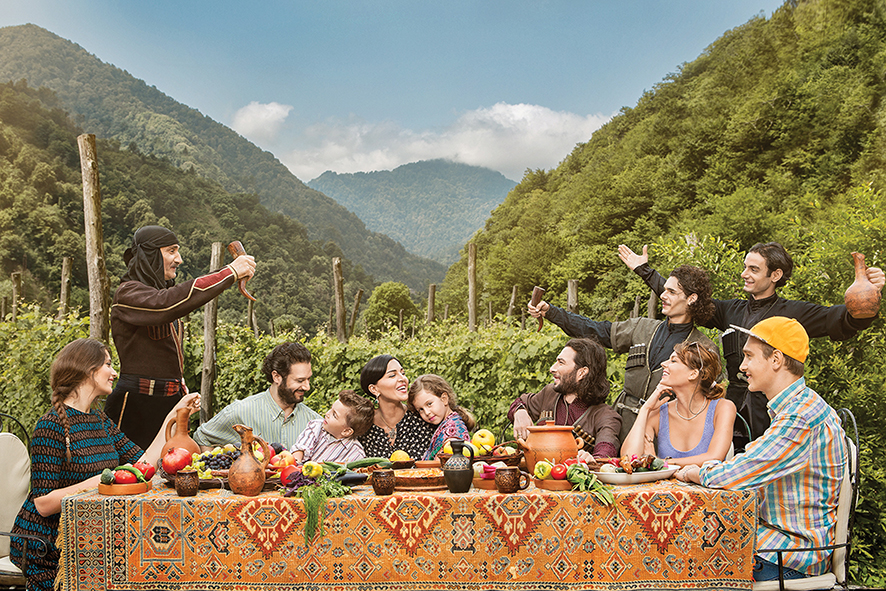
For Georgia’s restaurants, the current season serves as a reminder that hospitality has become inseparable from global affairs. A rainy spring in Tbilisi, a suspended airline route from India, new budget flights from London, and conflict in the Middle East all meet, quite literally, at the same dinner table.
In today’s interconnected world, the restaurant business no longer reflects only local demand. It has become a sensitive barometer of the global forces that determine who travels, where they go, and how the geography of tourism continues to evolve.
By Ivan Nechaev