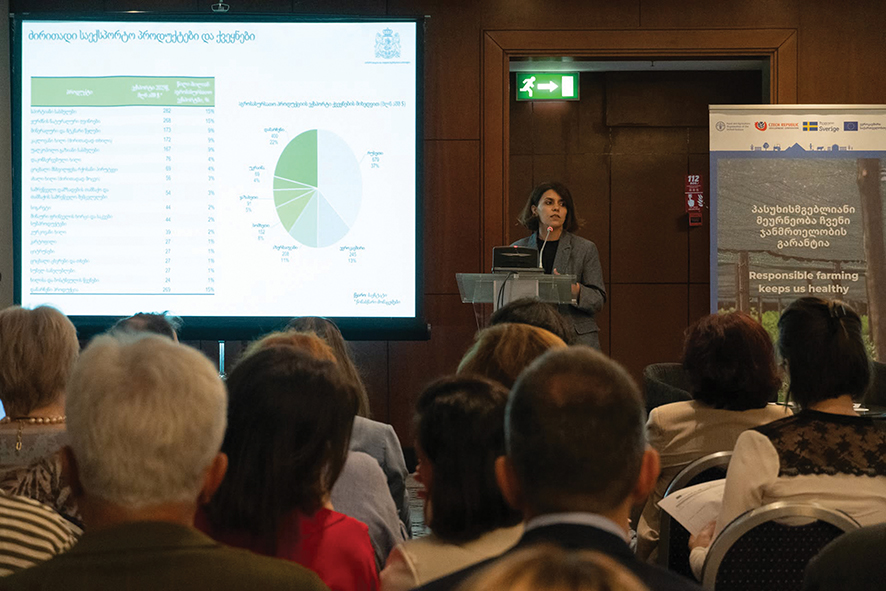
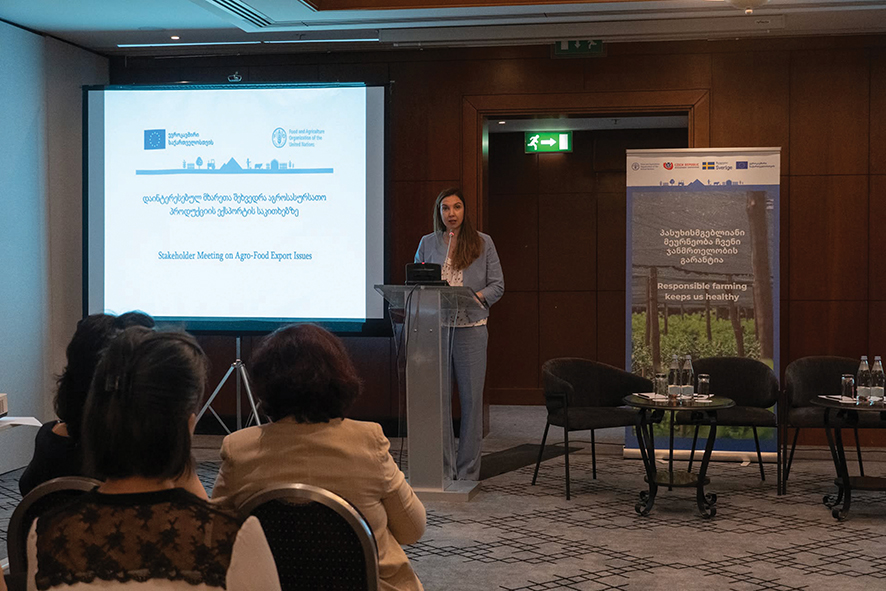
Government agencies, agrifood exporters, and industry associations met on July 3 to discuss ways to strengthen Georgia’s agricultural and food exports, with a particular focus on expanding access to European Union markets.
Organized by the UN Food and Agriculture Organization (FAO) under the EU-funded European Neighborhood Program for Agriculture and Rural Development (ENPARD IV), in cooperation with the European Business Association (EBA), the meeting examined current export trends, EU regulatory requirements, certification systems, and barriers limiting market access.
A key outcome was the agreement to establish a permanent public-private platform dedicated to export facilitation
A key outcome was the agreement to establish a permanent public-private platform dedicated to export facilitation. Through FAO’s technical assistance, the initiative will also prepare an agrifood export development plan designed to improve the competitiveness of Georgian producers, diversify export markets, and strengthen compliance with international food safety standards.
Agriculture continues to play a significant role in Georgia’s economy. According to the European Commission, the sector accounted for 5.5% of Georgia’s GDP in 2024, while employing approximately 34% of the country’s workforce, highlighting its importance for rural livelihoods.
Agrifood exports are also becoming increasingly important. According to Georgia’s Ministry of Environmental Protection and Agriculture, agrifood products accounted for 26% of the country’s total exports in 2024, reaching 107 countries. Georgia’s leading agrifood exports included wine ($276 million), alcoholic beverages ($186 million), mineral and spring waters ($163 million), non-alcoholic beverages ($139.1 million), and hazelnuts ($106.2 million).
Agriculture accounted for 5.5% of Georgia’s GDP in 2024, while employing approximately 34% of the country’s workforce
The European Union remains one of Georgia’s most important trading partners. Since the Deep and Comprehensive Free Trade Area (DCFTA) entered into force in 2014, Georgian producers have benefited from preferential access to the EU’s single market, provided they comply with European sanitary, phytosanitary, and food safety requirements. Meeting these standards remains one of the main challenges, and opportunities, for exporters seeking to expand sales to Europe.
The European Union has supported Georgia’s agricultural sector through the ENPARD program since 2013, investing in rural development, agricultural modernization, food safety, and the competitiveness of farmers and agribusinesses. FAO, one of the program’s principal implementing partners, has worked closely with Georgian institutions to improve food safety systems, strengthen agricultural value chains, and digitalize export certification procedures. The introduction of the EU’s TRACES NT system is expected to simplify export procedures while improving compliance with EU standards and increasing opportunities for Georgian producers in international markets.
The newly established public-private dialogue platform is expected to improve coordination between government agencies and businesses, helping identify regulatory bottlenecks, streamline export procedures, and unlock new opportunities for Georgian agrifood products in the EU and beyond.
By Team GT