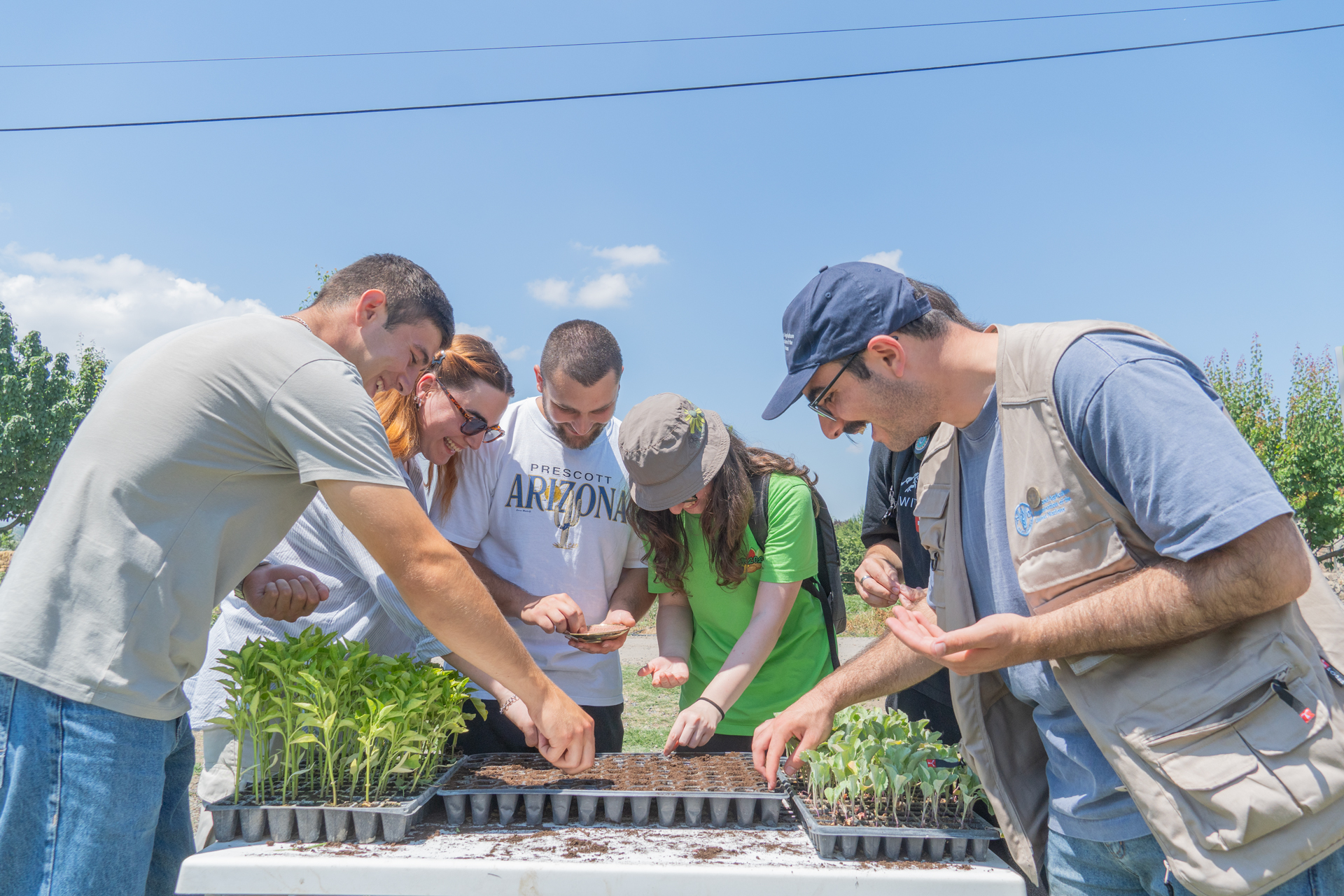
The Food and Agriculture Organization of the United Nations (FAO) marked World Youth Skills Day by organizing hands-on climate-smart agriculture training for students from the Agricultural University of Georgia at a farm in Marneuli.
The training took place at the farm of FAO Lead Farmer Naira Paksadze, where students worked alongside FAO agronomy and extension specialists to learn practical techniques designed to help farmers adapt to climate change.
Participants visited a modern seedling nursery, a greenhouse for vegetable production, and open-field plots to compare different cultivation methods. They also learned how drip and overhead irrigation systems operate and examined an agro-meteorological station that provides real-time weather data for farm management.
During the session, students prepared seedling substrate, filled planting trays, and sowed drought-resistant seed varieties used by local farmers to cope with changing weather conditions.
FAO says the initiative was designed to bridge classroom learning with practical farming experience while equipping future agricultural professionals with skills needed to address the growing impacts of climate change on food production.
The training was held under the fourth phase of the European Neighborhood Programme for Agriculture and Rural Development (ENPARD IV), funded by the European Union and Sweden.
FAO says more than 820 university students across Georgia have received practical agricultural training through ENPARD IV, while over 4,700 schoolchildren have participated in interactive food safety activities combining classroom instruction with field-based learning.
“The more students become familiar with an integrated farming systems approach, the better,” said Denis Reiss, Programme Officer for Sustainable Food Systems at the Delegation of the European Union to Georgia. “Learning from experts, as well as from farmers, is crucial for promoting affordable and relevant technologies addressing climate change issues.”
Guido Agostinucci, FAO ENPARD IV Programme Manager, said practical training helps students strengthen both their technical knowledge and their ability to support more resilient food systems.