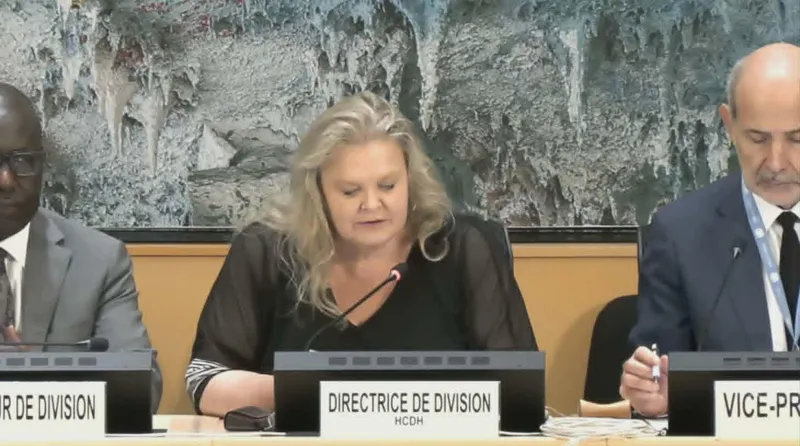
The report of the UN High Commissioner for Human Rights, Volker Türk, on the human rights situation in Georgia was presented at the 62nd session of the UN Human Rights Council (UNHRC) in Geneva.
The report was delivered by Maarit Kohonen Sheriff, Director of the Global Operations Division at the Office of the UN High Commissioner for Human Rights (OHCHR).
“The Office of the United Nations High Commissioner for Human Rights notes legislative and political developments in Georgia that raise serious concerns from a human rights perspective. In 2025, the adoption of legislation restricting civic space and undermining the right to peaceful assembly continued. The Office remains concerned by reports of human rights violations in the context of protest rallies, including arbitrary arrests, ill-treatment, and the disproportionate use of force against demonstrators and journalists,” Kohonen Sheriff said.
She noted that OHCHR calls on the Georgian authorities to investigate all allegations of human rights violations.
“The Office acknowledges the authorities’ response, including the arrest in May this year of five current and former law enforcement officers in connection with alleged acts of violence against demonstrators in 2024. OHCHR calls on the authorities to conduct prompt, independent, and thorough investigations into all such allegations, ensure accountability, and guarantee fully fair trials, due process safeguards, and the possibility of judicial review,” she said.
The report includes a series of recommendations to the Georgian government, focusing on the protection of the right to peaceful assembly and the response to what it describes as serious allegations of human rights violations.
Among its recommendations, OHCHR urges the Georgian authorities to:
- Present concrete measures to protect and promote the right to peaceful assembly and address allegations of human rights violations documented by OHCHR between June 1, 2023, and December 31, 2024, particularly those related to public protests, including unlawful arrests and the unnecessary or disproportionate use of force against journalists and media workers;
- Conduct prompt, independent, and thorough investigations into all allegations, ensure accountability, and guarantee fair trials and due process;
- Review the amendments adopted in 2025 to the Law on Broadcasting, the Criminal Code, the Law on Grants, the Law on Assembly and Demonstrations, and the Code of Administrative Offences to ensure compliance with international human rights law, particularly the International Covenant on Civil and Political Rights, while ensuring transparent legislative processes and meaningful public participation;
- Strengthen efforts to combat gender discrimination and violence and promote gender equality in political representation, including by reviewing gender-related legislative amendments adopted in 2025;
- Restore an enabling environment for civil society by ensuring that any restrictions on foreign funding for non-governmental organizations and broadcasters are strictly necessary, proportionate, and consistent with Georgia’s international human rights obligations.
The report also addresses the human rights situation in Georgia’s Russian-occupied regions.
OHCHR expressed regret over the continued lack of access for international and regional human rights bodies to Abkhazia and the Tskhinvali region/South Ossetia, calling for immediate and unhindered access for all relevant international mechanisms, including OHCHR itself.
The Office further called on all parties to lift restrictions on movement and reopen all crossing points along the administrative boundary lines, respond to reports of human rights violations—particularly those affecting ethnic Georgians in the Gali and Akhalgori districts and internally displaced persons—and facilitate dialogue while allowing international organizations to operate freely.
In addition, the report calls on all parties to investigate violations of the right to life, torture, and ill-treatment, ensure accountability for perpetrators, provide appropriate compensation to victims, and eliminate arbitrary deprivation of liberty in line with international legal standards.
Related story: HRW urges Georgia to repeal repressive laws and end politically motivated prosecutions