
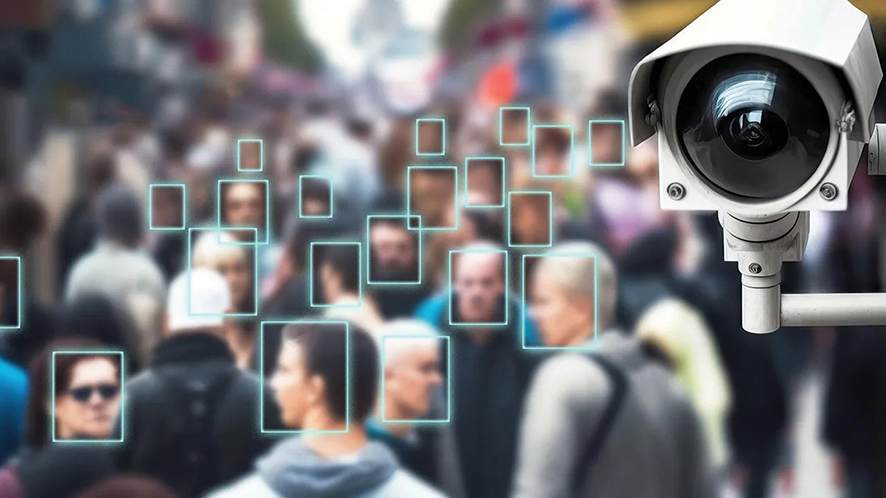
The Georgian government plans to expand the use of facial recognition cameras across the country and purchase an advanced anti-unmanned aerial vehicle (UAV) system as part of what it says are major upgrades to the country’s security infrastructure.
Speaking at a July 1 briefing, the Minister of State for Coordination of Law Enforcement Bodies, Mamuka Mdinaradze, said the government intends to install facial recognition cameras nationwide as part of crime prevention and public security measures.
“We will try to install facial recognition cameras not only on Rustaveli Avenue and in central districts, but throughout the country, based on security measures, including crime prevention,” Mdinaradze said.
He made the remarks in response to questions about a recent investigation by AlgorithmWatch, which alleged that the ruling Georgian Dream party has used a Russian facial recognition system to identify citizens.
Mdinaradze dismissed claims that Russia’s security services could gain access to Georgian citizens’ personal data through the system, describing the allegations as “ridiculous.” He also said that no surveillance technology had been purchased from Russia since he assumed his current position. However, AlgorithmWatch reported that Georgia first procured the facial recognition technology from Russia in 2013.
The investigation has prompted criticism from the Georgian Young Lawyers’ Association (GYLA/SAIA), which warned that the use of facial recognition technology during protests raises serious human rights concerns.
The organization said the ruling party has increasingly relied on such surveillance technologies during anti-government demonstrations since late 2024. It argued that, without sufficient transparency regarding the systems’ capabilities and adequate legal safeguards, their use against peaceful protesters could have a chilling effect on the exercise of the right to freedom of assembly.
SAIA added that AlgorithmWatch’s June 27 investigation deepens concerns over the deployment of facial recognition technology and raises further questions about the protection of citizens’ rights and personal data.
Alongside the expansion of surveillance technology, Mdinaradze announced plans to strengthen the capabilities of the State Protection Special Service by purchasing an ultra-modern anti-UAV system.
According to the minister, the service has already upgraded its secure communications system and peripheral infrastructure with a high-encryption module.
“The measures carried out and planned in the State Protection Special Service, including the purchase of an ultra-modern system against unmanned aerial vehicles, which means the detection and neutralization of several dozen aerial vehicles at the same time within a radius of 5-6 kilometers, allow us to say that the State Protection Special Service has never been at the level of development it is today and it is distinguished by its capabilities not only in our region,” Mdinaradze said.
Responding to a question about whether the anti-drone system would be used to protect senior government officials, Mdinaradze said the specific purpose was not important, arguing that such technology is standard equipment for modern state security services.
“Whatever version you say, whether it is so or not, it doesn’t matter. Any special service in the world, if it has the material ability and will to do so, is trying to acquire such ultra-modern systems in order to be armed, whether a forum is held, whether a diplomatic mission is coming, or there are measures to protect diplomatic missions operating in the country, or any other measures to protect these facilities. With ultra-modern equipment, this is an elementary and simple solution when you can afford such a system,” he said.
By Team GT