There is a peculiar danger that awaits every ancient culture: the moment it becomes too proud of its own past, it risks turning itself into an exhibition. The songs remain, the costumes remain, the stories remain, but they survive behind glass, protected and untouched. The most interesting moments in contemporary culture happen when artists refuse this kind of preservation.
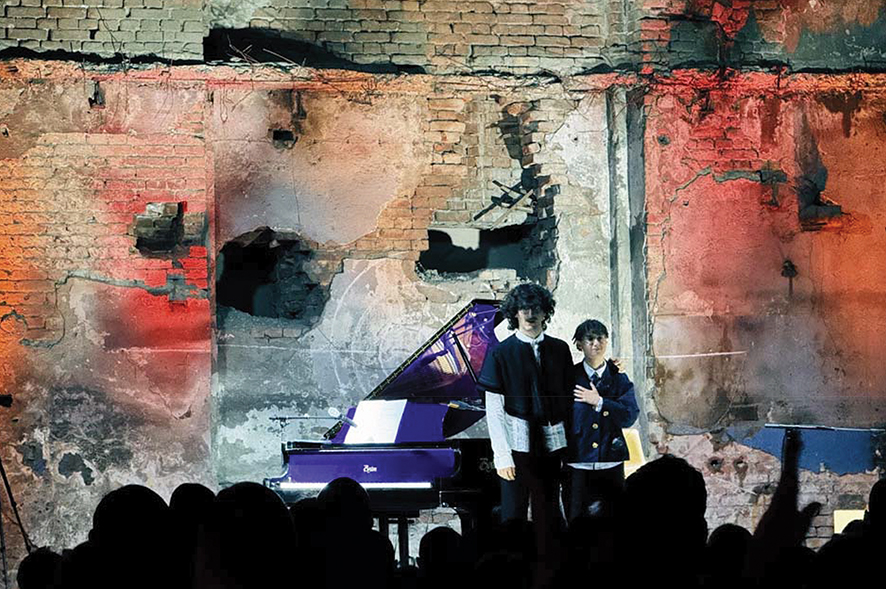
‘Georgian on My Mind,’ the collaboration between pianist Giorgi Gigashvili and singer Nini Nutsubidze, is not an evening about “bringing Georgian folklore to classical audiences.” Such a description would immediately establish an unnecessary hierarchy, placing European art music in the position of the universal language and Georgian musical memory as something that requires translation.
The evening proposes the opposite. It asks a more uncomfortable and more interesting question: what if Georgian musical imagination itself is the center from which we listen? This shift becomes evident already in the structure of the program. A Chopin mazurka is not simply a monument of the piano repertoire; it is itself a transformation of folk dance into intimate musical speech. Ravel’s ‘Une barque sur l’océan’ is a study of movement, color, and fluidity. Schumann’s lyrical introspection, Beethoven’s radical fragmentation in the late sonatas, Prokofiev’s almost mechanical violence in Precipitato: all these works are examples of composers taking inherited forms and pushing them toward something personal and new.
Placed next to them are the voices of Georgia: the urban melancholy of Irakli Charkviani, the unmistakable lyricism of twentieth-century Georgian song, and the contemporary textures of composers who treat Georgian identity not as a monument but as a living material.
What makes the project particularly compelling is that it avoids the usual language of “fusion.” Fusion often implies a diplomatic compromise: a little of this, a little of that. Here, the encounter is much more radical. These musical worlds are allowed to remain different. The roughness of a folk gesture does not have to become polished by classical technique, and the classical repertoire is not reduced to a decorative frame.
Giorgi Gigashvili’s piano playing has the rare ability to move between these worlds without changing his artistic seriousness. A Scarlatti sonata and a Georgian song receive the same degree of attention, curiosity, and emotional investment. This equality of listening may be the project’s most important ethical statement.
Nini Nutsubidze’s voice, meanwhile, reminds us of something that Western concert culture occasionally forgets: before music became a score, it was a human body breathing in front of another human body.
Perhaps this explains why the first Georgian performance of a project already welcomed by Europe’s major concert halls felt less like a triumphal return and more like a necessary conversation. After travelling through institutions that define the European classical tradition, the music came back to the place where many of its questions originated.
By Ivan Nechaev