For years, discussions about Eurasian geopolitics revolved around the great powers. Russia, China, the United States and the European Union dominated the conversation, while smaller states were often treated as spaces through which powerful external actors competed. Yet the geopolitical map of Eurasia is changing and shaping in ways that challenge this old assumption. Increasingly, countries once considered peripheral are becoming strategically indispensable. Among the clearest examples of this transformation are Kazakhstan and Georgia.
At first glance, the two countries appear very different. Kazakhstan is a vast Central Asian state rich in oil, uranium, and critical minerals, while Georgia is a small South Caucasus country located on the Black Sea. But geography has tied their futures together. As global trade routes shift and the international system become more fragmented, both states are finding themselves at the center of a new geopolitical reality shaped by connectivity, transport corridors, and energy security. The Russia–Ukraine war accelerated this shift dramatically.
For decades, much of Eurasian trade and energy transit depended heavily on Russian-controlled infrastructure. Railways, pipelines, and logistics networks built during the Soviet period continued to define regional commerce long after the Soviet Union collapsed. The war disrupted that system. Western sanctions on Russia, rising political risk, and growing uncertainty surrounding Russian transit routes forced governments and businesses to search for alternatives. That search has elevated the strategic importance of the so-called Middle Corridor, the trade route linking China and Central Asia to Europe through the Caspian Sea, the South Caucasus, and Turkey.
This is where Kazakhstan and Georgia increasingly intersect. Kazakhstan has emerged as the economic engine of Central Asia. The country accounts for roughly 60 percent of the region’s combined GDP, and possesses enormous reserves of oil, uranium, copper, zinc, and rare earth minerals. In recent years, Astana has invested heavily in rail modernization, Caspian port infrastructure, and logistics development to reduce dependence on Russian transit routes and diversify access to international markets.
But Kazakhstan cannot complete this strategy alone. Its westward connectivity depends on the South Caucasus, and especially on Georgia. Once goods cross the Caspian Sea through Azerbaijan, Georgia becomes the main gateway connecting Central Asia to Black Sea ports and European markets. Georgian railways, highways, ports, and digital infrastructure therefore occupy a strategic position in the emerging Eurasian trade system.
This has transformed Georgia’s geopolitical significance. For years, Georgia was viewed primarily through a security lens; a post-Soviet state caught between Russia and the West. Today, economics and connectivity are becoming equally important. As global supply chains become more politicized and fragmented, transit geography matters again. Countries capable of linking regions together gain strategic value beyond their military or economic size. Georgia now occupies exactly such a position.
The Baku–Tbilisi–Ceyhan pipeline, the Southern Gas Corridor, the Baku–Tbilisi–Kars railway, and the Trans-Caspian transport route are gradually creating a new Eurasian axis stretching from Central Asia to Europe. What makes this moment particularly important is that these projects are no longer viewed only as economic initiatives. They are increasingly understood as instruments of geopolitical resilience.
This is especially true for Europe. European governments seeking to reduce dependence on Russian energy and Russian-controlled transport routes increasingly view the South Caucasus and Central Asia as strategically important regions. Kazakhstan offers energy resources and critical minerals necessary for the green transition, while Georgia offers physical access to European markets through the Black Sea corridor.
At the same time, China also sees growing value in this route. Beijing’s Belt and Road Initiative was designed to expand continental connectivity across Eurasia, and Kazakhstan occupies a central role in that vision. Yet instability in Russian transit routes after 2022 increased the attractiveness of alternatives running through the Caspian basin and the South Caucasus. As a result, Georgia’s importance within China’s broader Eurasian calculations has also increased.
What makes the Kazakhstan–Georgia relationship particularly significant is that it reflects a larger structural transformation in world politics. The international system is becoming less centralized and more corridors driven. Infrastructure, ports, logistics hubs, energy routes, and digital networks increasingly shape geopolitical influence. Countries that can connect regions together gain leverage because they reduce dependency, diversify trade options, and provide strategic flexibility to larger powers.
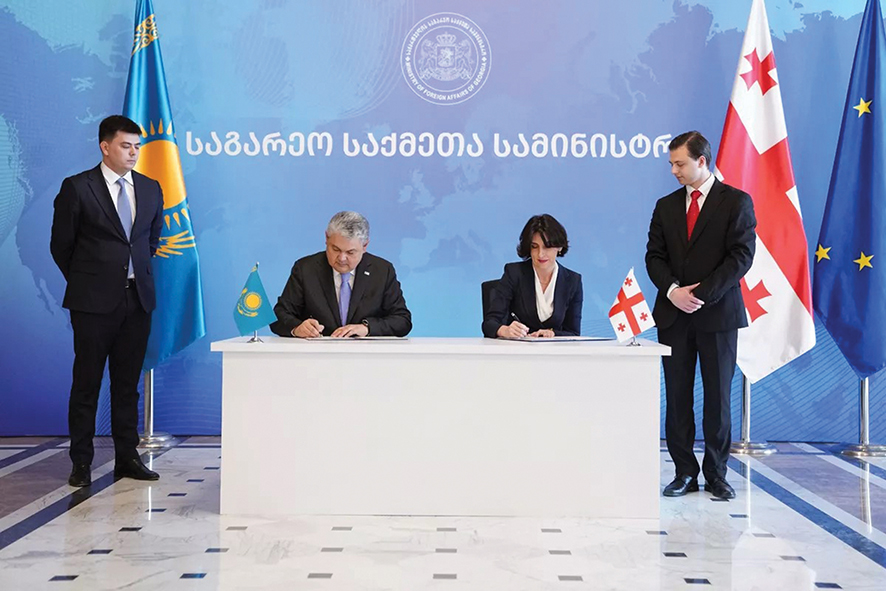
This is precisely what Kazakhstan and Georgia now offer. Kazakhstan’s foreign policy has been built around strategic balancing. Since independence, Astana has pursued relations simultaneously with Russia, China, the West, Turkey, and regional actors without fully aligning with any single bloc. Georgia’s geopolitical trajectory has been different, particularly because of its Euro-Atlantic orientation and security tensions with Russia, yet both countries increasingly share a similar strategic interest: avoiding isolation by embedding themselves within broader connectivity networks.
That shared logic explains why cooperation between Central Asia and the South Caucasus is deepening. The relationship is no longer based only on diplomacy or regional goodwill. It is increasingly becoming an integral in economic necessity and geopolitical calculation. Kazakhstan needs stable access to the Black Sea and European markets. Georgia needs larger transit flows, infrastructure investment, and strategic relevance within Eurasian trade networks. Both countries benefit from reducing excessive dependence on Russian-controlled routes while simultaneously positioning themselves within emerging global supply chains.
This transformation also changes how smaller states exercise influence. Traditional geopolitical thinking often assumed that power belonged mainly to large military actors. But today, infrastructure and geography can generate influence in different ways. A country that controls a strategic transit corridor, energy route, or logistics network can become geopolitically important even without massive military power. Kazakhstan and Georgia illustrate this shift clearly. Neither country can dominate Eurasia militarily.
Yet both increasingly shape how Eurasia functions economically. Their railways, ports, pipelines, and corridors influence the movement of energy, trade, technology, and investment across continents. In a fragmented international system, that role matters enormously.
The future of Eurasia may still be debated in Moscow, Beijing, Washington, and Brussels. But increasingly, it will also depend on what happens in Astana and Tbilisi.
Op-Ed by Abdulmelik Alkan, Adjunct Professor, Webster University