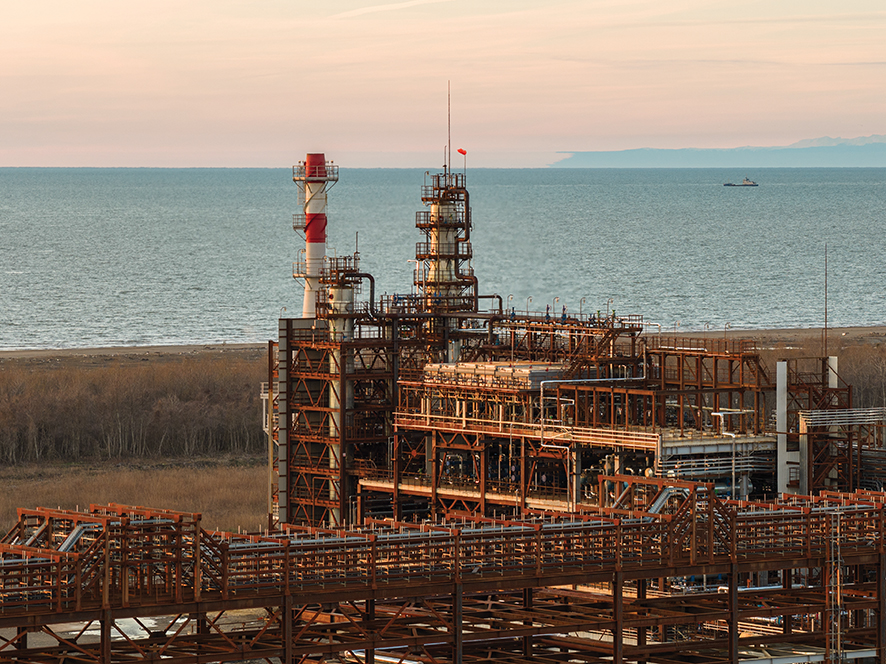
Black Sea Petroleum has commissioned Georgia’s first full-cycle oil refinery, dispatched the first Georgian refined oil products in the country’s history, signed a landmark technology agreement with Honeywell, and set out a roadmap to produce Euro-5 fuels and aviation-grade kerosene by 2028.
Black Sea Petroleum (BSP) began processing crude oil at its Kulevi oil refinery in autumn 2025, marking a historic shift for a country that until recently served solely as a transit corridor for Caspian crude. In its first public interview since commissioning, BSP’s Co-Founder and CEO David Potskhveria described a project that is already generating refined product exports, and one still in the early stages of a much larger build-out.
Economic Impact
Black Sea Petroleum points to the Lari as a downstream beneficiary: sustained hard-currency export revenues reduce Georgia’s chronic trade deficit in energy, and trade balance improvements contribute directly to currency stability.
During construction, BSP contracted over 300 Georgian companies, channeling a significant share of its 400 million Lari investment directly through the local economy. The project employed approximately 2,000 workers and engineers during construction. Operations now support 500 permanent staff, a figure expected to grow to 700 at full build-out. Total salary expenditure exceeds 90 million GEL. Additionally, more than 40 million GEL has been contributed to the state budget. Potskhveria noted that the project has attracted Georgian professionals back from abroad, and that the region where the refinery is located benefits even more.
Potskhveria is candid about the human capital challenge and about what BSP is doing to meet it. “We have a shortage of qualified personnel in the domestic labor market, this is one of our most immediate operational realities,” he tells us. “Our response has been to invest directly in the people of our country.”
The company has launched vocational and technical training programs targeting local and international workers, with courses designed to produce professionals capable of operating high-tech automated refining systems, meeting industrial safety standards, and managing quality control at an internationally competitive facility. Several hundred residents have already completed these courses.
“We recognize our responsibility to create opportunities and improve the lives of the people of our country,” Potskhveria notes. The program also includes specialized training courses for diverse professions.
BSP frames the refinery as the seed of a broader industrial ecosystem: petrochemicals, fertilizer manufacturing from refining by-products, and logistics operations. With this, the foundation for Georgia’s first domestically produced export oil products of industrial scale is already in place.
Geographic and Competitive Position
The refinery’s location provides measurable logistical advantages. The SOCAR Kulevi terminal handles both rail and sea loading. Poti port lies 30 kilometres away, the Baku-Supsa pipeline terminal 55 kilometers, providing backup optionality. Transit time to Turkey and Romania is one to two days by sea; to Mediterranean markets, four to nine days; to the US East Coast, around three weeks.
Georgia currently operates as a fully import-dependent fuel market. BSP directly addresses this: given its location, the refinery draws on multiple potential crude sources, giving it both supply flexibility and logistical leverage.
Development Roadmap
Following its operational launch in autumn 2025, BSP is advancing through a four-stage expansion. A vacuum distillation unit and bitumen production module are scheduled for commissioning in the first half of 2027, enabling output of vacuum gasoil and industrial bitumen. By early 2028, combined nominal capacity will reach 4.5 million tons per year, with a utilization potential of 5 million tons. A Merox sweetening unit for kerosene desulphurization will also become operational alongside the second distillation unit.
The first product to emerge from the Honeywell partnership will be Jet A-1 aviation kerosene, targeted for production from 2028. Euro-5 automotive gasoline and diesel are planned for the end of 2028.
Potskhveria noted that all site infrastructure: pipelines, power supply and engineering communications, has been laid out in anticipation of these units, which is expected to compress construction timelines for later phases.
Construction has already begun on a second atmospheric-vacuum distillation unit with a nominal capacity of 3.3 million tons per year. In parallel, the company is adding 120,000 cubic meters of reserve storage capacity.
Longer-term, BSP’s masterplan includes Deep Conversion units to maximize conversion of heavy fractions into high-value distillates, eliminating most residual fuel oil output

Technology and the Honeywell Partnership
The significant recent development is a licensing and engineering agreement with Honeywell UOP, covering the design and installation of secondary processing units required to manufacture high-specification fuels. Under the agreement, Honeywell will supply process licenses, basic engineering, proprietary catalysts, and advanced control systems for isomerization, reforming, and hydro treatment units. The company has already commenced licensing and engineering work.
Feedstock Diversification and Sanctions Compliance
For International compliance, BSP employs LSEG’s World-Check KYC screening system, retains UK and Swiss law firms for LEGAL OPINION, and maintains ongoing dialogue with Georgian state institutions. “We operate in a global market. International compliance is non-negotiable,” Potskhveria says.
Since commissioning, BSP has received crude from Azerbaijan and Russia. Potskhveria was direct on the company’s intentions: European markets represent the premium destination for refined products, and access to those markets requires non-Russian feedstock. The company began exploring Turkmen and Kazakh crude supply in 2025 and expects volumes from Central Asian producers to increase from April 2026 onward.
Market Outlook
BSP intends to prioritize domestic supply once Euro-5 fuels enter production, with exports to neighboring countries on a residual basis. Potskhveria argues that the presence of a domestic refiner, even one importing all its crude, structurally reduces the scope for sharp retail fuel price movements in Georgia by entering a market previously supplied entirely by imports.
“Georgia was the only country on the Black Sea coast without its own refinery. That is no longer the case, and the Black Sea Petroleum team is proud of it,” he says.
By Team GT