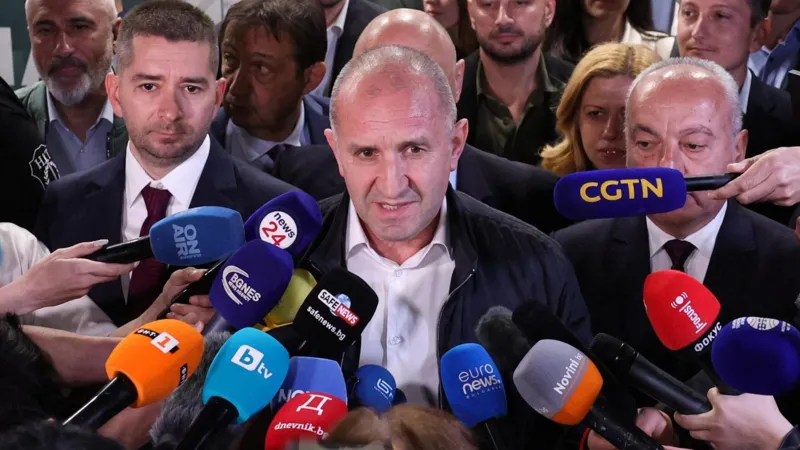
Rumen Radev’s newly formed political movement, Progressive Bulgaria, won Sunday’s parliamentary election, marking a decisive shift in the country’s political landscape after years of instability, the BBC reports.
With 87% of the vote counted, Progressive Bulgaria (PB) secured a commanding majority of at least 135 seats in the 240-seat parliament, based on official results. The party outperformed its main rivals, with the liberal “We Continue the Change – Democratic Bulgaria” (PP-DB) coalition, which received around 15% of the vote, and former prime minister Boiko Borisov’s GERB party trailing with 13%.
The vote was Bulgaria’s eighth general election in five years, coming after prolonged political fragmentation and repeated government collapses. The latest election was triggered after the previous administration attempted to pass a controversial budget in December, leading to mass protests that Radev openly supported in his capacity as president.
In his victory speech, Radev thanked voters for rejecting what he described as “the self-satisfaction and arrogance of old parties” and pledged to build “a strong Bulgaria in a strong Europe.”
“What Europe needs right now is critical thinking, pragmatic actions and tangible results, particularly in shaping a new security architecture and restoring industrial competitiveness,” he said.
Radev, 62, stepped down from the presidency in January after nine years in office to launch his political movement. A former MiG-29 fighter pilot and commander-in-chief of the Bulgarian Air Force, his transition into party politics and subsequent electoral victory mark a significant development in Bulgarian politics.
He campaigned primarily on domestic issues, promising to tackle corruption and restore stable governance following years of fragile coalition governments.
Despite securing a parliamentary majority, Progressive Bulgaria is expected to seek cooperation with other parties to pass key legislation, particularly judicial reforms, which require a two-thirds majority. Radev confirmed he is open to coalition talks.
On foreign policy, Radev is widely viewed as a pragmatic leader with a more cautious stance toward Russia. He has previously criticized EU sanctions on Moscow and called for dialogue with the Kremlin. He also opposes direct Bulgarian military support for Ukraine, arguing that continued arms supplies risk prolonging the war.
However, analysts in Sofia suggest his government is unlikely to obstruct EU-wide support for Kyiv. Instead, Bulgaria is expected to maintain indirect involvement, including arms exports through third countries: a practice that has made it a significant supplier of ammunition and explosives to Ukraine since 2022.
The war has revitalized Bulgaria’s defense industry, with major investments underway. In October 2025, German defense company Rheinmetall announced a €1 billion joint venture with Bulgaria’s VMZ plant in Sopot to produce up to 100,000 NATO-standard 155mm artillery shells annually. A separate gunpowder facility is also planned, as part of broader European efforts to scale up military production.
While opposing direct military aid, Radev has supported strengthening Bulgaria’s role within the European defense sector. “Bulgaria is becoming part of the European defense ecosystem,” he said during a visit to Rheinmetall’s headquarters in Germany in 2025.
Observers note that his likely approach may resemble that of Slovakia’s Prime Minister Robert Fico — critical of certain EU policies, but not actively blocking defense production or broader European initiatives related to Ukraine.
The election result gives Radev a strong mandate to govern, but his ability to balance domestic reform priorities with complex geopolitical dynamics will shape Bulgaria’s role within both the European Union and the wider region.
Source: The BBC