The Holy Synod of the Georgian Orthodox Church has concluded a closely watched meeting without clarifying key eligibility criteria for the election of the next Patriarch, leaving open questions over age limits and educational requirements as the succession process moves forward.
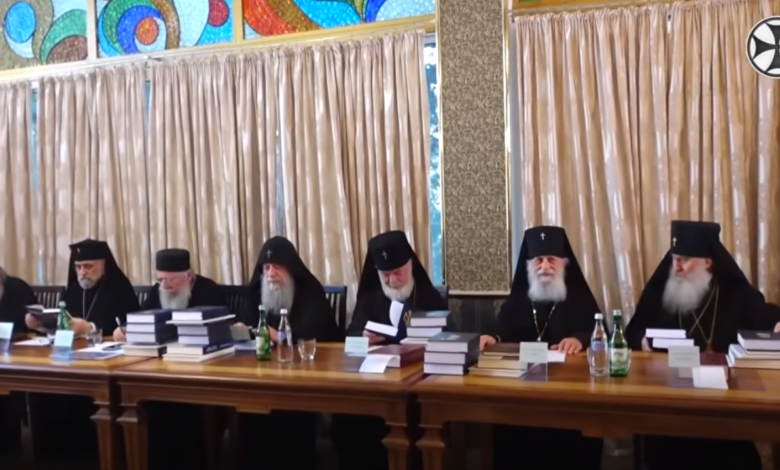
The April 3 session, which lasted nearly six hours, was expected to provide definitive guidance on who can stand as a candidate to succeed the late Patriarch Ilia II. Instead, church officials said discussions focused primarily on “procedural matters,” with final decisions on contentious issues postponed to the next Synod meeting, scheduled for April 24.
Despite the lack of formal rulings, senior clergy suggested that candidates will likely be expected to have at least a theological seminary background. “Regarding education, there was no specific discussion, although at a minimum, a theological seminary remains a requirement,” Archpriest Andria Jagmaidze, head of the Patriarchate’s public relations service, told journalists after the meeting.
Uncertainty also remains over how the Church will interpret the statutory age requirement for candidates, which states that a Patriarch must be “no younger than 40 years of age and no older than 70.” Jagmaidze claimed that the Synod did not determine how strictly the upper age limit will be applied, with further debate expected later this month.
The ambiguity surrounding these provisions could directly affect the eligibility of at least two widely discussed contenders.
Metropolitan Isaiah of the Nikozi and Tskhinvali diocese has drawn attention due to the absence of publicly documented formal theological qualifications. However, Church rules also require hierarchs — including bishops and metropolitans — to possess “proper theological education,” suggesting that his credentials were deemed sufficient when he was appointed bishop in 1995 and later elevated to metropolitan rank in 2006.
Meanwhile, Metropolitan Daniel of the Chiatura and Sachkhere diocese is approaching the statutory age limit. He is set to turn 71 on May 29, shortly after the latest possible date for the election of a new Patriarch, raising questions about whether the age restriction will be interpreted strictly at the time of election or more flexibly.
Both figures are seen as potential challengers to Metropolitan Shio (Mujiri), who has served as Locum Tenens since 2017 and is widely considered a frontrunner in the succession process.
The 39-member Holy Synod is expected to shortlist three candidates at its next meeting on April 24, to be held at the Holy Trinity Cathedral in Tbilisi. These candidates will then be presented to an extended church assembly, which will elect the new Patriarch.
Metropolitan Nikoloz (Pachuashvili) stated that the selection process within the Synod will involve individual voting rounds, with the three candidates receiving the highest number of votes advancing to the final stage.
Under the Church’s 1995 statute of administration, the election must take place no earlier than 40 days and no later than two months after the Patriarch’s death — setting May 17 as the latest possible date.
The extended assembly will include both clergy and lay representatives, though only members of the Holy Synod are eligible to stand as candidates and cast votes. To be elected, a candidate must secure more than half of the votes — at least 20 out of 39. If no candidate reaches this threshold, a runoff vote is held.
The election of a new Patriarch is a pivotal moment for the Georgian Orthodox Church, one of the country’s most influential institutions, with deep cultural, social, and political significance.
The lack of clarity over eligibility criteria has fueled debate within both ecclesiastical and public spheres, reflecting broader questions about continuity, reform, and leadership within the Church following the end of Ilia II’s decades-long tenure.
With the April 24 Synod meeting expected to narrow the field, attention is now focused on how the Church will interpret its own rules — decisions that could shape not only the list of candidates but the future direction of the institution itself.
Header image: The Holy Synod meeting on April 3. Photo: videograb from the report of Ertsulovneba channel of the Georgian Patriarchate