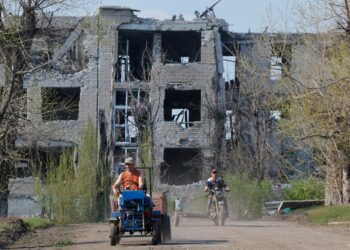
This past week in Ukraine followed a grimly familiar pattern. On the ground, Russia kept pushing forward in small, grinding steps, taking villages here and there rather than attempting dramatic breakthroughs. In the air, it returned to large-scale missile and drone strikes, especially against Ukraine’s energy system, after a brief pause tied to US-backed diplomacy. Ukrainian officials say Moscow used that lull not to de-escalate, but to reload.
The result is a war defined less by sweeping movements on maps and more by steady attrition: incremental advances, mounting civilian hardship, and both sides trying to strengthen their hand ahead of negotiations without giving up anything essential.
Slow advances, constant pressure
Russia announced a string of modest territorial gains across several fronts. At the end of January, Russian state media said troops had taken three villages in Zaporizhzhia and Donetsk regions, followed days later by another reported capture in southeastern Zaporizhzhia. Reuters could not independently confirm these claims, but they fit a broader trend: Moscow is probing Ukrainian defenses, widening footholds where it can, and forcing Kyiv to respond across many pressure points at once.
Further north, Russia also claimed to have taken a village in Ukraine’s Sumy region, underscoring that the northern border remains active. The goal there appears less about major advances and more about keeping Ukrainian forces stretched, threatening supply routes, and preventing Kyiv from shifting troops south and east.
For civilians near these fronts, the effects are immediate. Reuters reporting from southeastern Ukraine described villages emptying out as Russian forces “lurch forward.” Shelling intensifies, drones become constant, transport links fail, and people leave; not because a line on a map has officially shifted, but because daily life becomes impossible. Often, civilian evacuation is the first visible sign that the tactical situation is worsening.
Winter strikes hit hard
The most consequential events of the week came from the sky. After what had been described as a temporary pause in attacks on energy infrastructure, Ukrainian officials say Russia launched a massive combined strike: hundreds of drones and dozens of missiles in a single overnight assault.
According to Reuters, the barrage damaged energy facilities and residential areas as temperatures dipped to around minus 20 degrees Celsius. At least a dozen people were injured, and an evening strike in Zaporizhzhia killed two 18-year-olds and wounded nine others. In Kyiv, more than 1,100 apartment buildings were left without heat. In Kharkiv, authorities described large numbers of residents enduring freezing apartments after power and heating facilities were hit.
President Volodymyr Zelensky framed the strikes as both a humanitarian weapon and a political message. He accused Russia of exploiting the pause to prepare a renewed assault designed to freeze cities, exhaust repair crews, and weaken Ukraine’s position ahead of talks. Even the details of the supposed moratorium became contested: Russia said it had already expired; Ukraine said it was meant to last several more days. The episode showed how fragile and unenforced such arrangements are.
Civilians still paying the price
Frontline towns continued to suffer deadly strikes. On February 4, Ukrainian officials said shelling and aerial bombs hit a market area in Druzhkivka, killing at least seven people and injuring eight more. Russia did not comment, and both sides deny deliberately targeting civilians. Still, incidents like this remain a stark feature of life near the front, where populated areas sit within range of artillery, bombs, and drones.
The rhythm is brutally consistent: pressure on the ground, deep strikes on infrastructure, and civilians caught in between.
Ukraine quietly strikes back
Ukraine’s own long-range attacks into Russia continued, though with far less spectacle than Russia’s barrages. Russian officials reported civilian deaths from Ukrainian drone strikes in the Belgorod region.
Beyond the border areas, Ukraine has kept targeting oil refineries and fuel infrastructure; part of a broader effort to disrupt Russia’s ability to sustain high-tempo operations. These strikes don’t usually lead to immediate changes at the front, but analysts see them as an attempt to slowly complicate Russia’s war economy.
Small gains, no breakthroughs
Measured week to week, the territorial picture barely moves—but it does move. According to Russia Matters’ weekly assessment based on ISW data, Russia gained about 29 square miles of Ukrainian territory between January 27 and February 3. Ukraine, meanwhile, maintained a small foothold, around four square miles, inside Russia’s Kursk and Belgorod regions.
These figures underline the reality of this phase of the war: villages and fields change hands, not cities. The biggest shocks are felt not on maps, but in homes when the power goes out.
Talks continue, fighting doesn’t
Diplomacy ran alongside the violence rather than replacing it. Reuters reported that Ukrainian and Russian officials completed what Ukraine called a “productive” first day of US-backed talks in Abu Dhabi. The focus was on practical issues, but the core disagreements remain untouched: Russia’s demands for territorial concessions versus Ukraine’s refusal to give up land it still controls, along with unresolved questions about security guarantees and major sites like the Zaporizhzhia nuclear plant. Kremlin officials have also signaled that territory is only part of their demands, reinforcing the sense that negotiations face long odds.
Air defense becomes urgent again
With Russia’s renewed strike campaign, air defense took center stage in international support. Sweden and Denmark announced a joint plan to buy and deliver Tridon air defense systems to Ukraine, worth about $290 million. Ukraine also said it was working with RTX to speed up Patriot missile deliveries and deepen industrial cooperation. Estonia prepared a new aid package focused on drones and counter-drone systems, reflecting how unmanned systems now dominate the battlefield above and behind the front lines.
The pattern holds
Taken together, the week looks much like the months before it. Russia presses forward inch by inch while using missile and drone strikes to target heat, electricity, and morale in the depths of winter. Ukraine absorbs those blows, tries to hold the line, applies limited pressure inside Russia, and scrambles for faster air-defense resupply. Talks continue, but the fundamentals—territory, security guarantees, and the use of civilian infrastructure as leverage—remain unresolved.
Unless Ukraine’s air defenses can be strengthened faster than Russia can assemble large strike packages, the coming weeks are likely to follow the same harsh equation: small changes on the battlefield, and outsized suffering in the cities.
Compiled by Ana Dumbadze