
Over the past week, the war in Ukraine has entered a more dangerous and intense phase. Russian forces have increased pressure along the eastern front, while both sides continue to contest energy infrastructure, and civilian casualties have risen sharply from long-range attacks.
Moscow appears to be using the arrival of spring to push a fresh offensive, concentrating on the heavily fortified Donetsk line connecting Sloviansk, Kramatorsk, and Kostiantynivka. Smaller Russian assaults have also targeted Pokrovsk and the Zaporizhzhia region. According to the Institute for the Study of War, Russian troops launched a battalion-sized attack northeast of Sloviansk, along with several smaller attacks, likely preparing for a broader campaign. Ukrainian officials reported more than 600 assaults over four days, with analysts noting that Russia’s renewed use of armored vehicles signals a push to gain ground, even if a decisive breakthrough remains unlikely.
The fighting continues to be a costly war of attrition rather than swift maneuvering. While Russian forces described heavier fighting and pressure in Pokrovsk during winter, Ukrainian commanders said there is no sign of an imminent overwhelming assault. In the southeast, Russian troops have pressed forward in the open terrain of Zaporizhzhia, where defending is especially difficult. Analysts suggest Russia has the manpower to continue advancing, but extensive drone activity is limiting large-scale mechanized gains.
Ukraine’s response has focused on slowing and punishing Russian advances through drones, long-range strikes, and localized counterattacks. Kyiv has expanded its mid-range strike capability, hitting Russian logistics, depots, and supply routes up to 50 kilometers behind the front lines. Long-range strikes have targeted refineries, ports, and other strategic infrastructure, gradually eroding Russia’s ability to replace battlefield losses. The week’s pattern shows Russian incremental pressure on land countered by Ukrainian attacks on the systems sustaining the Russian war effort.
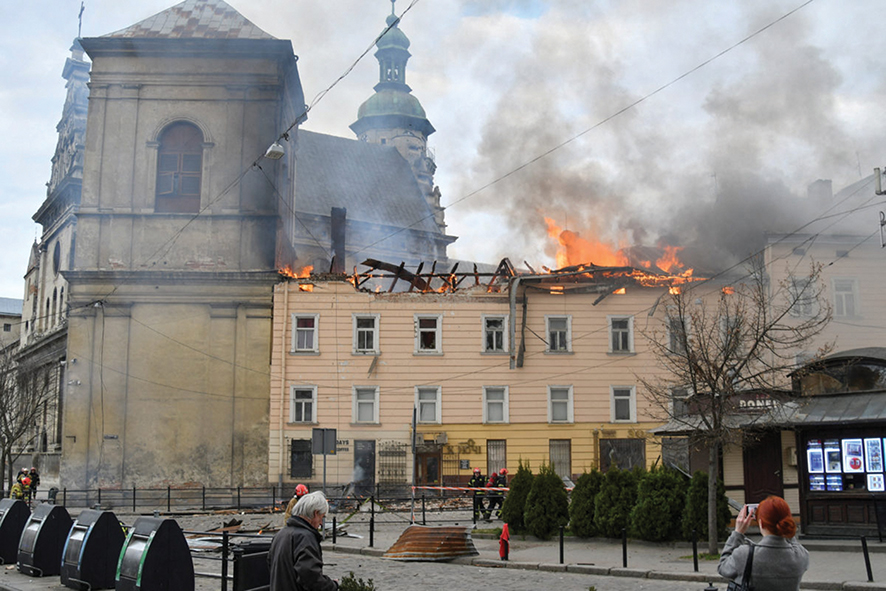
Civilians have again borne a heavy cost. On March 21, Russian strikes killed four people and disrupted power across northern Ukraine after a drone hit an energy facility in Chernihiv region. Subsequent attacks left more than 200,000 households without electricity. On March 24–25, Russia launched one of its heaviest drone waves in months, killing at least eight people and injuring dozens, and causing damage in western cities that had previously been relatively less exposed. Cultural sites were also damaged, including a UNESCO-listed area in Lviv.
By March 26, Russian attacks killed two more people near Kharkiv, injured nine, and damaged port and energy facilities in Izmail on the Danube: a key logistical hub. Ukrainian officials warned that Russia may be preparing additional long-range drone bases in Belarus and occupied territory, signaling a potential intensification of the air war.
Ukraine, for its part, kept escalating attacks on Russia’s energy network. Reuters reported that Ukrainian strikes in recent weeks hit a growing list of Russian oil targets, including the Saratov refinery, while attacks on Baltic export infrastructure forced the suspension of crude and oil-product loadings at Primorsk and Ust-Luga, two of Russia’s key export terminals. Reuters calculations published on March 25 said that at least 40% of Russia’s oil export capacity was halted by a combination of Ukrainian drone attacks, pipeline disruption and tanker seizures, making it the most severe oil-export shock in modern Russian history. On March 26, a Russian official said a Ukrainian drone attack damaged an industrial area near Kirishi, home to one of Russia’s biggest refineries. Russia also accused Ukraine last week of intensifying attempts to hit Gazprom compressor stations serving TurkStream and Blue Stream, though Ukraine did not comment publicly. Together, these attacks show that Kyiv is trying to compensate for Russian pressure at the front by squeezing Russian export revenue and fuel logistics.
Diplomatically, the week brought movement but limited tangible progress. Ukrainian and US negotiators met in Florida over the weekend, holding what the White House described as “constructive” talks, with follow-up discussions on Sunday. Russian representatives were notably absent. According to Reuters, the meetings focused on drafting bilateral documents and exploring a potential drone deal, while the broader issue of security guarantees remains unresolved. President Volodymyr Zelensky emphasized that Kyiv cannot accept proposals linking high-level security assurances to giving up territory in Donbas, which he described as an unacceptable risk to national security.
Meanwhile, international support for Ukraine continued, though with a mix of reassurance and practical limitations. European Council leaders reiterated that the EU fully backs Ukraine in negotiations, firmly insisting that borders cannot be changed by force. They pledged to provide credible security guarantees through initiatives such as the “Coalition of the Willing,” which would allow willing EU members to coordinate defense support even if some countries, like Hungary or Slovakia, veto certain measures at the EU level. European Commission President Ursula von der Leyen confirmed that the EU would still find a way to deliver the previously promised €90 billion support loan to Ukraine despite Hungary’s objections, signaling that Kyiv could receive aid through alternative mechanisms rather than being blocked entirely by a single member state. Germany also simplified arms-export procedures for certain air and naval defense equipment to speed deliveries to Ukraine, and Zelensky confirmed that the United States is continuing Patriot missile supplies, even if they remain below Ukraine’s operational needs. At the same time, the broader international context is becoming more complicated: the war with Iran has diverted US attention and strained air-defense resources, while G7 foreign ministers meeting in France emphasized that Ukraine remains a priority, even as global crises compete for diplomatic focus.
Compiled by Ana Dumbadze