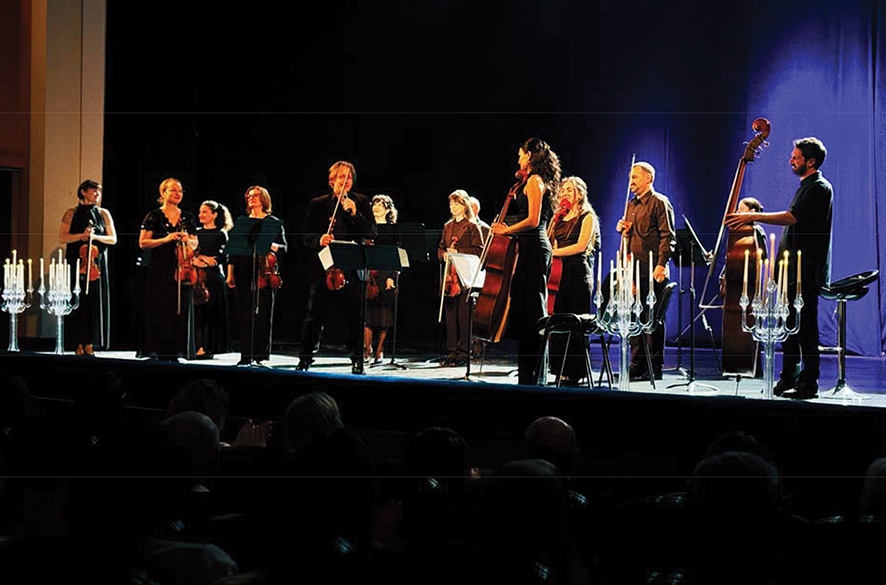
A Baroque evening in Tbilisi often arrives wrapped in expectation: balance, polish, a shared understanding of proportion. At the Griboedov Theater, Andrés Gabetta enters this field with Antonio Vivaldi as both material and method, shaping a program that treats familiarity as a site of pressure rather than reassurance.
From the first phrases of The Four Seasons, Gabetta establishes a tightly regulated sound world. Bow distribution becomes the central organizing principle: strokes remain economical, placed close to the string, with articulation carrying structural weight. In Spring, the opening ritornello unfolds with a near-geometric clarity. Phrasing aligns with harmonic rhythm, cadential points articulated through subtle agogic inflection rather than overt emphasis. The pastoral topic recedes, allowing the internal architecture of sequence and repetition to come forward.
Summer deepens this approach through compression. The first movement sustains a controlled density, where repeated-note figures accumulate tension through micro-variations in bow speed and contact point. The storm in the final movement grows from within the texture: rapid figurations maintain rhythmic discipline, while dynamic range remains contained, creating the sensation of pressure building inside a closed system. The result redirects attention from pictorial effect toward structural process.
Gabetta leads from the violin with a continuous exchange between solo line and ensemble. The orchestral fabric responds through finely calibrated entries, particularly in the lower strings, where harmonic grounding acquires a kinetic role. In the Concerto in B minor, RV 387, associated with the Ospedale della Pietà and the violinist Anna Maria, ornamentation functions as a generative layer. Embellishments extend beyond surface decoration; they participate in motivic development, often anticipating harmonic shifts or prolonging dissonances before resolution. Cadenzas emerge as localized expansions of the form, maintaining continuity with the surrounding material.
In Grosso Mogul, tempo becomes a flexible parameter. Gabetta introduces slight accelerations within sequential passages, creating a sense of forward propulsion that interacts with harmonic rhythm. Double-stops and bariolage passages receive a sharply profiled articulation, each string crossing clearly defined. The effect brings contrapuntal strands into sharper relief, revealing an internal dialogue within the solo part itself.
The inclusion of Henry Purcell’s Curtain Music frames the program through the lens of theatricality. Rhythmic gestures in Purcell carry a sense of address, a directed energy that moves outward. This quality extends into the Vivaldi performances, where phrase endings often retain a slight suspension, as if holding space for response. The rhetoric of Baroque music, its gestures, figures, and cadences, appears here as an active communicative system.
Throughout the evening, tuning and temperament play a subtle yet decisive role. Chordal sonorities reveal carefully balanced intervals, with thirds shaped to enhance resonance within the ensemble. Vibrato remains selective, applied as an expressive device at points of harmonic tension or melodic arrival. This restraint sharpens the profile of dissonance, allowing suspensions and appoggiaturas to register with greater clarity.
Gabetta offers a reading in which Vivaldi’s language operates through precision and internal energy, drawing focus toward the mechanics of its construction. The repertoire retains its recognizability while revealing a denser network of relationships within its surface.
Review by Ivan Nechaev