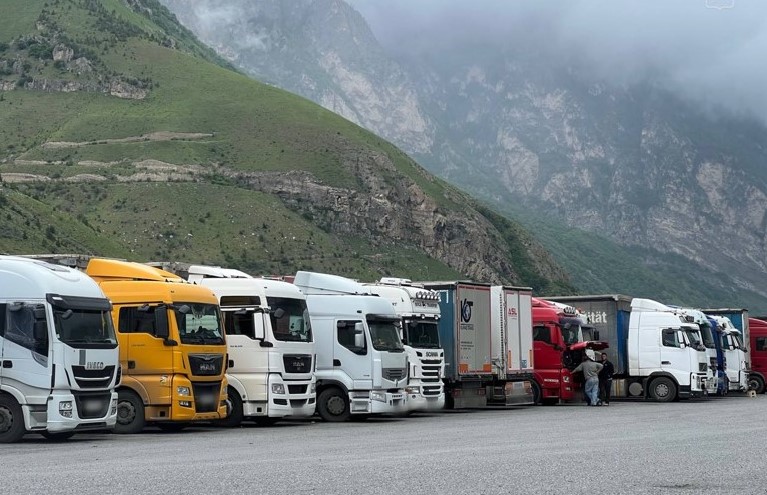
Prolonged paperwork procedures at the Upper Larsi border crossing are forcing Georgian truck drivers to rely on so-called intermediaries and pay unofficial fees, the Transport Corridor Research Center (TCRC) says.
The organisation says delays caused by Russian customs procedures are creating long queues and additional pressure on drivers, making the system vulnerable to informal payments.
Drivers reportedly wait 7–8 hours to reach the Russian border post after leaving the Kazbegi holding area, followed by another lengthy queue for document processing behind an iron fence.
TCRC says that after cargo checks and stamping of documents, drivers are then required to complete registration procedures that can take another 7–8 hours, worsening fatigue and operational costs.
In these conditions, many drivers opt to hand over documents to intermediaries who, the report states, coordinate with customs officials and charge around 5,000 rubles (about 180 GEL), up from a previous 3,000 rubles.
The centre says this creates an informal system that drivers are effectively forced into due to delays and exhaustion.
TCRC also cites International Road Transport Union Secretary General Humberto De Preto, who warns that without reducing border delays and administrative barriers, transport demand in the region could fall by up to 35% compared to projected growth by 2030.
He also notes that long border waiting times reduce the value of infrastructure investments, as trucks stuck for days at checkpoints face significant financial losses.
As a possible solution, TCRC suggests introducing a system where documents are submitted directly, drivers’ contact details are recorded, and completed paperwork is later returned without third-party involvement.
The organisation points to earlier Russian Customs steps, including free parking facilities near Vladikavkaz and electronic processing measures, saying similar improvements could be applied to document issuance procedures.
TCRC says improving the system is essential to strengthen the competitiveness of Georgian transport operators and protect drivers’ rights, and urges a structured review of the issue using existing communication channels with Russia.