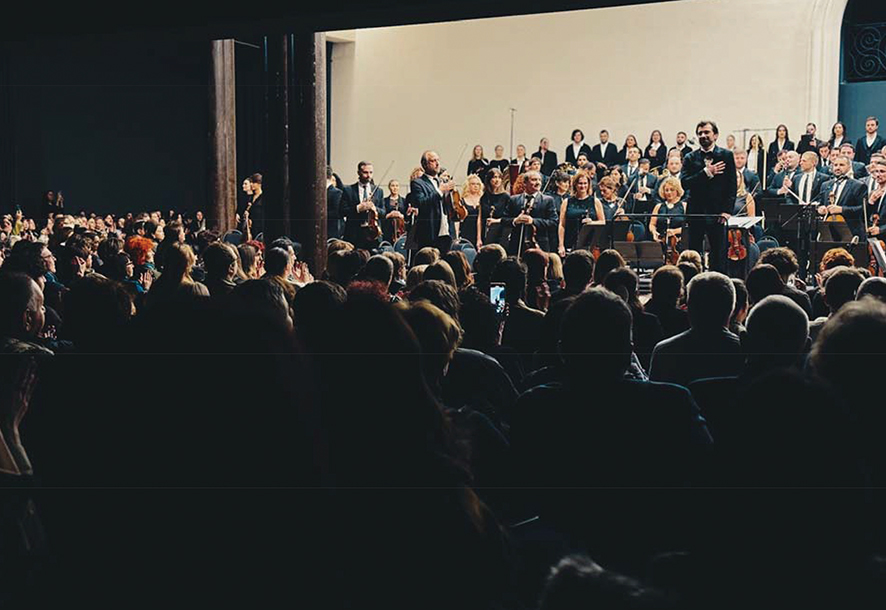
Tbilisi’s Philharmonic Auditorium shimmered with a rare energy on October 31— an evening that became both a centennial celebration and an act of collective transcendence. The Evgeni Mikeladze Georgian Philharmonic Orchestra, under the direction of Kakhi Solomnishvili, chose Gustav Mahler’s Symphony No. 2 in C minor, “Resurrection” for this monumental occasion. The choice embodied an idea of renewal through endurance, a concept deeply woven into both Georgian cultural memory and Mahler’s musical cosmology.
The centenary concert unfolded as a ritual of remembrance and reawakening. The stage, densely populated with the orchestra, mixed choir, and soloists Tamar Iano and Natalia Kutateladze, carried the weight of history. The name of Evgeni Mikeladze — conductor, visionary, and martyr of Stalinist terror — resonated like a silent invocation throughout the performance. His ghost seemed to hover above the ensemble, transforming the centennial from commemoration into resurrection itself.
From the first tremor of the low strings, Solomnishvili built Mahler’s vast architecture with precision and psychological insight. The opening movement unfolded like a vast mural — its tension gathering in concentric waves, each return of the funeral march transforming into a pulse of defiance. The orchestra’s sound had a sculptural density; the brass, especially the horns, projected both monumentality and dread, while the strings breathed in long, human phrases that seemed to remember something ancient.
Solomnishvili’s pacing was deliberate, avoiding grandiose gesture. The form itself became philosophical: Mahler’s struggle between mortality and transcendence was treated as a meditative process rather than a spectacle. Each movement accumulated a kind of metaphysical gravity. The Andante moderato, with its dance-like nostalgia, shimmered with a pastoral serenity — not as a retreat from suffering but as a reflection of interior peace.
The Scherzo, based on Mahler’s own song “Des Antonius von Padua Fischpredigt,” carried an almost grotesque energy, as if the orchestra embodied a world spinning within its own absurdity. The woodwinds’ articulation was sharply human, producing a kaleidoscope of timbres that mirrored the contradictions of existence.
The entrance of mezzo-soprano Natalia Kutateladze in “Urlicht” introduced an intimacy that pierced the symphonic monument. Her voice, warm and luminous, rose like a confession from the depths of human longing. Tamar Iano’s soprano in the final movement emerged as the counterpoint of celestial release — her tone radiant, unforced, with a purity that gave the illusion of timelessness.
The Mixed Choir, prepared by Omar Burduli, provided the foundation for the Resurrection’s culminating ascent. Their entrance — hushed, almost whispered — felt less like singing than collective breathing. The sound expanded organically, filling the Philharmonic Auditorium with a sonic architecture of light. When the full choir and orchestra joined in the final apotheosis, the experience transcended musical climax and entered the realm of social ritual.

Mahler’s Resurrection Symphony has long stood as one of Western music’s most charged meditations on spiritual rebirth. Within the Georgian context, its resonance deepened. The Philharmonic’s hundred-year history traces a path through the upheavals of Soviet repression, national redefinition, and cultural perseverance. In that sense, Mahler’s question — What comes after death? — became inseparable from Georgia’s own century-long dialogue with memory and identity.
The performance articulated a sociological truth: that music, as a shared form of emotion, creates continuity where history fractures. The audience, drawn from multiple generations, became participants in a living artwork that spoke about endurance and collective becoming.
By the time the final chord dissolved into silence, the concert hall felt transformed — less a venue than a chamber of reflection. The performance aligned the metaphysical with the civic, revealing how a symphony can function as both artwork and social gesture. The Philharmonic’s centennial evening became a declaration of vitality, an assertion that institutions grounded in art and memory continue to shape public consciousness.
Review by Ivan Nechaev