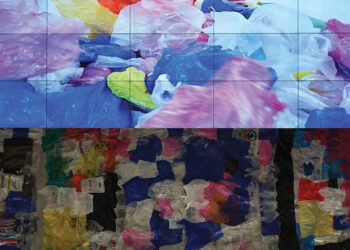
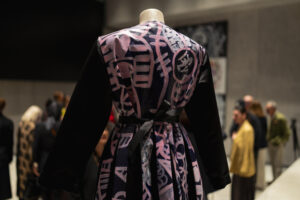
Art Foundation Anagi exhibition space is currently hosting Qi Qiao’s exhibition “Where the Gaze Begets the Spring”. In this exposition, the Chinese-born artist develops a poetic and introspective visual language shaped by the idea of the gaze – its capacity for perception, transformation, memory, and emotional transition.
Qi Qiao lives and works between France, Georgia, and China. This transnational rhythm has allowed her practice to evolve across multiple cultural contexts, where differing sensibilities influence her approach to image, space, and feeling.
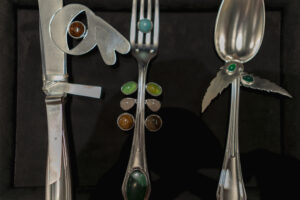
The exhibition also opens a collaborative dialogue with Georgian-French artist Irakli Nassidzé, whose applied works enter into conversation with Qi Qiao’s practice. Together, their distinct artistic languages intersect through a shared field of visual and conceptual exchange.
We spoke with Qi Qiao about her practice, her sources of inspiration, and how living and working across different cultural environments continues to shape her artistic expression.
How do you approach the idea of the gaze in this exhibition, and how does perception become a space for emotional or philosophical reflection?
The gaze is like an invisible form of writing – a quiet breath that touches the mind, passes through the soul, and stays in the body. In this exhibition, I see the gaze between the two artists becoming a kind of poetic force that slowly transforms how we see the world, almost like it opens into an inner spring.
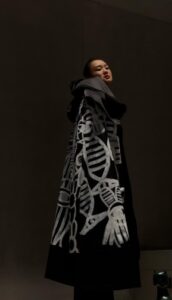
Your life moves between France, Georgia, and China. How do these different cultural environments shape the visual and conceptual direction of your work?
I try to gather the scattered beauty of the world in order to weave narratives that awaken dreams and open pathways toward the imagination.
The collaboration with Georgian-French artist Irakli Nassidzé brings together two distinct practices. How did this dialogue evolve, and what new perspectives emerged through it?
Irakli Nassidzé and I feel like two opposite poles drawn toward the same light. It’s exactly this difference between us that gives strength to what we create together. Even though we come from different cultures, we understand each other through the silence of the gaze, often before any words are spoken. He’s my alter ego, in everyday life as well as in our artistic journey.
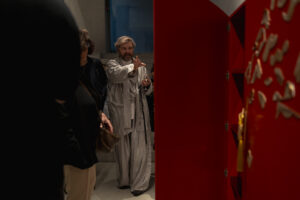
The exhibition moves between the visible and the intangible. How do you translate inner or emotional states into visual form?
The soul is intangible, but it carries living memory. It animates the spirit, guides the body, and shapes the way we live in the world. It is through the soul that our gaze toward reality is formed, slowly creating a visual language that feels sensitive, intimate, and internal.
How do you see this exhibition engaging with the context of contemporary Georgian art, and can transnational collaborations open new forms of dialogue here?
I see this exhibition as a very intimate visual dialogue, shaped by my different experiences and enriched by Georgian culture – a place along the ancient Silk Road, where cultures have long passed through and interwoven. Through this exhibition, we are weaving new invisible threads between Georgia, Asia, and Europe, creating new artistic constellations.
By GT Team