There are productions that reinterpret Shakespeare through contemporary imagery, and there are productions that use Shakespeare to expose the hidden mechanics of the present. David Doiashvili’s A Midsummer Night’s Dream at the Royal District Theater unmistakably belongs to the second category.
What initially appears to be another stylized Shakespeare adaptation gradually reveals itself as something much more structurally unsettling: a theatrical investigation into political hallucination, managed perception, and the unstable relationship between performance and reality in contemporary Georgia. And this becomes inseparable from the production’s historical context.
Because the “New Georgian Theater” announced alongside the premiere is not an abstract symbolic gesture. It emerges directly from institutional rupture and political conflict inside Georgian cultural life.
The troupe associated with the New Georgian Theater effectively lost its theatrical home after public tensions and protest actions connected to broader political processes in the country; actors openly participated in civic protest movements, and the collective itself entered a prolonged state of confrontation with institutional structures. One actor and activist connected to the broader protest context was imprisoned, becoming a traumatic symbolic figure for large parts of the artistic community.
This history fundamentally alters how the production operates. The performance is not “about” political crisis in any simplistic illustrative sense. Rather, political derealization becomes embedded into the production’s dramaturgical architecture itself.
Shakespeare After the Collapse of Shared Reality
Most modern stagings of A Midsummer Night’s Dream focus on erotic confusion, carnivalesque liberation, fluid identity, or dream logic. Doiashvili’s interpretation appears interested in something colder and more contemporary: the institutional production of illusion.
The production repeatedly returns to one central question: Where is truth spoken? Importantly, the question is spatial rather than moral. Truth does not disappear entirely. It becomes displaced between competing theatrical systems.
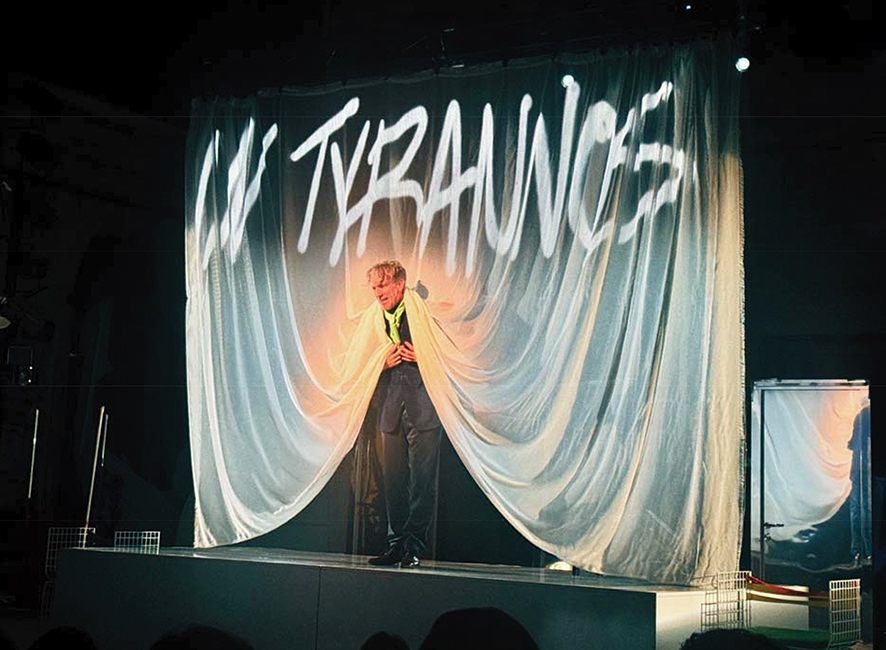
Inside the world of rulers, elites, and manipulated spectacle, theater becomes an instrument of controlled fantasy. Power manufactures perception. Emotional experience becomes choreographed. Desire becomes politically aestheticized. The “dream” ceases to function as poetic liberation and begins operating as ideological atmosphere.
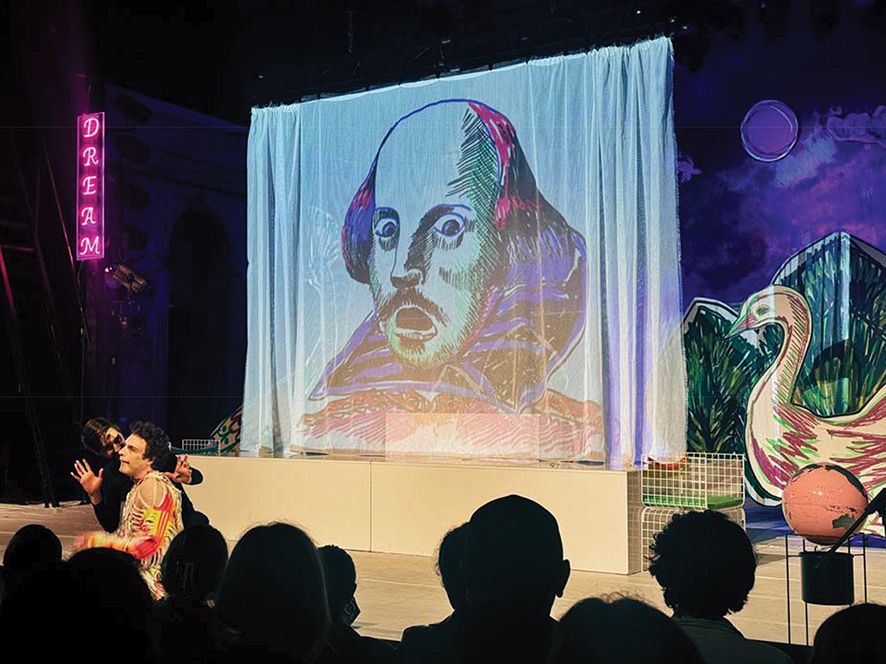
This is where Doiashvili’s production becomes genuinely sophisticated. Rather than simply modernizing Shakespeare politically, he appears to divide the play into competing ontological regimes. On one side: the dream-machine of authority. On the other: the crude, fragile, materially real theater of the mechanicals; the peasants, workers, amateur performers traditionally treated in Shakespeare as comic relief. And here the production makes its most radical intervention.
The Peasants as the Last Custodians of Reality
Historically, the mechanicals in A Midsummer Night’s Dream embody theater in its most primitive and transparent form. Their performances fail technically, their illusions collapse visibly, their acting is awkward, literal, and emotionally naïve. Precisely because of this, they often become the play’s most human figures. Doiashvili appears to recognize the enormous contemporary potential hidden inside this structure.
In his production, the world of official illusion increasingly resembles contemporary political media reality itself: emotionally manipulative, visually excessive, unstable, dreamlike, and ideologically managed. Meanwhile, the peasants’ theater repeatedly interrupts this hallucination through direct traces of actuality. Video footage from protests enters the stage space. Documentary fragments rupture theatrical continuity. Most devastatingly, the performance incorporates the final voice messages of an imprisoned colleague.
This changes the entire philosophical structure of the production. Reality no longer exists outside theater.
Reality survives only as interruption inside theater.
The peasants, traditionally positioned at the bottom of Shakespeare’s social hierarchy, become the only figures capable of reintroducing material truth into a system dominated by performed illusion. This inversion is extraordinarily intelligent because it preserves Shakespeare’s original theatrical mechanics while radically recontextualizing them.
The “bad actors” become ethically legible precisely because their theatricality remains incomplete. Their bodies resist seamless illusion. Their speech carries friction. Their presence preserves vulnerability. In a culture saturated with professionalized spectacle, imperfection suddenly becomes truthful.
Political Hallucination and the Georgian Present
The production’s real subject therefore is not fantasy, but derealization. Contemporary Georgian society increasingly exists inside overlapping aesthetic regimes: state spectacle, media dramaturgy, protest imagery, European symbolic aspiration, national mythologies, digital emotional performance, institutional instability.
Public life itself has become hyper-theatricalized. Under such conditions, Shakespeare’s forest acquires new meaning. It no longer functions merely as unconscious territory or erotic labyrinth. It becomes a perceptual zone where competing realities struggle for legitimacy. Doiashvili pushes this logic to its limit.
The dream-world of the production is not magical in a romantic sense. It resembles contemporary ideological atmosphere itself: seductive, unstable, emotionally overwhelming, visually immersive, and politically anesthetic. One no longer knows whether characters are dreaming reality or performing it. This is precisely why the documentary intrusions matter so profoundly. Protest footage and prison voice messages do not merely “reference politics.” They puncture the ontological membrane of the production.
For brief moments, theater loses control over illusion. And those moments become the production’s emotional center.
The work of scenographer Keti Nadibaidze becomes crucial within this framework. Doiashvili’s productions have long treated scenography less as visual environment than as psychological infrastructure. Space operates oppressively. Bodies become trapped inside visual systems larger than themselves. Excessive theatricality produces not liberation, but claustrophobia.
In A Midsummer Night’s Dream, this strategy acquires political dimensions. The forest appears less natural than algorithmic: an unstable immersive environment where emotional orientation continuously collapses. Characters move through sensory overload rather than pastoral mystery. Visual density itself becomes ideological. This aligns closely with the contemporary condition the production diagnoses: a society overwhelmed by competing performances of reality. The forest becomes informational space.
The Return of Theater as Risk
Perhaps the production’s greatest achievement lies in recovering theater’s dangerous function. Much contemporary political theater merely illustrates political positions already familiar to its audience.
Doiashvili avoids this trap almost entirely. He does not transform Shakespeare into direct protest theater. Instead, he interrogates the mechanisms through which reality itself becomes staged.
This is far more unsettling. Because the production ultimately suggests that modern political systems no longer function primarily through censorship or direct repression alone. They function through perceptual management. Through emotional choreography. Through immersive illusion. Through narrative saturation. Theater therefore becomes politically significant not when it delivers correct messages, but when it disrupts perceptual stability itself.
The inserted documentary fragments accomplish exactly this. They refuse smooth symbolic absorption. The imprisoned colleague’s voice cannot fully become theater. It remains stubbornly real. And precisely because of this, it destabilizes the entire performance machine surrounding it.
Most productions of A Midsummer Night’s Dream conclude by restoring harmony. Couples reconcile, hierarchies stabilize, performances conclude, dreams dissolve. Doiashvili’s conceptual framework seems to resist such closure entirely. Because contemporary derealization has no final awakening.
The production understands something fundamental about the present historical moment: people increasingly experience reality itself through layers of mediation so dense that direct experience becomes almost inaccessible. Politics becomes spectacle. Trauma becomes content. Protest becomes image circulation. Identity becomes performative maintenance.
Under these conditions, Shakespeare’s comedy mutates into something closer to ontological horror. Who controls the dream? Who authors perception? Which performances become socially recognized as reality? And what remains of truth after theatricality colonizes everyday life itself?
Inside the Royal District Theater, Doiashvili appears to answer with devastating precision: truth survives only in the moments when illusion fails.
Review by Ivan Nechaev