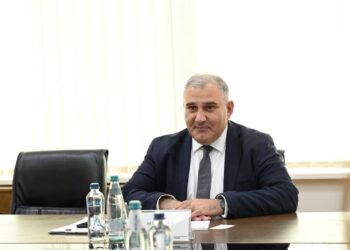
The Ministry of Internal Affairs is set to establish a new department tasked with what officials describe as “systematic monitoring” of communication in public space, focusing on alleged hate speech, offensive campaigns and aggressive content.
Mamuka Mdinaradze, State Minister for Coordination of Law Enforcement Agencies, said at a briefing at the Government Chancellery that the new unit had been agreed after consultations with the Ministry of Internal Affairs.
“A special department will be created in the Ministry of Internal Affairs as soon as possible,” Mdinaradze noted.
He added that the department’s main function would be the systematic monitoring of hate speech, offensive campaigns and aggressive communication in public spaces, as well as what he described as an appropriate legal response. Mdinaradze said this would include public posts, photos, captions and videos on social media.
Mdinaradze also said the unit would act proactively and would not rely solely on citizen complaints, adding that it would carry out its own monitoring, conduct legal assessments and, if necessary, refer cases to court.
Opposition figures and critics of the ruling Georgian Dream party say the move amounts to an attempt to restrict freedom of expression under the pretext of tackling hate speech.
Tamta Mikeladze, Equality Policy Program Director at the Social Justice Center, criticized the initiative, arguing that monitoring hate speech should be handled by human rights-oriented institutions rather than police structures.
“In democratic systems, monitoring hate speech is usually assigned to human rights-oriented institutions, not to police structures, because the involvement of the police in the sphere of expression always poses the risk of abuse of power and political control,” Mikeladze wrote on social media.
She also questioned the legal definition of “aggressive communication,” saying the term was vague and open to political interpretation.
“‘Aggressive communication’ is such a vague concept that it can be used against practically any critical, sharp, ironic or emotional political expression,” she stated. “Disciplining the language, emotions and political tone of citizens turns out to be something unthinkable. It is like creating a morality police.”
Mikeladze further claimed that monitoring functions previously associated with the State Security Service were now being expanded to the Ministry of Internal Affairs.
“It seems that the State Security Service’s resources are no longer enough, they are already listening to and monitoring so many people with new technologies, and they decided to drag the police into the surveillance field,” she alleged.
Mikeladze argued that surveillance in authoritarian systems serves not only as a security mechanism, but also as a tool for political and social control that encourages self-censorship among citizens.
“In the name of ‘public safety,’ ‘order,’ or ‘ethical communication,’ the state gradually encroaches on areas that should remain part of a free and pluralistic society,” she added.
Last year, Tbilisi City Court fined a number of citizens, including activists and journalists, over social media posts deemed offensive by high-ranking officials. Police had requested proceedings under Article 173, Part 16 of the Criminal Code, introduced on February 6, 2025, during a period of pro-European protests and heightened political tensions.