
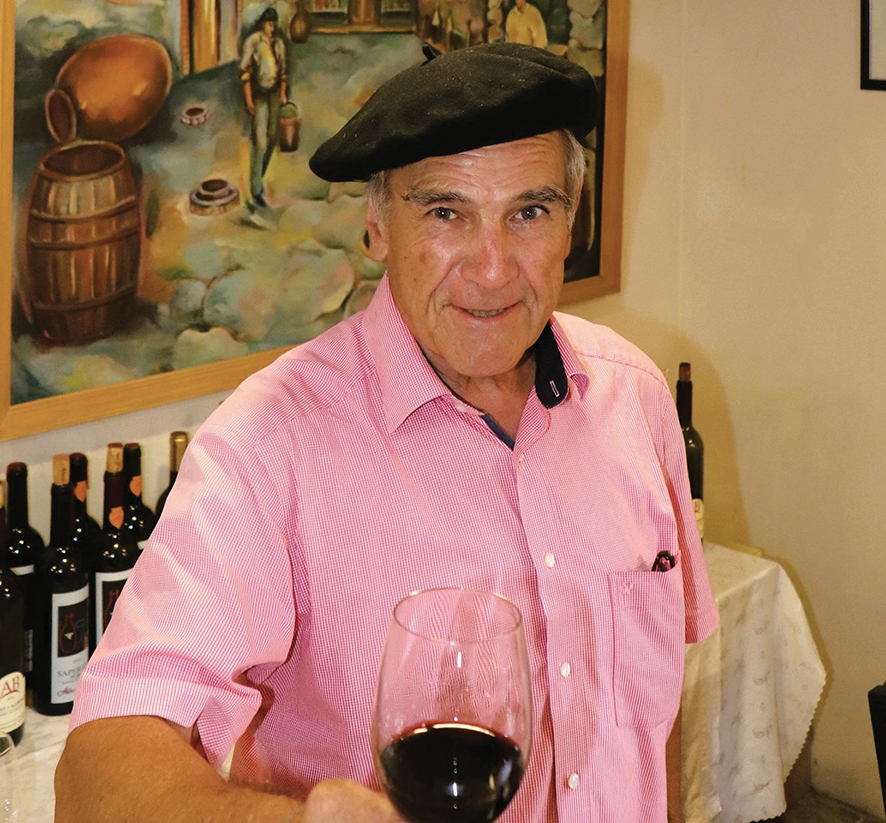
A Conversation with German Winemaker and Wine Expert Hilarius Pütz. Interview by Tatjana Montik.
Hilarius Pütz originally came to Georgia for what was supposed to be a six-month assignment. Years later, that temporary stay has evolved into a lifelong mission. Born and raised in Germany’s renowned Mosel wine region, the veteran winemaker has established his own vineyards in Georgia while dedicating himself to training young vintners, preserving rare indigenous grape varieties, and reviving the forgotten wine traditions of the former German settlements in the South Caucasus.
In this conversation, he explains why Georgia continues to inspire him, why he believes the country’s future lies in quality rather than quantity, and why patience remains a winemaker’s greatest virtue.
Mr. Pütz, you come from one of Germany’s most famous wine regions. How did you end up in Georgia?
I grew up in the Mosel Valley, surrounded by vineyards, and wine has been part of my life for as long as I can remember. I studied viticulture, managed several prestigious wineries in Germany, and at the same time cultivated my own vineyards. Back then, I could never have imagined living permanently anywhere else.
Shortly before coming to Georgia, however, I became seriously ill. No one knew whether I would ever fully recover. Together with my family, we decided to sell our vineyards in Germany. Soon afterward, I was offered a six-month contract in Georgia.
Those six months changed my life.
The longer I worked here, the more I realized the extraordinary potential of this country. I was fascinated by its indigenous grape varieties, its eight-thousand-year-old winemaking tradition, and the countless opportunities that were still waiting to be explored.
Six months gradually turned into many years.
And somewhere along the way, I forgot about my illness; or perhaps, as I like to say, my illness forgot about me.
Has your view of Georgia changed over the years?
Certainly. My relationship with Georgia is much more nuanced today than it was in the beginning.
I have met remarkable people here and truly enjoy working with them. At the same time, I have to admit that not all of my business experiences have been positive.
One difference I have noticed lies in the way people often think about time. Many understandably focus on short-term results and want to see quick returns on their investments. But great wine simply doesn’t work that way. If you want to produce truly exceptional wines, you have to think in decades rather than seasons.
I often tell young winemakers: You should still be able to look your customers in the eye ten years from now.
Trust cannot be built within a single vintage. It grows slowly, year after year.
Take Saperavi, for example. After four or five years of bottle ageing, a good wine can become an extraordinary one. Yet many producers feel compelled to sell it much earlier.
I choose a different path. I keep large quantities of wine in the cellar for years before releasing them. It ties up money, of course, but that is precisely how quality is created.
And I have seen customers who once switched to cheaper producers eventually return. They taste the difference.
You often speak about the tremendous potential of Georgian wine. What makes it so unique?
I firmly believe that, in terms of quality, Georgia has the potential to become one of the world’s greatest wine-producing countries.
It possesses a truly unique combination of ancient winemaking traditions, hundreds of indigenous grape varieties, and an extraordinary diversity of terroirs. Added to this is the traditional qvevri method: a winemaking technique that relies on minimal intervention and remarkably few additives. It is exactly the kind of authenticity that wine lovers around the world are looking for today.
Then there are the grapes themselves: Kisi, Khikhvi, Chinuri, and of course Saperavi. These are not international varieties found everywhere; they are grapes with their own distinct identity and character.
A German sommelier once told me, “When Saperavi is made really well, it can outperform any Bordeaux.”
Whether one agrees with that statement or not, it illustrates the growing respect that Georgia’s finest wines are earning on the international stage.
What does Georgia need to do to realize that potential?
Above all, it must commit itself wholeheartedly to quality. Georgia has around 45,000 hectares of vineyards. For a country with only a few million inhabitants, exporting wine is not a choice—it is a necessity. But on Western markets, Georgia cannot compete on price.
Most essential materials, machinery, bottles, corks, filters, and technical equipment, have to be imported. Shipping alone adds significant costs. As a result, Georgian wine will almost inevitably be more expensive than many competing products. That makes quality even more important. Every bottle must justify its price through excellence. This is precisely why I am so encouraged by the younger generation. Many young Georgians are eager to learn. They study viticulture in Germany, France, or Italy and then bring that knowledge back home. That gives me every reason to be optimistic.
For many years you have also been deeply involved in educating young Georgian winemakers. How did that begin?
When I first arrived in Georgia, I noticed that while university education in viticulture was solid, it was largely theoretical. Practical training opportunities were limited.
Together with the German development agency GIZ, we therefore helped establish a hands-on vocational training program based on the German dual education system.
Today, that three-year program has been running successfully for more than a decade.
At the same time, increasing numbers of young Georgians are studying viticulture abroad. Many come to me with questions, eager to understand how theoretical knowledge can be translated into practical experience. That is something I truly enjoy. I am deeply impressed by the openness of this younger generation. They are curious, eager to learn, and willing to embrace new ideas. I believe they represent the future of Georgian winemaking.
For many years you have been involved not only in winemaking but also in preserving the history of the former German settlements in Georgia. How did that come about?
For many years, I have maintained close ties with the descendants of the Caucasus Germans. Those relationships have led to a number of projects. At the moment, for example, we are supporting discussions about a town partnership between Bolnisi in Georgia and Neustadt in Germany.
But there is another project that is particularly close to my heart: reviving the wine heritage of the former German colonies in Georgia.
Few people realize that, alongside the traditional Georgian qvevri method and the modern European cellar techniques used today, there once existed a third style of winemaking: a unique Swabian-Georgian tradition.
What made this tradition unique?
When the first German settlers arrived in Georgia in the early nineteenth century, they found the local qvevri method unfamiliar. Fermenting wine in large clay vessels buried underground simply wasn’t part of their culture.
Instead, they built large oak barrels and fermented the wine in wood, combining their own winemaking knowledge with Georgian grape varieties and local growing conditions.
The result was an entirely distinctive style of winemaking.
Today, however, that tradition has been almost completely forgotten.
We are currently working to have this historical method officially recognized once again. At the same time, organizations such as Helvetas are supporting projects that train local winemakers and help revive this unique cultural heritage.
For me, this tradition is an integral part of Georgia’s history, and it deserves to be preserved.
Another major focus of your work is Asureti, formerly known as Katharinenfeld, where you have been reviving an almost forgotten grape variety called Schalltraube.
Yes, and Schall grape has a fascinating story. Only recently, descendants of the Schall family came to visit us.
According to everything we know today, a settler by the name of Schall once discovered a wild grapevine growing in the forest. He transplanted it, propagated it, and over time it evolved into a cultivated variety that became closely associated with Assureti. I find that story absolutely captivating.
Just a few days ago we planted another thousand vines of Schall grape. Our goal is not only to preserve this nearly forgotten piece of cultural heritage but also to give it a future.
What makes this grape so unusual?
The most remarkable thing is that Schalltraube is a female grape variety. Most grape varieties around the world are hermaphroditic: they pollinate themselves. Georgia, however, still preserves several ancient female varieties, and Schalltraube is one of them. That means it cannot grow alone. It must always be planted alongside pollinating varieties. In our vineyards, for example, we alternate rows of Schall grape with Chinuri to ensure proper pollination.
Details like these demonstrate just how extraordinary Georgia’s indigenous grape heritage really is.
Do you believe there is a market for wines made from Schalltraube?
Yes, but we have to take it one step at a time. Initially, we hope to reach the descendants of the former German settlers, many of whom feel a deep emotional connection to the history of their ancestors. In the long run, however, I would like Schall grape to become known far beyond that community. But one thing is absolutely essential.
The wine has to be outstanding. Only exceptional quality can establish such a rare variety on the international market. Fortunately, there are already several highly committed winemakers in Asureti and Bolnisi who are producing truly impressive wines from Schall grape.
That gives me great confidence for the future.
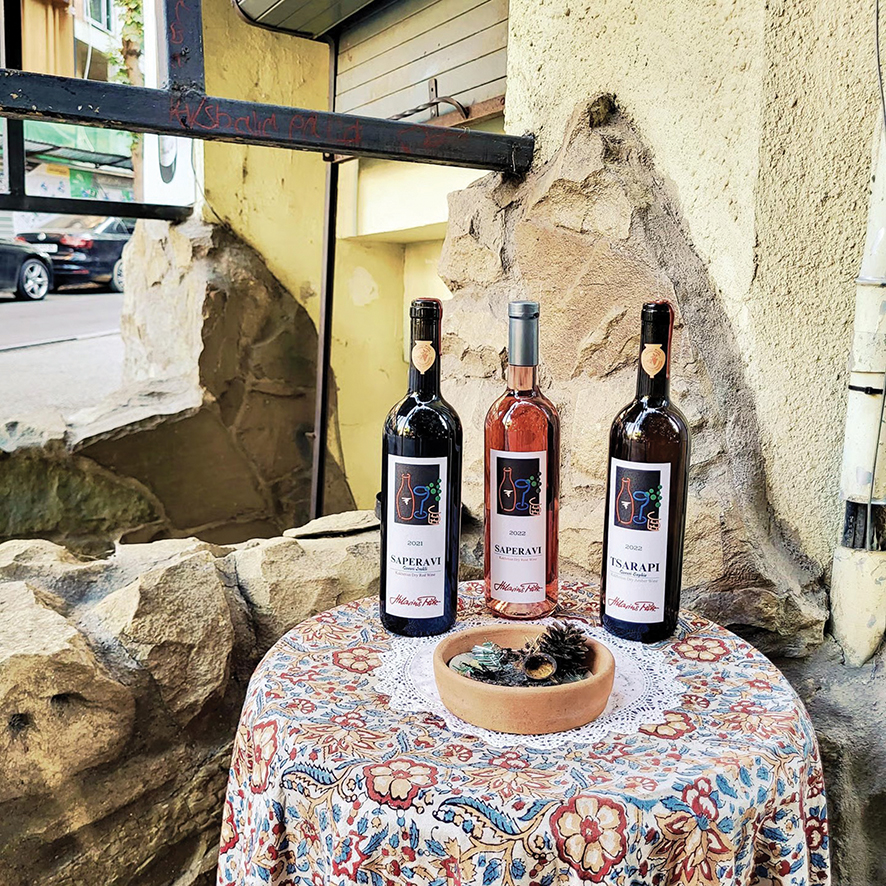
Outside the community of Caucasus Germans, very few people know this history. Do you regret that?
Yes, I do. Within the families of the former German settlers, the memory has survived from generation to generation. Beyond that circle, however, only a handful of people are aware of the important contribution these communities made to Georgian viticulture and craftsmanship. Places such as Bolnisi were major wine-producing centres for generations.
The settlers brought not only their technical skills but also a deep commitment to quality. I believe this story deserves to be told; not out of nostalgia, but because it illustrates how much can be achieved when different cultures learn from one another. That is exactly what we are trying to encourage today. Bringing people together. Sharing knowledge. And creating wines that are proud of their origins rather than trying to imitate someone else’s.
Listening to you, one gets the impression that you don’t simply produce wine: you work in partnership with nature.
That is exactly how I see it. Although I am not officially certified as an organic producer, I have followed ecological principles for many years. I don’t use mineral fertilizers or herbicides, and I avoid insecticides whenever possible. My goal is to preserve the natural balance of the vineyard. When biodiversity is healthy, nature takes care of much of the work itself. There are harmful insects, of course, but there are also the insects that prey on them.
The key is to observe nature rather than constantly trying to control it. Many challenges cannot be solved with chemicals. They require patience, careful observation, and a great deal of manual work.
How is climate change affecting your work?
It is changing viticulture everywhere, and Georgia is no exception. In recent years we have seen increasing damage from sunburn on the grapes. Many growers respond by installing irrigation systems. Personally, I don’t believe that is always the best solution. For me, everything begins with the soil.
Healthy soil, rich in organic matter, retains water far more effectively. That is why I devote so much attention to improving soil health and maintaining diverse ground cover in the vineyards. A living soil often protects the vines better than any technical solution ever could.
Today, I also teach seminars in Armenia on sustainable viticulture and vineyard cover-cropping systems. It is encouraging to see how interested younger winemakers are in these subjects.
You often speak about young winemakers. Why is education so important to you?
Because knowledge only survives when it is passed on. Over the years I have written several textbooks on viticulture and winemaking, combining modern scientific knowledge with the practical experience of older Georgian winemakers. Today many young Georgians use these books as part of their studies. I admit that makes me rather proud. But what matters even more to me is personal exchange. Young people ask questions. They want to understand. They are willing to experiment and to challenge established ideas. I find that incredibly inspiring.
It would be a great loss if the knowledge accumulated over decades simply disappeared with one generation.
Can great wine actually be learned from books?
The fundamentals—certainly. But every textbook has its limits. I remember a trainee from Switzerland who once laughed and said to me, “You explain everything according to the rules—and then you go into the vineyard and do something completely different.”
I laughed too. Then I told him, “First you need to learn the rules. Only after that comes experience.”You learn to see what a vine needs simply by looking at it. You learn to read the soil. You develop a sense of when a wine needs more time—and when it doesn’t. These are decisions that no textbook can ever fully teach. They come only through years of observation.
You deliberately seek out old vineyards. Why?
Old vines have always fascinated me. Their roots reach deep into the earth, drawing minerals that younger vines can never access. Their yields are lower—but to me, that is not a disadvantage. I am not interested in producing record harvests. I am interested in producing wines with character. In Kardanakhi, where I work, there are eleven different soil types within a remarkably small area. In theory, you could make eleven completely different wines from the very same grape variety. That is exactly what fascinates me. Every vineyard has its own personality. My task is to allow that personality to express itself. Every site tells its own story.
Is that your definition of terroir?
Absolutely. Many people focus on grape varieties. I prefer to talk about vineyards. The authenticity of a wine is not determined by the grape alone. It is created by the interaction of soil, microclimate, the age of the vines, and the vision of the person making the wine. That is also why I would never buy grapes from other growers. If a bottle bears my name, every grape in it should come from my own vineyards. Only then can I truly stand behind the wine.
Your customers seem to appreciate that philosophy.
They do, and I hear it surprisingly often. People write to me saying, “We can drink your wines and wake up the next morning feeling perfectly fine.” Naturally, I am pleased to hear that. But there is another compliment that means even more to me.
Sometimes people tell me, “The day you stop making this wine yourself, it will never be quite the same again.” For a winemaker, I can hardly imagine greater praise. Every wine should reflect the personality of the person who created it. You can produce technically flawless wine. Or you can make it with your heart. I believe people can taste the difference.
Georgia is widely regarded as the cradle of wine. Has living here changed your own understanding of winemaking?
Without question. When I first came to Georgia, I had to learn an entirely different philosophy of winemaking. The traditional qvevri method was something I had never encountered in Germany. At the beginning, I tried to learn from academics. But the most valuable lessons came from somewhere completely unexpected. I worked with a family whose grandfather had been a cellar master during the Soviet era. By then he was suffering from dementia, yet I took him with me into the vineyards whenever I could.
There were days when, for two or three hours, everything suddenly became crystal clear to him. During those moments he would talk about the old Georgian grape varieties, about harvest timing, about reading the vines, about details that have never found their way into textbooks. I learned more from that old man than I ever did in some lecture halls.
Perhaps that is the greatest beauty of winemaking. Knowledge only survives when one generation is willing to pass it on to the next.
You often describe Georgia as a unique wine country. What makes it so special?
It is not only the grape varieties. It is history itself. Wine has been made here for around eight thousand years. Archaeologists have discovered grape seeds inside ancient qvevri fragments that have been scientifically dated to that remarkable age.
That is why I like to call the South Caucasus the birthplace of wine. Since 2013, Georgia’s traditional qvevri winemaking method has been included on UNESCO’s Representative List of the Intangible Cultural Heritage of Humanity. That recognition attracted worldwide attention.
What fascinates me most, however, is how natural the process remains.The grapes are pressed, the juice and skins are placed together into the qvevri, fermentation begins naturally, and the wine remains on its skins for months. No cultured yeasts. No fining agents. Hardly any intervention at all. It is an ancient method. And perhaps because it is so ancient, it feels surprisingly modern today. At a time when consumers increasingly seek authenticity and minimal intervention, Georgia possesses something the rest of the wine world cannot simply recreate.
Yet at the same time, you enjoy experimenting. One of your most unusual projects is a Blanc de Noirs made from Saperavi. How did that idea emerge?
In Georgia, people traditionally don’t even speak of “red wine.” They call it shavi ghvino—”black wine.” Saperavi is one of the world’s most deeply pigmented grape varieties. Making a white wine from it seemed almost impossible. Which, of course, made me want to try.
Every single grape had to be handled with extraordinary care to prevent the pigments in the skins from colouring the juice. It was painstaking manual work. In the end, we produced what was probably Georgia’s first Blanc de Noirs made from Saperavi.
From a commercial perspective, it makes very little sense. If I calculated the production costs honestly, every bottle would have to be considerably more expensive. But not every idea begins with economics. Some ideas simply refuse to let go of you. And when I watch people taste this wine for the first time—the surprise on their faces, followed by genuine delight—I know every hour of work was worthwhile.
You regularly welcome visitors from all over the world. What do these encounters mean to you?
A great deal. Wine and tourism belong together in Georgia. Many visitors arrive knowing almost nothing about Georgian wine. Only when they walk through the vineyards, meet the winemakers, and taste the wines where they are made do they begin to understand this country. That is why I love hosting tastings. Guests come from Germany, Switzerland, Austria, Poland, Denmark, the Baltic States, and many other countries.
We taste wines together. We talk about grape varieties, landscapes, history, and culture. Often those conversations become just as important as the wine itself. People don’t simply take bottles home with them. They take home memories.
Even after all these years, your enthusiasm seems undiminished. What continues to inspire you?
Passion. I simply cannot imagine my life without vineyards. Every morning, when I walk among the vines, I discover something new. No two vintages are ever the same. Every harvest tells its own story. And when I see that people genuinely enjoy the wines we have created, that is the greatest reward I could ask for. Many people see wine as a product. I see it as the result of time, patience, experience, and respect for nature. Perhaps that is why I have never seriously thought about stopping. There are still countless stories waiting to be discovered in Georgia’s vineyards. I only hope that the next generation will continue telling them.
Interview by Tatjana Montik
Tatjana Montik, journalist, author, and passionate admirer of Georgia, has spent the past 15 years living in and reporting on this captivating South Caucasus country. See more of her experiences in her new travel diary and cultural guide, Georgia: A Tapestry of Time and Space.









