The European Union has upgraded the Black Sea Submarine Cable project, granting it “Project of Mutual Interest” (PMI) status under its latest cross-border energy framework. The move, coordinated by the European Commission and backed by the European Parliament and the Council of the European Union, is expected to unlock funding, accelerate permitting, and give the project stronger political support across the participating countries.
The cable is part of a wider list of 235 priority energy infrastructure projects aimed at strengthening connections between European power systems, reducing dependence on single suppliers, and expanding access to cleaner electricity. The push has taken on added urgency since the Russian invasion of Ukraine forced a rethink of Europe’s energy security and supply routes.
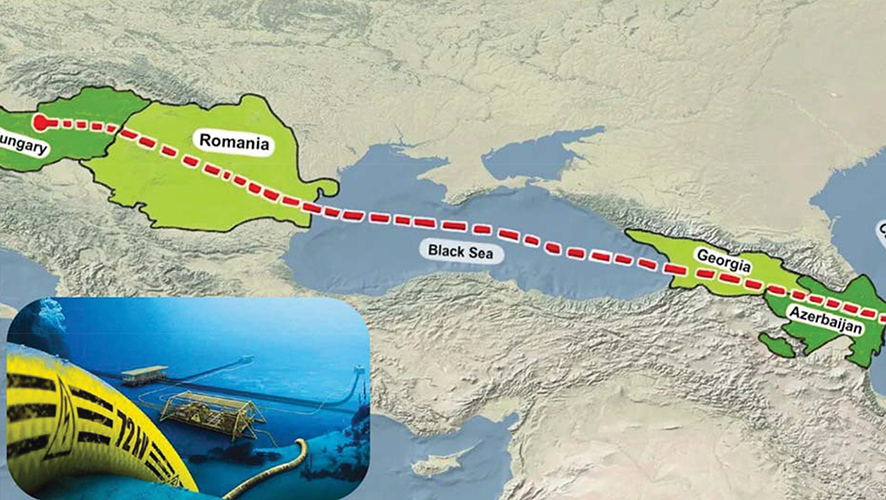
At the center of the project is a high-voltage direct current cable stretching roughly 1,155 kilometers between Anaklia in Georgia and Constanta in Romania. With a planned capacity of up to 1,300 megawatts, it would be capable of transmitting electricity on the scale of a mid-sized power plant.
Most of the route will run beneath the Black Sea, making it one of the longest subsea electricity interconnectors currently under development. The use of HVDC technology allows power to travel long distances with lower losses, and enables the connection of different grid systems that do not operate in sync.
In practical terms, the link would allow electricity generated in Georgia and the wider South Caucasus, particularly from hydropower, wind, and solar, to flow directly into the European market.
Current cost estimates range between €2.5 billion and €3.5 billion, depending on final engineering decisions, seabed conditions, and converter station design. The PMI designation makes the project eligible for EU financial support through instruments such as the Connecting Europe Facility, which has historically covered between 30 and 50 percent of costs for priority interconnection projects.
Additional financing is expected from international financial institutions, export credit agencies, and private investors. While early interest has been reported, final commitments will depend on regulatory clarity and the structure agreed between participating countries.
The project fits into the EU’s effort to diversify energy supply and expand electricity imports from neighboring regions with strong renewable potential. Since 2022, the EU has accelerated plans to reduce reliance on Russian fossil fuels while building out cross-border electricity infrastructure.
By creating a direct link to the South Caucasus, the Black Sea cable would open a new corridor for low-carbon electricity, complementing existing interconnections within Southeast Europe and supporting the EU’s long-term decarbonization goals.
Concerns about Georgia’s internal infrastructure remain central to the discussion. Giorgi Margebadze, head of the Small and Medium Hydropower Plants Association, pointed to the limits of the current system.
“The grid is old and overloaded. This has become the main bottleneck in almost every region and village,” he said in January.
He also emphasized the scale of untapped potential. “Georgia’s renewable energy resources are significant. We are talking about roughly 50 billion kilowatt-hours annually. The challenge is not generation: it is getting that electricity where it needs to go.”
From the government side, Deputy Economy Minister Inga Pkhaladze framed the cable as part of a broader strategic shift.
“This is a new European destination for Georgia’s energy sector,” she said in December 2025. “Closer alignment with European rules should make investment and approvals more predictable going forward.”
Although the cable physically connects Georgia and Romania, it is structured as a multinational initiative involving Georgia, Romania, Azerbaijan, and Hungary. That reflects its bigger purpose, which is to create a regional electricity corridor rather than a simple point-to-point connection.
Azerbaijan could contribute additional renewable electricity, particularly from planned wind projects in the Caspian Sea. Hungary’s participation highlights demand further within Europe, where countries are looking to diversify supply sources and strengthen grid resilience.
Georgia’s renewable energy potential is widely seen as one of its biggest economic opportunities, but infrastructure remains a limiting factor. Much of the transmission network was built decades ago and was not designed for large-scale exports.
This has already led to situations where fully financed renewable projects are delayed because the grid cannot handle additional capacity. Without significant upgrades, the country risks falling short of its export ambitions.
In 2025, Georgia also experienced periods when electricity demand exceeded domestic production, leading to imports during peak seasons. That gap shows the need for both expanded generation and stronger transmission infrastructure.
Feasibility studies have confirmed that the Black Sea Submarine Cable is technically and economically viable. The project has now moved into a more detailed preparation phase, including seabed mapping, environmental and social impact assessments, and early engineering design work.
These steps are complex and can take several years, particularly given the depth and geological variability of the Black Sea.
While the PMI designation does not guarantee construction, it does materially improve the project’s chances of moving forward. It prioritizes the cable within EU planning frameworks, streamlines cross-border permitting, and opens access to funding mechanisms.
It also sends a signal to investors that the project has strong political backing at the European level.
Several key steps still need to fall into place. Financing must be finalized, technical designs refined, and Georgia’s internal grid upgraded to handle future electricity flows.
If those pieces come together, the Black Sea Submarine Cable could become one of the most significant new energy links between Europe and the South Caucasus. It would establish a long-term route for renewable electricity trade across the Black Sea and strengthen Europe’s transition toward a more interconnected, resilient, and low-carbon energy system.
By Team GT