Museums have long been designed to neutralize uncertainty. Their architecture promises orientation; their collections establish historical continuity; their display strategies produce clarity. Even the celebrated “white cube” functions less as an aesthetic choice than as an ideological device, isolating artworks from the instability of everyday life and presenting them as autonomous objects available for contemplation.
Tolia Astakhishvili’s Figure of the Child at Vienna’s mumok systematically dismantles that model.
Occupying two underground floors of Austria’s leading museum of modern and contemporary art, the exhibition does not merely install artworks inside an institutional framework. Instead, it transforms the museum itself into an unstable material whose architecture, circulation and historical authority become part of the artistic proposition. Rather than presenting discrete objects, Astakhishvili constructs a continuously shifting ecology of spaces in which sculpture, drawing, photography, architectural intervention, sound and museum history become impossible to separate.
Over the past two decades, immersive installation has become one of the dominant formats of contemporary exhibition-making. Yet immersion has increasingly drifted toward spectacle. Visitors are expected to enter visually overwhelming environments that privilege sensory impact over sustained reflection. Astakhishvili proposes an entirely different model. Her installations are not immersive because they surround the viewer; they are immersive because they destabilize the mechanisms through which perception itself is organized.
Nothing in Figure of the Child behaves according to conventional museum logic. Temporary partitions interrupt architectural continuity. Corridors narrow unexpectedly before opening into larger chambers. Mirrors dissolve the distinction between actual and reflected space. Fragments of domestic interiors coexist with industrial materials, suspended textiles, found objects, drawings and photographs. The exhibition continuously produces situations in which orientation must be reconstructed rather than assumed. What appears initially as fragmentation gradually reveals itself as a carefully calibrated spatial syntax.

Astakhishvili has consistently rejected the modernist understanding of sculpture as a self-contained object. Instead, her practice belongs to a broader lineage of artists who have treated architecture as both subject and medium: from Gordon Matta-Clark’s physical interventions into buildings to the total environments of Ilya and Emilia Kabakov. Yet these comparisons only partially explain her achievement.
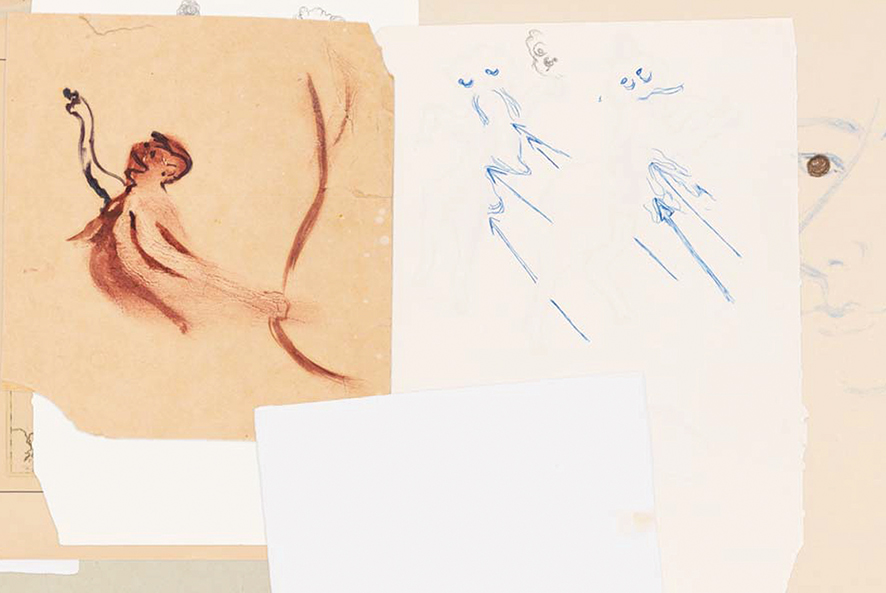
Unlike Matta-Clark, she rarely performs acts of architectural violence. Unlike Kabakov, she avoids narrative allegory. Unlike installation artists who construct fictional worlds, Astakhishvili refuses theatrical closure altogether. Her spaces remain provisional, occupied by traces rather than stories. Objects appear less as symbols than as evidence: evidence of habitation, repair, abandonment, care, maintenance and continuous transformation.
This attention to material residue may constitute the exhibition’s most significant contribution to contemporary installation practice. Rather than celebrating ruin, a tendency that has become almost conventional within post-industrial aesthetics, Astakhishvili investigates incompletion. Her walls are neither finished nor destroyed. Surfaces carry marks of previous interventions without becoming archaeological relics. The exhibition therefore resists both nostalgia and monumentality. It operates within an aesthetic of permanent revision, where construction and dismantling coexist.
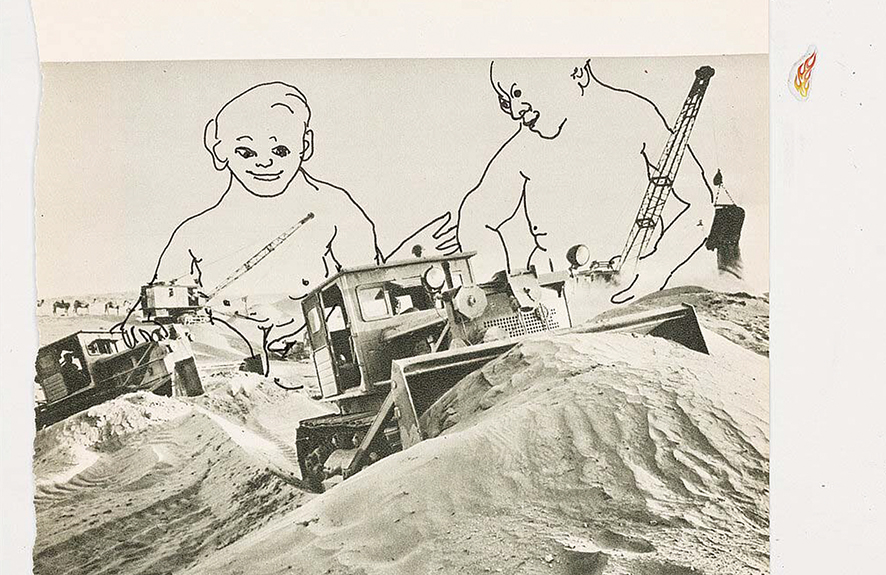
The title Figure of the Child reinforces this logic. Importantly, the child should not be understood as a biographical or psychological motif. Instead, it functions as an epistemological position. Childhood represents a mode of perception preceding certainty, when spatial relationships have not yet become habitual and every environment requires active negotiation. The exhibition repeatedly returns visitors to this condition, replacing recognition with orientation, certainty with exploration.

Unlike many contemporary exhibitions that reward rapid visual consumption, Figure of the Child unfolds through duration. Meaning accumulates slowly as visitors repeatedly encounter recurring materials, altered perspectives and unexpected relationships between museum architecture and inserted structures. One does not simply look at the exhibition; one gradually learns its grammar.
Equally significant is Astakhishvili’s dialogue with mumok’s permanent collection. Rather than treating canonical works as historical anchors, she incorporates paintings, sculptures and installations by artists including Pablo Picasso, James Ensor, Medardo Rosso, Nan Goldin, Louise Lawler, Charlotte Posenenske, Vito Acconci and Nam June Paik into her own spatial composition. These works remain recognisable, yet their institutional authority is subtly displaced. Art history no longer appears as a linear sequence of masterpieces but as an active participant within an unfinished architectural environment.

Such a strategy also challenges conventional curatorial hierarchies. Instead of separating contemporary intervention from historical collection, Astakhishvili produces what might be described as a horizontal field of artistic coexistence. Historical works neither dominate nor illustrate the exhibition. They circulate within it.
This curatorial intelligence extends beyond the exhibition itself. Before the official opening, mumok devoted several weeks to Tolia Curriculum, an experimental public program that exposed the normally invisible processes of installation, discussion and collective production. In doing so, the museum temporarily abandoned one of its defining characteristics: the presentation of completed cultural objects. Process itself became exhibition.
Although Astakhishvili’s biography is rooted in Georgia and Berlin, her work deliberately resists simplistic readings through national identity or post-Soviet experience alone. Instead, she identifies a condition increasingly shared across contemporary Europe: cities permanently under renovation, temporary architectures, unstable housing, migration, displacement and infrastructures that never quite reach completion. Her installations therefore function less as representations of particular places than as spatial models of contemporary life itself.

There is also an important institutional dimension to this exhibition. By granting Astakhishvili unprecedented freedom to transform two entire floors of the museum, including works from its own internationally significant collection, mumok demonstrates a willingness to question the neutrality of its own architecture. Few museums are prepared to surrender so much curatorial control. The result is not simply an exhibition hosted by mumok but a temporary redefinition of what the museum can become.
For that reason, Figure of the Child should not primarily be discussed as a successful installation. Its real achievement lies elsewhere. It proposes an alternative understanding of the museum, not as a place that stabilizes history, but as a space capable of producing uncertainty, negotiation and intellectual risk.
In an era when museums increasingly compete through spectacle, accessibility and digital visibility, Astakhishvili reminds us that contemporary art retains another possibility altogether: it can still make perception itself unstable. That is a far more radical gesture than creating another immersive environment. It is, perhaps, one of the most compelling arguments for the continuing relevance of the museum in the twenty-first century.
Review by Ivan Nechaev