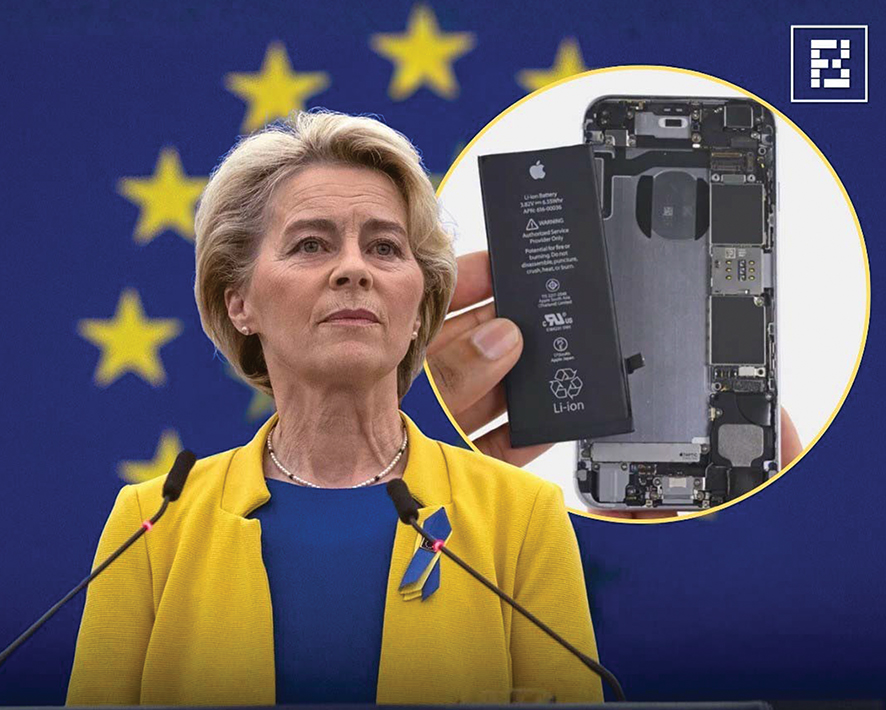
For years, most smartphones have followed the same design logic: streamlined, sealed, and difficult to fix. If your battery starts dying quickly or your screen gets cracked, the usual answer isn’t a DIY repair: it’s either an expensive service center visit or a full replacement.
That wasn’t always the case. Back in the 1990s and early 2000s, mobile phones were built with removable batteries and user-accessible parts, but over time the industry moved toward sealed designs in the name of thinness, water resistance, and manufacturing efficiency.
That approach might be starting to change, at least in Europe.
Between 2025 and 2027, the European Union is introducing new rules that aim to make smartphones last longer and be easier to repair. On paper, it sounds technical; in practice, it could change how phones are designed everywhere.
The changes starting in 2025
From June 2025, new EU ecodesign rules started to be applied to smartphones and tablets sold in the region.
The main idea is to reduce electronic waste and make devices more durable over time. Some of the key requirements are that:
• Batteries must stay in good condition longer, retaining about 80% capacity after 800 charge cycles;
• Phones must be more resistant to damage like drops and scratches;
• Manufacturers must provide software updates for several years after release;
• Spare parts must remain available for years after a product stops being sold;
• Replacement parts should be delivered fairly quickly, within 5–10 working days.
There’s also pressure on companies to provide repair information more openly, especially to professional repair shops.
2027: batteries become the big headline
The latest change in the news comes from the EU Battery Regulation, which will take full effect in 2027.
From that point, smartphones sold in the EU are expected to be designed so that users can replace the battery themselves using basic tools.
This is a big shift from current smartphone design, where batteries are often glued in and not meant to be touched by users.
It doesn’t necessarily mean every phone will become easy to open, but it does suggest the end of fully sealed battery systems as the standard design.

Repair: easier, but not completely open
One thing worth clarifying is that this isn’t a full “repair freedom” policy.
Manufacturers will still control a lot of the system, including how spare parts are supplied, whether certain components are paired with software systems, and how repair tools and instructions are distributed.
So while repair becomes more possible, it’s not completely unrestricted.
It’s more accurate to say the EU is forcing companies to make repair feasible, rather than fully open-ended.
Behind the scenes: a bigger shift for manufacturers
The bigger impact might actually be on the companies themselves.
If phones are expected to last longer and be repairable, that changes how everything is organized.
Companies need to store spare parts for years, supply chains have to stay active for longer product cycles, devices may need to be designed in a more modular way, and software support has to last longer than it used to.
In other words, smartphones stop being short-term products and start becoming long-term commitments.
Will this affect the rest of the world?
Even though these rules only apply in the EU, they probably won’t stay contained there.
Most smartphone companies design one global product line. It’s expensive to build completely different versions for different regions, so changes in Europe often end up influencing global designs.
A good example is the shift to USB-C charging, which became standard across many phones after EU pressure, including in the Apple iPhone 15 lineup.
Because of that, it wouldn’t be surprising if more repairable batteries and longer-lasting devices slowly become the norm worldwide.
So what’s actually changing?
At a basic level, the direction is pretty clear: smartphones are being pushed away from being disposable upgrades every couple of years.
Instead, they’re moving toward something closer to long-term devices that are meant to be repaired, maintained, and kept for longer.
It’s not a sudden change, and it won’t happen overnight. But if these rules work the way the EU expects, the idea of a completely sealed smartphone might soon start to feel outdated.
By Team GT