By the time Masurca Fogo premiered in Wuppertal in April 1998, Pina Bausch had already transformed contemporary performance beyond recognition. The revolution had happened years earlier. Dance could no longer pretend to be merely about movement, theater could no longer rely on text alone, and choreography had become something infinitely more elusive than the organization of bodies in space. Bausch had dismantled the grammar of both ballet and dramatic theater so completely that Masurca Fogo arrived not as an act of rupture, but as the mature expression of an artistic language that no one else has been able to inherit in full.
That language finally reached Georgia this July. The closing performances of the seventh Tbilisi International Ballet Festival introduced Georgian audiences to Tanztheater Wuppertal for the first time: an absence that, in retrospect, feels almost impossible to explain. Few companies have exerted such influence over contemporary performance, and few artists have been so thoroughly quoted, appropriated, simplified and misunderstood. Nearly every choreographer working today carries traces of Pina Bausch, whether consciously or not. Yet imitation has often reduced her work to visual vocabulary: rows of chairs, repetitive gestures, emotional intensity, bodies exposed to exhaustion. What rarely survives is the architecture beneath those images. Masurca Fogo offers perhaps the clearest demonstration of what that architecture actually is.
The piece belongs to Bausch’s celebrated cycle of works developed after long creative residencies across the world: Palermo, Hong Kong, Istanbul, Budapest, Seoul, Lisbon, Santiago, Tokyo. These productions are frequently described as “travel pieces,” a phrase that misses almost everything essential about them. They are not portraits of cities, nor ethnographic observations translated into choreography. Bausch never attempted cultural representation. She collected atmospheres.
The process itself has become almost legendary. The company would spend weeks wandering through unfamiliar places with no intention of researching history in any academic sense. Dancers visited cafés, beaches, parks, markets, restaurants, abandoned streets. They watched strangers. They listened. They accumulated fragments without knowing whether any of them would eventually matter. Back in Wuppertal, Bausch asked questions rather than gave instructions. What frightened you? What surprised you? What stayed in your memory? Show me. Not through explanation, but through action.
This method is remarkably close to anthropology, although without anthropology’s desire to classify. It resembles documentary filmmaking, although without documentary’s faith in evidence. The resulting works occupy a strange territory between memory and invention. Places disappear as geography and re-emerge as emotional landscapes.
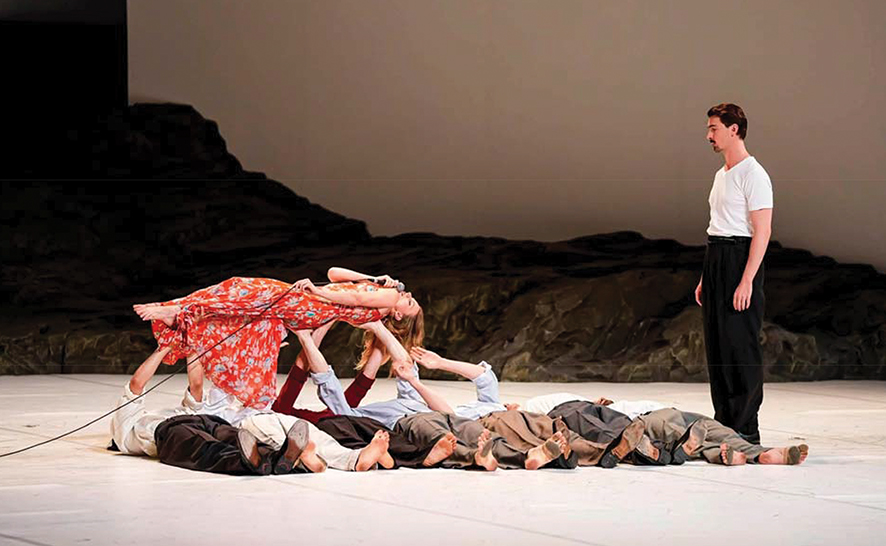
Portugal, therefore, is everywhere in Masurca Fogo, and nowhere at all. The Lisbon that appears on stage is not the Lisbon of monuments or political history. It is a city dissolved into sensation: dazzling white light that erases contours; sudden rain; music drifting from an unseen source; afternoons that seem immune to urgency; public squares where people remain together without speaking; the perpetual awareness of the sea just beyond vision. None of these images claim authenticity. Their truth lies elsewhere. They belong to memory after memory has already begun transforming experience into fiction.
This refusal to illustrate reality explains why Bausch’s work has resisted ageing far more successfully than many overtly political performances from the same period. theater built around topical commentary inevitably waits for history to move beyond it. Bausch pursued another ambition. She searched for structures of feeling. Nothing is fully articulated; everything is immediately recognizable.
Watching the performance means gradually abandoning the habits conventional theater has taught us. Narrative becomes irrelevant within minutes. Questions about character, motivation or causality simply lose their function. The temptation to decode individual scenes eventually gives way to another form of attention altogether. Images begin operating the way memories operate—through association rather than logic.
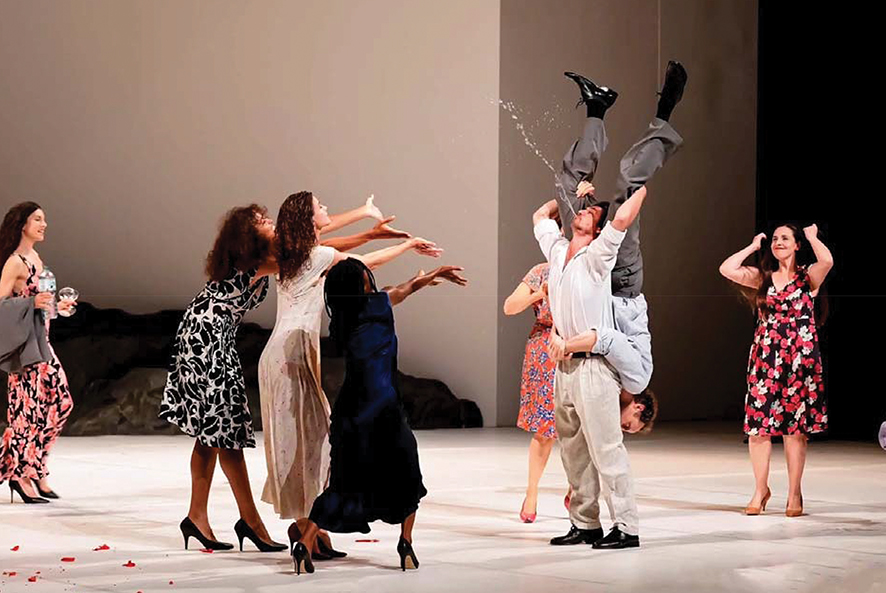
A woman repeatedly crosses the stage. Someone laughs at the wrong moment. Two people embrace for slightly too long. A body collapses, then rises again as though nothing extraordinary has happened. Water appears. Silence interrupts celebration. Nothing concludes. Everything returns. One could describe these moments endlessly without ever approaching what actually happens in the theater.
The remarkable achievement of Masurca Fogo lies precisely here. Bausch discovered a theatrical form capable of producing meaning without depending upon interpretation. The spectator does not solve the performance. The performance gradually reorganizes the spectator’s own emotional rhythms.
This is where her work departs decisively from expressionism, despite frequent attempts to place her within that lineage. Expressionism externalized inner psychology. Bausch rarely appears interested in psychology at all. Her performers do not represent interior states. They exist as presences continually negotiating the fragile distance separating one body from another.
Much has been written about loneliness in Bausch, although loneliness is perhaps the wrong word. Isolation suggests absence. Masurca Fogo is crowded from beginning to end. The stage constantly fills with encounters, games, celebrations, flirtations, collective rituals. Yet every act of intimacy remains delicately unstable. Human connection appears not as achievement but as continuous labour.
That understanding feels surprisingly contemporary. The late twentieth century imagined globalization as an expansion of encounters. Cultures would travel. Borders would soften. Curiosity would replace suspicion. Masurca Fogo, commissioned with the support of EXPO ’98 Lisbon and the Goethe-Institut, emerged directly from that historical optimism.
Seen today, the production has acquired another layer neither Bausch nor anyone else could have anticipated. Travel has become frictionless while genuine encounter has become increasingly rare. Cities begin resembling one another. Algorithms recommend identical cafés, identical museums, identical photographs. Tourism often consumes difference faster than it experiences it.
Bausch imagined something radically slower. Her choreography insists that discovery begins not with movement across geography but with sustained attention. Travel becomes an ethical practice of observation rather than acquisition. Perhaps this explains why Masurca Fogo continues feeling unexpectedly fresh. It belongs to a world that no longer exists while proposing a way of looking that has never been more necessary.
There is another misconception surrounding Bausch that the Tbilisi performances quietly dismantled. Her reputation remains inseparable from melancholy. Photographs reinforce the myth: solemn faces, empty chairs, dark dresses, impossible longing. Yet spending an evening with Masurca Fogo reveals something closer to generosity than sadness. Humor occupies an astonishing amount of space. People become ridiculous because people are ridiculous. Courtship fails. Confidence collapses. Bodies refuse elegance. Dignity survives humiliation through persistence rather than triumph.
Few directors understood laughter as profoundly as Bausch. Comedy, in her theater, is never positioned against suffering. It emerges from exactly the same source. The audience laughs because recognition arrives before judgement.
Peter Pabst’s stage design shares this extraordinary restraint. His scenography has always rejected spectacular illusion in favor of environments that appear simultaneously concrete and impossible. Like memory itself, they refuse stable perspective. Marion Cito’s costumes accomplish something equally rare. They resist symbolism. Clothing remains clothing, carrying traces of personality without reducing anyone to character.
Music drifts through the evening as though carried by weather rather than dramaturgy. Amália Rodrigues, Duke Ellington, Ben Webster, Baden Powell, Lisa Ekdahl, Marcos Suzano and dozens of other voices coexist without hierarchy. The soundtrack behaves less like composition than recollection. Songs return unexpectedly, interrupt one another, disappear before completion. Listening becomes another form of travelling.
The revival itself deserves particular attention. Restaged for the 2025–26 season under Azusa Seyama-Prioville, Rainer Behr and Robert Sturm, the production demonstrates how carefully Tanztheater Wuppertal has approached the impossible question confronting every company built around a singular artistic vision: how does one preserve work that was never meant to become repertoire? Choreography can be recorded. Movement can be reconstructed. Presence cannot.
The transmission of Bausch’s theater depends upon something closer to oral tradition than notation.
Original cast members continue passing invisible knowledge to younger performers—not simply where to stand or how to move, but how to inhabit uncertainty without illustrating it. One senses this continuity throughout the ensemble. Nothing feels reconstructed. Everything feels lived.
For the Tbilisi International Ballet Festival, presenting Masurca Fogo carried significance extending well beyond institutional prestige. Since its founding in 2017 under the artistic direction of Nino Ananiashvili, the festival has established itself primarily through classical ballet and international guest artists. Inviting Tanztheater Wuppertal subtly expanded that conversation. It suggested that ballet festivals need not defend disciplinary borders. The future of dance increasingly belongs to institutions willing to acknowledge that choreography has outgrown its historical definitions.
Georgia offered an unexpectedly receptive context for such a work. The country’s theatrical tradition has never been dominated by psychological realism alone. Visual metaphor, ritual, musicality and collective presence have long occupied central positions within Georgian stage culture. Watching the audience respond to Masurca Fogo, one had the impression that ambiguity required remarkably little explanation.
Perhaps because everyday life in Tbilisi itself often unfolds with theatrical intensity. Perhaps because Georgian culture still understands gathering as something richer than social function. Perhaps because memory here remains a public rather than exclusively private experience. Whatever the reason, Bausch’s theater did not arrive as an exotic European masterpiece requiring reverence. It entered into conversation.
Three decades after its premiere, Masurca Fogo still refuses to deliver conclusions. It asks for neither interpretation nor agreement. It simply proposes another way of paying attention—to strangers, to silence, to absurdity, to fleeting moments that usually disappear before thought can organize them.
Contemporary theater frequently seeks relevance by explaining the world with increasing urgency. Pina Bausch trusted observation instead. Looking back, that may have been the more radical political gesture. Not because observation changes reality immediately. Because it changes the quality of perception from which every future reality begins.
Review by Ivan Nechaev