Acclaimed American journalist and war correspondent for The New Yorker, Jon Lee Anderson has spent decades reporting from some of the world’s most volatile regions, from El Salvador to Lebanon, to Afghanistan, Iraq and Iran. Known for his profiles of Hugo Chávez, Fidel Castro, Che Guevara, and Augusto Pinochet, Anderson turns his penetrating eye to Iran’s Supreme Leader, Ayatollah Ali Khamenei.
For more than 35 years, Khamenei presided over the Islamic Republic not as a charismatic leader or a distinguished theologian, but as a calculating consolidator of power, tightening clerical rule, expanding the reach of the security state, and projecting Iranian influence across the Middle East through an extensive network of proxy militias. Khamenei was austere and opaque; a man whose carefully cultivated image of personal simplicity masked the formidable apparatus of repression and geopolitical ambition he commanded. In his interview with Radio Free Europe/RL’s Georgian Service, Anderson suggests that following Khamenei’s death, Iran and the wider Shia Muslim world may yet reveal the full measure of his legacy, one defined as much by fear, coercion, and ideological rigidity as by the aura of spiritual authority that sustained his rule.
On Khamenei: If one were to paint his portrait in words, what would the main strokes be?
This was the man who, following Khomeini’s death, carried the Islamic Republic forward for the next 35-odd years. After Khomeini, who was seen by many almost as God, he proved himself a wily arbiter and manipulator of power, guiding the country from his role as Supreme Leader while maintaining a symbolic connection to the spiritual realm.
He was not a Marjah (Grand Ayatollahs [Marja’ al-Taqlid] – VT). He was not a holy man truly versed in Islamic jurisprudence, but he acquired that role in large part thanks to the machinations that followed Khomeini’s death and to the idea he helped orchestrate: that Iranians preferred to be ruled by one man, one leader, rather than by a council of men. Essentially, the Islamic Republic that we’ve come to see in these last few years is Khamenei’s Islamic Republic, his handiwork.
Khamenei was not charismatic. He led the Friday prayers, he issued fatwas, he spoke through others in laying down the final word on pretty much everything to do with Iranian life and with its foreign policy, but he was not seen very much.
He was a gray-bearded guy with glasses, he wasn’t interesting to look at. He wasn’t Fidel Castro, he wasn’t Saddam Hussein. Even Bashir al-Assad, as weak-chinned as he was, was nonetheless a recognizable face. So was Gaddafi.
But not Ayatollah Khamenei. He was this cipher, an enigma. But in assessing what his power was, what his true legacy was, it’s a combination of insistence on clerical power and the power exercised through the theocracy that he ruled over and consolidated via the instruments of state security. And finally, the extension and fortification of Iranian power in the region through these proxy militias, most of which began their lives during the time of his predecessor, Khomeini, but also through him. That’s Hezbollah in Lebanon and Syria, Hamas in the Palestinian territories in Gaza, and the Houthis in Yemen.
So, speaking from a geostrategic point of view, you have to doff your cap to Khamenei. If the point of his life was to make Iran’s presence felt and make it a force to be reckoned with in the Middle East and in the Muslim world dominated by Sunni states, then he was very influential. And from the very beginning of the Islamic Revolution, it was Khomeini, assisted by people like him at his side, who so mercilessly crushed all opposition, first political and then ethnic and every other form of dissidence and protest in Iran, until his dying days. And they faced off against the US, that great hegemonic power of the last century.
Doesn’t that kind of austerity come with the job description? Khomeini was known not to smile or laugh. You need to instill in people a sense of the divine, no?
That’s right. And especially in Iran, the Ulema (Shiite Islamic scholars educated in madrasas, who hold significant power as interpreters of theology and law – VT) consecrate and exalt the idea of simplicity, humility, and modesty. This was something that we first saw with Ayatollah Khomeini, just this white robe and the beard, a very simple life: austerity. And Khamenei continued to project that as his symbolic connection with the spiritual world.
But he wasn’t always like that. How does a man fascinated by poetry, a translator of Khalil Gibran, end up as a theological tyrant the likes of which you are more likely to find in some medieval chronicles than in this day and age?
Good point. How did a psychotherapist like Radovan Karadžić become a bloodthirsty monster once Yugoslavia fell apart and he became the architect of ethnic cleansing? Or take Robert Mugabe of Zimbabwe, who had seven university degrees. He was an educated man. And yet he became a corrupt and venal despot. We evolve through life. And Khamenei, in his youth, was even part of a group that looked to a secular Ulema. He was a child of his time, like so many others who came of age in that postwar period, when nationalism was colliding with ideologies like Marxism. And Marxism began to fade. He was part of the revolution that to a large extent replaced Marxism-Leninism as the great expansionist ideology of his day. No movement more than the one that Khomeini and Khamenei headed in Iran has so reshaped the world in the last 45 years.
The idea of political Islam, embodied in Iran’s Wilayat al-Faqih (“Guardianship of the Islamic Jurist”), truly changed the world. They didn’t just overthrow the Shah and upset the Shia-Sunni balance in the Middle East; they immediately tried to export their revolution, sometimes violently, as in Saudi Arabia. In a way reminiscent of Fidel Castro after the Bay of Pigs, they humbled the United States, pushing the Soviet Union out while keeping it close, and confronting the US directly through the hostage crisis. Since then, a frigid peace endured, now disrupted by what appears to be a retributive war under Trump.
His death was celebrated by many, but many also mourned him, not only in Iran but in the Shia Muslim world at large. What did he embody to those who mourned him? What has the Islamic Republic lost with his departure?
I think that in death we may learn a lot more about Khamenei than when he was alive, about the way he wielded power, about his personal life, about his personal habits, and perhaps about the way people saw him. When I saw pictures of these people, women weeping disconsolately for him, I don’t recall seeing images of women and huge numbers of people marching in the streets and weeping when Saddam Hussein died, or when Gaddafi died, as brutal as his death was. We did see that in the case of Khomeini, and I think that’s something that should give us food for thought.
I believe they feel they’ve lost this father figure with a spiritual dimension, having given him a certain God-like quality because of that spiritual dimension, his role as an Ayatollah, and the Shia beliefs in which they embrace their suffering as a form of popular identity, of communal identity. So every time there is a martyrdom like his, they feel that this strengthens them, that it strengthens their purpose on earth. It sounds paradoxical, perhaps to secular Westerners, but it gives them a greater attachment to their original purpose and identity as Shia Muslims.
You mentioned Gaddafi and Assad, and in both Libya and Syria regimes that basically crumbled overnight once the top figure was removed. In Iran, that did not happen. What makes Iran structurally different?
Its history, ideology, civilizational identity. I could go on about why the power of men like Muammar Gaddafi or Bashar al-Assad ultimately crumbled. Their systems were highly vertical, largely sustained by terror. Khamenei’s system also relied on repression, but it wasn’t only that. Iran is a very old nation, made up of many ethnicities and nationalities, with a 47-year-old revolutionary regime that is also a security state, but one that functioned. It wasn’t tied solely to the survival of one leader. A system developed in which the clerical state coexisted with a kind of capitalist one: an industrial base, an airline, a nuclear program, an automotive industry, vast cities, and connections with the outside world. It was, and remains, a sophisticated nation that isn’t easily summed up.
Khamenei at times erred, and the regime used terror to maintain control, as in the recent killings of protesters. But at other moments, during the years of President Mohammad Khatami in the early 2000s, for example, there was a kind of modus vivendi. The state, growing stronger economically and militarily, had this gray-bearded cleric in the background attending Friday prayers, while a reformist president opened Iran to new relationships and ideas. At times, Khamenei seemed to know when to lift the lid off the pressure cooker; at others, he tightened it again. But this is not a state that is easily summed up, or easily defeated.
That’s a system he built over those 37 years of his rule, and it seems to have endured so far. It also seems to have come as a surprise to many in the West that it did endure.
That’s right. But I also think that the Trump administration committed a strategic error by saying at the outset that this was about regime change. If you tell your enemy, your adversary, at the outset of a battle, that it will be him lying dead at the end of it, he will fight to the end. There are very few people on this earth who will simply give up and die and agree to be killed. And that’s the situation that we have at the moment. And it puts us in new territory. Because you already have a moral dilemma that is open and being debated at this moment about the morality or the legality of murdering a foreign leader, any leader, by a foreign power.
However despised Khamenei might have been, this is not something the Iranians have done themselves. It’s something the Americans and the Israelis are doing of their own volition. And it may be popular with some Iranians, even a lot of Iranians. But there are also, no doubt, many Iranians, millions perhaps, who feel very aggrieved about this and whose lives are linked, for any number of reasons, to the survival of the regime. It may be the only regime they know. It is, after all, their government.
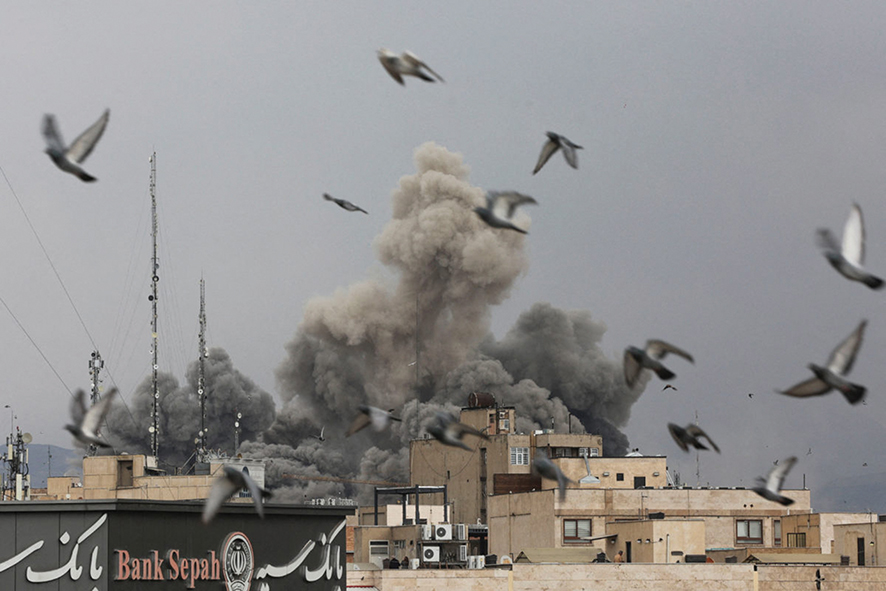
And then there are the civilian casualties. I think there’s a big risk of this going out of control. We already have the Iranians striking at American or Israeli targets in 14 countries in the region. The US has closed embassies. This war is widening.
The Secretary of War of the United States, as he likes to call himself, Pete Hegseth, says he is not held back by any rules of engagement. This is, as he sees it, a just war, and he can do whatever he wants. And I think we’re in uncharted waters here. I personally covered quite a few wars on the ground, including the Iraq invasion and the Afghan war. And I remember how much people like Dick Cheney or, for that matter, Donald Rumsfeld were later accused of being cavalier about the consequences of their invasion of Iraq.
If Donald Rumsfeld was cavalier about the aftermath of Iraq, and we saw what happened there, then how does one describe what Hegseth says?
Look, there’s no doubt that the government that Khamenei created, and over which he exercised power, was merciless and deeply cruel to its citizens. Having said that, the idea that the United States and Israel take it upon themselves to be the castigators, the punishers, the executioners of someone like that, and then give different public explanations within a few hours for the reasons they did it, just puts us into a different realm, I think.
And the question all that leads us to is this: should the United States continue to bomb and bomb and bomb Tehran? To what aim? Who is expected to emerge in the wake of Ayatollah Khamenei? Donald Trump suggested that he didn’t really care, that it might well be a person who was even worse. It seems to me that when you wield war, it is the greatest moral transgression men can wage. Therefore, it has to be the last resort, because innocents will die.
On who is expected to emerge, to succeed him, it appears that Khamenei’s son, Mojtaba, is to become the new Supreme Leader. We spoke about the shadow of Khomeini looming over his father. How large is the shadow looming over Mojtaba? What should we expect from him?
Well, can you imagine? It’s always tough to be a big man’s son. And I have no doubt that if he’s willing to step into his father’s shoes, then he’s contemplating the possibility of his own death. What I think, again, non-Iranians or Westerners perhaps don’t fully grasp, is the willingness of people like Mojtaba or his father to find martyrdom, the idea that death is simply a continuation of life, and that by dying nobly it will further consecrate and consolidate the revolution that they are living for today.
We don’t necessarily know whether Mojtaba is embracing the prospect of death of a martyr, though. We could have surmised that in case of his father, but nothing that we know of Mojtaba so far kind of tells us that he’s looking forward to that prospect. In fact, according to the Iranian opposition, his name seems to be connected to quite a few corruption scandals. But if he’s voluntarily accepting the role, and he knows that the Israelis will try to kill him, and for that matter, the Americans too, then he’s putting himself on a target range. And he has, I would say, a less than 50-50 chance of survival.
At this rate, how considerable is it that Iran could run out of Ayatollahs?
How many people there in the country? Many millions. I think that there’s an inexhaustible supply of potential Ayatollahs. What we don’t know is whether there’s an inexhaustible supply of bombs, or interceptors for the bombs and the drones and the cruise missiles that Iran can fire out to America and Israel’s proxies.
Interview by Vazha Tavberidze