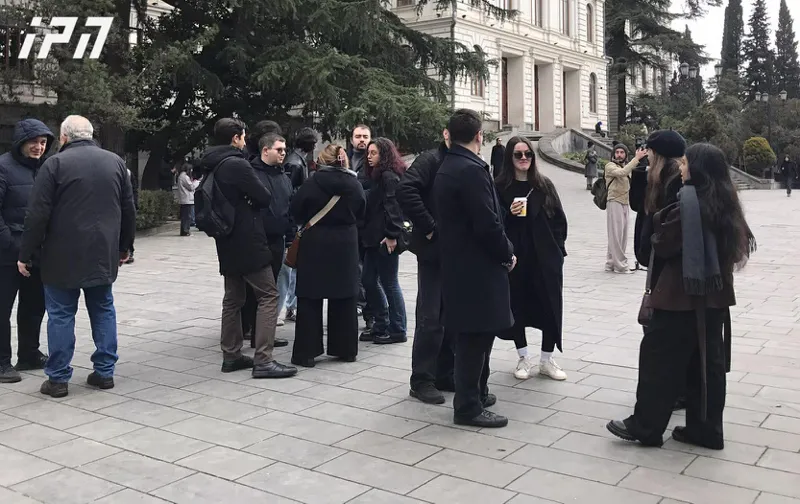
Students opposed to the proposed merger of Ivane Javakhishvili Tbilisi State University (TSU) and Georgian Technical University held a protest on Monday near the first building of TSU, demanding transparency and participation in decision-making as the university’s Academic Council met to discuss the controversial initiative.
The protest coincided with a closed-door session of the Academic Council, during which the issue of merging the two institutions was reportedly on the agenda. Students say they were barred from entering the building by the university’s security service, which cited security concerns as the reason for restricting access.
Protesters claim that TSU Rector Jaba Samushia had previously assured them that a limited number of student representatives would be allowed to attend the meeting. However, students claim that this promise was not upheld.
“Yesterday, we contacted the rector and informed him that we wanted to attend the Academic Council meeting. He told us that a certain number of students would be allowed inside. Today, however, the security service is not letting us into the building, citing security measures,” said student activist Megi Diasamidze.
She added that students are confused by the situation and say the lack of access has only deepened concerns about how the decision-making process is being conducted.
“We are in complete uncertainty and do not understand what is happening. That is precisely why we wanted to attend the meeting — to hear the arguments and understand the positions of those involved,” Diasamidze said. “At this stage, we do not have a concrete plan of action, but we demand that the rector meet with us publicly.”
She also noted that TSU students are coordinating with students from Georgian Technical University and are planning joint discussions and possible actions.
The proposed merger of TSU and GTU was announced earlier by the Ministry of Education, Science, and Youth as part of a broader reform of Georgia’s higher education system. Government officials say the merger is intended to consolidate academic resources, reduce administrative overlap, and transform the unified institution into a leading regional hub for education, research, and innovation.
Critics, however, argue that the initiative lacks sufficient consultation with academic staff and students and poses risks to institutional autonomy, academic freedom, and the distinct identities of the two universities. TSU, Georgia’s oldest and most prestigious university, has a strong tradition of self-governance, while GTU has a different academic structure and focus, particularly in engineering and technical sciences.
Student groups and some academic circles have expressed concern that the merger could lead to centralized governance, staff reductions, and changes to academic programs without adequate safeguards or transparency. They also question the absence of a detailed public roadmap outlining how curricula, faculties, and governance bodies would be integrated.
The government has stated that a temporary governing council would be established to oversee the reorganization process and that acting rectors would be appointed during the transition period. However, details regarding timelines, funding, and the legal framework of the merged institution remain unclear.
As discussions continue, student protesters say they will maintain pressure on university leadership and authorities to ensure that their voices are heard and that any decision affecting the future of Georgia’s higher education system is made through an open and inclusive process.
Image: IPN