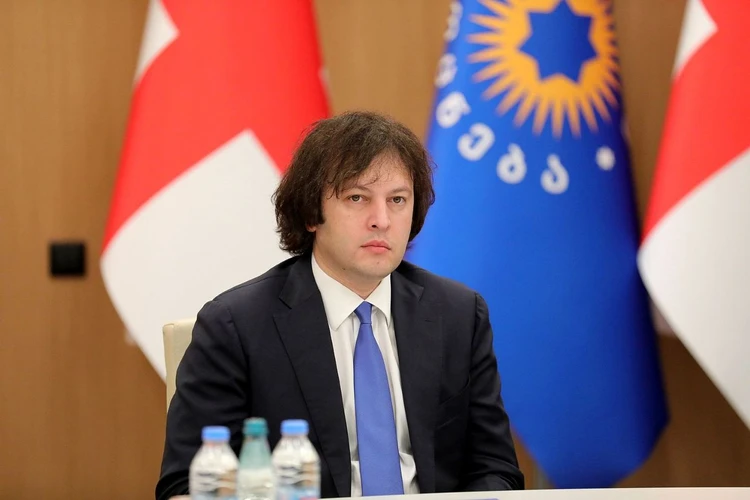
Georgia’s Prime Minister Irakli Kobakhidze issued a new response to the BBC investigation on Wednesday, confirming for the first time that water cannons used during the dispersal of anti-government protests in Tbilisi in winter 2024 did contain a substance — though, he insisted, it was not the World War I-era chemical agent known as “camite”. He said it would be up to the ongoing State Security Service (SSG) investigation to determine exactly what the substance was.
Speaking at a press conference at the Government Administration, Kobakhidze again accused the BBC of spreading false information and announced that Georgian authorities would challenge the broadcaster’s reporting through the UK’s media regulator and, “if necessary”, in international courts. He described the BBC documentary as a “provocation planned in the signature style of foreign intelligence services” aimed at fueling unrest in Georgia and “blackmailing” both the government and the public.
Based on the BBC’s findings, whistleblowers from Georgia’s riot police indicated that the government may have used an obscure chemical combat agent known as “camite” — a substance developed over a century ago and abandoned in the 1930s due to concerns about its prolonged effects — in water cannons during the November–December 2024 protests sparked by the government’s reversal on EU integration. The BBC alleged that the chemical could have been mixed into the water jets used extensively against demonstrators.
Kobakhidze rejected the allegation, while acknowledging that “a substance was mixed” into the water. “The main question is whether it was a banned substance,” he said, repeating Interior Minister Gela Geladze’s claim that the ministry has “never acquired camite, not even under the United National Movement (UNM) government.” Pressed on what exactly police had used, Kobakhidze said additional details would come from the SSG investigation. Asked whether the police could have used a different substance falling under the same UN classification code as camite, he replied, “Probably,” arguing that the code covers dozens of materials, most of them not prohibited.
Responding to another question — whether it was possible to rule out the use of a different banned substance classified under that same code — the Prime Minister said he believed so, adding that “presumably the Interior Ministry would have checked what type of powder Vano Merabishvili acquired back then,” referring to the former UNM Interior Minister. Kobakhidze said that if any wrongdoing were ultimately proven, “theoretically” responsibility could fall on Merabishvili, since “it would mean he deliberately acquired a specific powder,” though he stressed that the official investigation should take precedence over political speculation.
The SSG has opened an inquiry into potential harm to citizens’ health under the article on abuse of official powers, while also probing the possibility of “aiding a foreign organization in hostile activities” — a formulation that suggests the BBC’s Georgia-based interviewees may be investigated as well. Since Monday, multiple individuals featured in or connected to the film have been summoned for questioning.
The BBC said it identified the likely chemical with the help of several high-level whistleblowers, including former riot police weaponry chief Lasha Shergelashvili, who left the agency in 2022 and now lives in Ukraine. Shergelashvili told the BBC that in 2009 he was instructed to test a compound intended for water-cannon use and described its effects as far more powerful and long-lasting than tear gas. He said colleagues informed him that the same chemical continued to be used until at least 2022 and was deployed again in 2024.
Shergelashvili could not name the substance, but the BBC obtained a 2019 riot-police inventory listing two unidentified chemicals: “Chemical liquid UN1710” and “Chemical powder UN3439”. A former senior riot-police officer confirmed to the BBC that the document was genuine and that these materials were likely to have been added to water cannons.
The BBC reported that UN1710 was identified as a solvent, while UN3439 proved “much harder to identify”, as it is an umbrella code covering a wide range of hazardous industrial compounds. However, the channel said the only chemical ever known to have been used as a riot-control agent under that classification was bromobenzyl cyanide — camite. Weapons experts consulted by the BBC concluded that, given the availability of safer modern riot-control agents, deploying an obsolete and more potent compound could meet the definition of a chemical weapon.
The documentary sparked immediate and intense public debate in Georgia. Government critics expressed outrage over the potential use of a banned chemical against protesters, while the ruling Georgian Dream party and its allies sharply attacked both the BBC and the individuals who participated in the investigation.