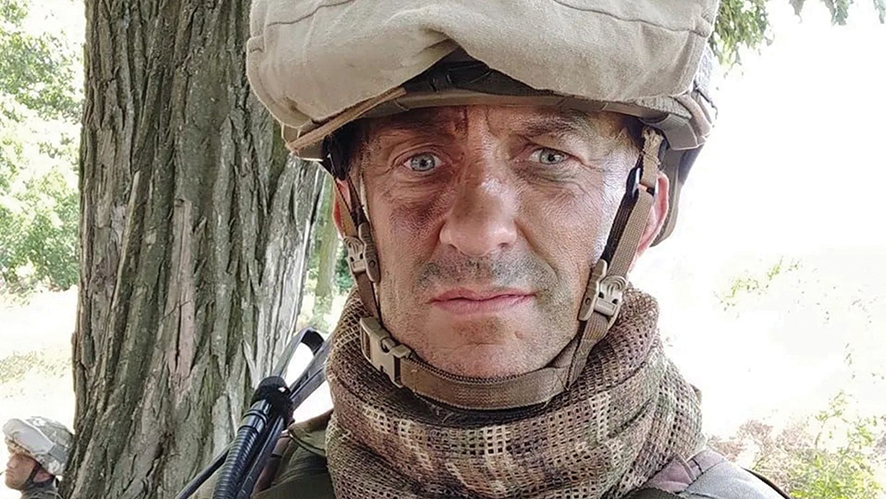
If you’re drawing the enemy in, killing far more of them than they kill of you, and fighting on ground you’ve chosen, then you stay and fight as long as you can, — says Shaun Pinner, a former British soldier and veteran of Ukraine’s armed forces who survived the Mariupol siege and months of Russian captivity.
Pinner, who has fought for Ukraine since 2018 and has seen the war’s realities more closely than most foreign volunteers, speaks to RFE/RL’s Georgian Service about the battle for Pokrovsk, why its defense resembles “a modern-day Hougoumont,” how long Ukrainian forces can hold without being encircled, and the political and psychological clout Moscow desperately needs from capturing the city.
He also discusses Ukraine’s manpower crisis, the consequences of delaying mobilization reforms, and why he believes Russia’s push past Pokrovsk — even if successful — would come at catastrophic cost.
The Kremlin deadline to capture Pokrovsk was pushed from November 15 to December 15. How imminent does it look that Pokrovsk will indeed fall?
I can’t tell you for certain that we’ll hold it. There are allegedly about 115,000 Russians there, and we’re outnumbered eight to one. What I do know is that Ukraine’s strategic plan hasn’t changed since the first days of the invasion. I lived through being in a pocket in Mariupol: you exhaust the enemy’s ability to push. Yes, you know you’re encircled, but you keep going because the goal is to drain the enemy’s resources so Kyiv can survive.
Mariupol is the prime example—many say that if we hadn’t held it as long as we did, Kyiv might have fallen. As a soldier, you understand it’s not about clear wins or losses; sometimes you draw the enemy in. That’s why I compare it to Waterloo—Hougoumont held up an imperial force, and Pokrovsk is the same kind of bastion. Hopefully, with a better outcome. If Putin does take it, the defensive layers north of Pokrovsk are substantial—dragon’s teeth, trenches, tank ditches, razor wire. They’d have to go through all of that again.
Just how long can the Ukrainian forces hold out without the risk of being encircled?
What I’m going to say sounds uncomfortable, but if you’re drawing the enemy in, fighting on ground you’ve dictated, and they’re losing far more men than you are, then you should hold Pokrovsk as long as possible. When I was there last November, Russians were eight kilometers out. In a year, they’ve only pushed eight kilometers—at enormous cost.
Suppose they capture Pokrovsk. Where do they go next?
It’s a crossroads. They’ll reinforce, restore rail links—some strategic value, but nothing that fundamentally changes the war. Russian infantry is terrible. They’re good at reconnaissance, small assault groups, and bombing, but their infantry is very poor. Even if they take Pokrovsk, they’ll be exhausted and depleted, with winter locking them in place.
Logically, they’d try to push toward Kramatorsk and Izyum. But moving north of Pokrovsk will cost them heavily—Ukraine benefits from that; that’s where the traps are. The point is to deplete Russian forces so they can’t move on.
As for encirclement, Putin claimed more than two weeks ago that they had Pokrovsk trapped, even inviting journalists. Twenty days later, it’s clearly not encircled. They’re stalling and waiting for reinforcements because of heavy casualties.
As a commander, it’s like sealing off a flooding compartment in a submarine—you make a brutal decision to save the rest. If Ukraine has reinforcements and the pocket remains open, and if they’re killing enough Russians, then you hold as long as you can.
How big a morale shift would Pokrovsk’s fall create—for Russians and Ukrainians?
For Ukrainians, it would hurt morale—let’s not pretend otherwise. We don’t want to lose anything, and we’re inching back. At some point we must launch an offensive, which raises the question of manpower. Is that under control? Can we realistically do it?
But Russia also knows this won’t be a walkover. They’re getting hit hard—Operation Spiderweb, losing dominance in the Black Sea, daily strikes on Russian territory. Ukrainian innovation, Flamingo missiles, for example, is having real effect. There’s still fight and will. People are tired, and corruption scandals don’t help, but I remind people that’s part of a working democracy. My concern is troop numbers.
Will Ukraine lower the conscription age?
I never understood why the 18–25 group was allowed to leave in 2022. Many could have gone into officer school for four years and be trained professionals by now. I’m not saying put 18-year-olds on the front line; train them, find their specialties—infantry, drones, engineering. There was no reason not to mobilize them early.
Now Ukraine is chasing its tail. They let that age group leave, and now they aren’t coming back. There are still plenty of fighting-age men in cities like Dnipro and Kyiv, but because mobilization wasn’t done earlier, any decision now will be very unpopular. Someone—Zelensky or a successor—will have to make that call and make service appealing.
What about Russia? How big would the morale boost be?
Putin wants that trophy. He’s under far more pressure than people realize—economically and politically. He needs Pokrovsk to show progress before winter slows everything down. Without it, he’s going into the winter with coffins, not gains.
There are no real “front lines” in this war. It’s essentially a 20-kilometer kill zone. You don’t mass troops in lines anymore: you rely on quick reaction forces, like the recent case in Dobropilya, where Russian troops broke through but were quickly isolated and destroyed over a couple of weeks. Nearly the entire front is watched by drones 24/7, rotating constantly. There’s almost nothing that isn’t being observed.
And to finish off – what are your thoughts on the Trump Administration’s “28-point peace plan” offered to Ukraine?
In a week where Russian neo-Nazi groups are offering cash prizes for the first three executed Ukrainians, and a British propagandist has filmed himself encouraging pigs to feed on the bodies of dead Ukrainian soldiers, we’re supposed to accept an amnesty for crimes against humanity? It’s repugnant. I’m sick with anger. This so-called 28-point ‘peace plan’ reads less like a strategy for a just, durable settlement, and more like an attempt to appease Putin; a blueprint to tie Ukraine’s hands, strip away its right to defend itself, and reward an aggressor with no intention of stopping.
A peace plan that protects the perpetrator and punishes the victim isn’t peace. It’s surrender dressed up as diplomacy.
Interview by Vazha Tavberidze