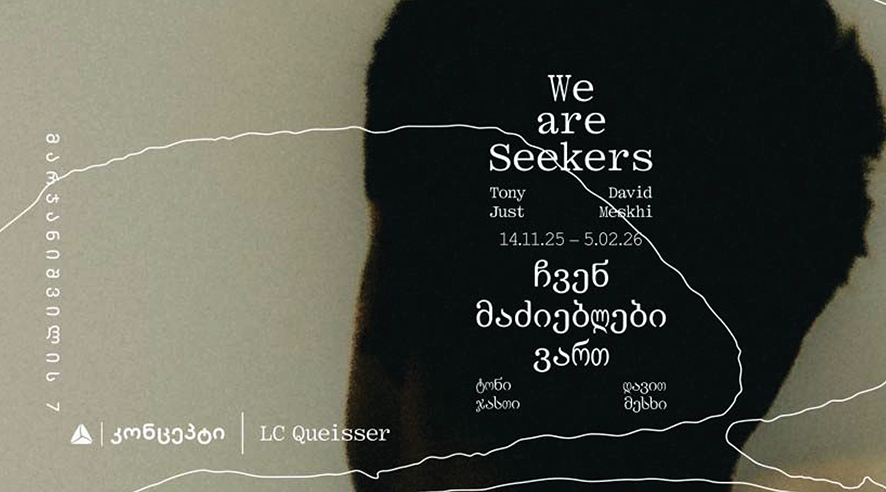
In the bright, controlled quiet of TBC Concept Gallery, We Are Seekers unfolds like a manual for navigating human thresholds. David Meskhi and Tony Just construct a shared terrain where images behave as porous organisms and memory turns into a working material. Curated by LC Queisser, the exhibition cultivates a field of open-ended search—an epistemic zone where inquiry itself becomes a medium as tactile as paint or photographic grain.
Both artists speak about seeking in a tone usually reserved for spiritual apprenticeships. The title reads less as an announcement and more as an initiation ritual: a reminder that art grows through desire for something still out of reach. In this sense, the exhibition belongs to a lineage that includes the wandering philosophers of antiquity, the medieval mystics mapping celestial diagrams, the Situationists drifting through urban semiotics, and even the Soviet-era athletes rigorously training the body into an instrument of utopian projection. Meskhi and Just activate this genealogy with a contemporary pulse—restless, errant, alert to the world’s trembling surfaces.
Tony Just’s Berlin Year as Alchemical Laboratory
Tony Just describes his works as “based on drawings, memories and accidents.” The line carries the discreet precision of a craftsman who senses the metaphysics embedded in chance. Every accident becomes a hinge toward a new visual syntax. The Berlin studio serves as a site where lived experience, digressive marks, and intuitive gestures progress toward hybrid structures.
His surfaces often resemble palimpsests—layers of time sedimented into color. In museum terms, they recall the condition reports of fragile frescoes: traces of previous states visible beneath the new. Just cultivates this archaeology of the canvas as a mode of thinking. Memories operate as anchors; accidents open avenues; drawings function as connective tissue between the conscious intention of the artist and the atmospheric forces shaping the work. Through these combined impulses, the paintings gain the aura of liturgical objects—quiet, attentive, susceptible to revelation.
In contemporary sociological language, such practice illustrates the “distributed authorship” of an artist who collaborates with environment, intuition, and the unpredictable rhythms of daily life. The paintings speak with the tone of something discovered rather than produced. Their forms appear like fragments of a world still undergoing self-assembly.
David Meskhi and the Afterlife of the Athlete
If Just studies the ghostly logic of the mark, Meskhi approaches the human body as an archive. Raised in the atmosphere of Soviet gymnastics, his visual vocabulary carries the resonance of discipline, repetition, and the ritualistic elegance of sport. For many years, his photographs explored Georgian youth as agents of freedom and gravity alike. We Are Seekers introduces a different chapter: athletes “removed from the mat,” re-situated within unfamiliar visual ecosystems.
Meskhi’s images traverse the border between corporeal presence and spectral outline. He describes the sensation as “moving through shadows toward something not yet fully seen.” This articulation echoes the phenomenological writings of Maurice Merleau-Ponty, for whom perception is an encounter with what is still emerging. In Meskhi’s prints and manipulated photographs, bodies linger in transitional states. They appear suspended—as if captured in mid-metamorphosis.
The physical and digital manipulations intensify this effect. Each layer pushes the athlete away from documentary clarity and toward the aesthetic territory of myth. The figures hold the aura of demiurges practicing an unnamed discipline. They carry the history of the Soviet gymnasium, the turbulence of post-Soviet youth culture, and the contemporary global appetite for reinterpreting archival materials. Meskhi treats the athlete as a vessel through which collective memory continues its long, unhurried rehearsal.
The Exhibition as Phenomenological Chamber
The curatorial structure of We Are Seekers enhances the exhibition’s metaphysical undertones. LC Queisser positions the works in a choreography that simulates a journey: the viewer moves through stages that resemble thresholds rather than rooms. Each wall behaves like a fragment of an unfinished map. The combined effect evokes the labyrinthine spaces described by Jorge Luis Borges—architectures designed for wandering minds.
Uncertainty becomes a productive climate rather than a conceptual theme. The viewer enters a state reminiscent of early 20th-century museum ethnography, when scholars believed that proximity to ritual objects could induce altered perception. Here, the objects themselves generate the atmosphere. Meskhi’s shadow-like bodies and Just’s layered abstractions radiate a kind of contemplative charge. One senses the artworks as interlocutors: companions in the act of seeking.
This is where the sociological dimension gains particular sharpness. The exhibition reflects a global condition marked by accelerated change and fragmented identities. The seeker becomes a figure of our era—the individual navigating shifting environments, layered histories, hybrid cultures. The gallery transforms into a microcosm of contemporary subjectivity: fluid, searching, perpetually in dialogue with invisible forces.
Tbilisi as a Capital of Restless Vision
Both artists carry histories intertwined with Tbilisi’s evolving artistic landscape. Just spent significant time here during residencies, contributing to the intellectual fabric of the city through teaching, murals, and print experiments. Meskhi shapes Tbilisi’s visual memory with a presence that stretches from local youth culture to international museum circuits. Their collaboration situates the city as a node where global and local artistic trajectories intersect.
TBC Concept Gallery becomes a stage for this convergence. The exhibition participates in the ongoing transformation of Tbilisi into an analytical, self-reflective cultural capital—one that cultivates transnational dialogues without dissolving its own specificity. The seekers in the gallery mirror the seekers walking the city’s streets: readers, students, artists, migrants, wanderers, workers. Each brings a layer of meaning to the broader social fabric.
Review by Ivan Nechaev