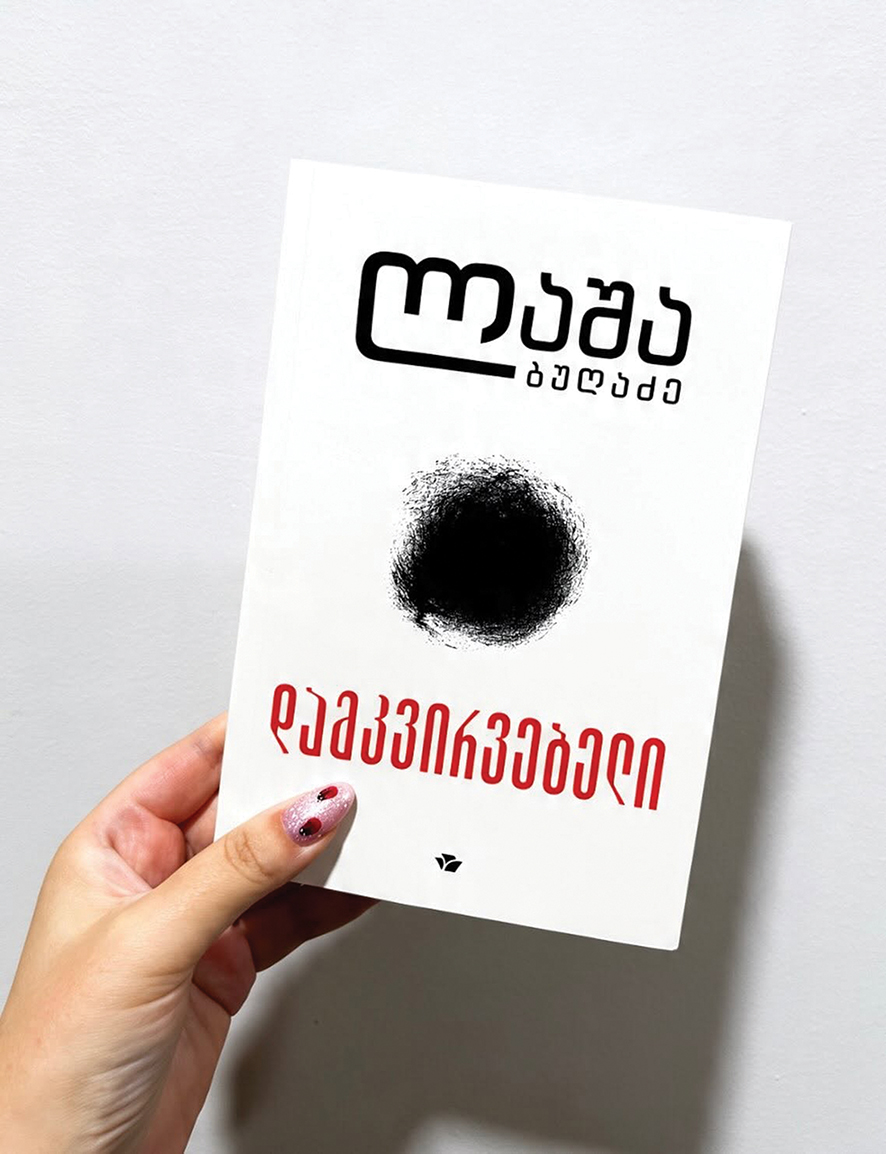
In a Tbilisi branch of the bookstore chain Biblusi, someone drew a penis on the first page of every available copy of Lasha Bugadze’s novel The Observer. The incident was reported by Facebook user Lika Lazishvili. Biblusi later said it occurred at its Gldani Mall branch and that books by several authors had been damaged. The bookstore called the behavior unacceptable and disrespectful, and Sulakauri Publishing, which published the novel, described it in similar terms toward the author, readers, the bookstore, and the publisher. One detail changes how the act reads: it was not a single copy, but every copy.
A lone obscene doodle is vandalism. Repeating it across an entire stock begins to look like a message. The point is no longer an individual book, but the book as a category: something singled out for treatment different from everything around it. And that is where the story shifts from the gesture itself to what is being marked.
Bugadze’s The Observer is a dystopian novel about a Georgia that has spent decades under an authoritarian ruler. Its protagonist returns as an international observer and encounters a society where political reality has become grotesque and the future feels suspended. Recently, the same book was refused entry to Rustavi Women’s Prison No. 5 when activists tried to deliver it to imprisoned activist Nana Sander. According to Radio Tavisupleba, the delivery was halted after staff cited a security-service decision that the book contained “political content.”
These are very different events: one inside a prison, the other inside a bookstore; one an institutional decision, the other an anonymous act of damage. It would be irresponsible to treat them as a coordinated campaign without evidence. Still, they converge on a shared pattern: the novel is no longer treated simply as literature, but as a politically charged object whose circulation must be managed, restricted, or symbolically degraded.
Fiction can become politically charged without slogans or instructions. It can construct a world close enough to reality that readers begin making comparisons on their own, or exaggerate familiar political habits until they become visible. This is one of the oldest functions of satire, which does not merely argue against power, but makes it appear absurd. A political speech asks for agreement; satire often produces an image that lingers beyond agreement.
Bugadze’s work has long operated in this register, using comedy, grotesque situations, and uncomfortable characters to explore Georgian social and political life. Earlier commentary on his writing, including a review of The Golden Age in Hot Chocolate, emphasized this blend of black humor and distorted social observation rather than conventional realism.
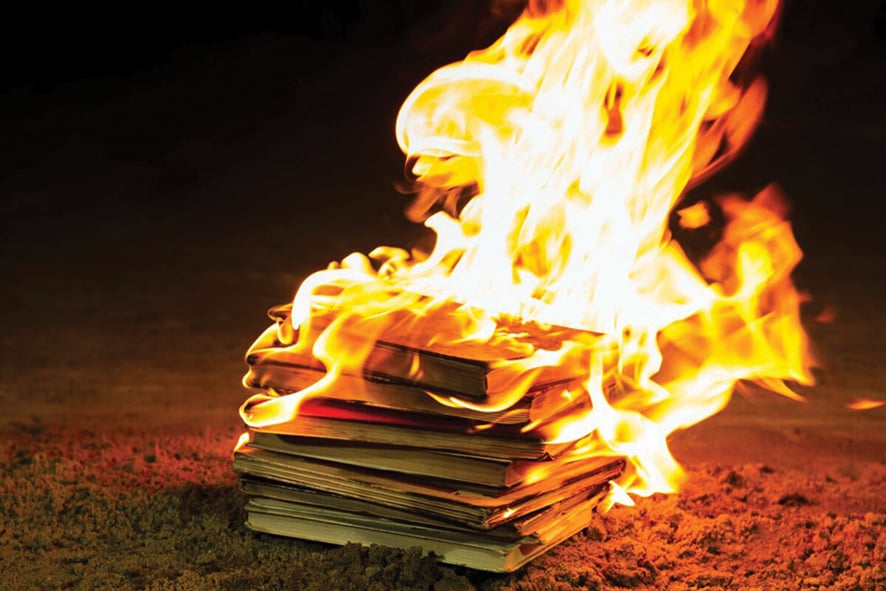
In that context, the response to the book becomes more than simple contempt. Defacing a text does not argue with it; it reclassifies it. Political cultures often rely on such gestures, tearing posters, burning books, marking images, not to refute meaning, but to change the object’s status in public perception. The obscene mark works especially well because it collapses seriousness into ridicule.
Its placement on the first page is crucial. It functions like an unauthorized preface: before the author speaks, another voice has already intervened. The reader encounters not only the novel, but an imposed framing of it.
This is an old logic of control. Books have always been marked, banned, confiscated, or destroyed, because control over a text is not only about its content, but about the conditions of its encounter. A banned book is inaccessible; a confiscated one is absent; a damaged book remains readable, but the reading is altered. In this last case, censorship does not remove the text: it contaminates it, inserting an external voice into the act of reading.
The bookstore context matters because such spaces usually suspend ideological hierarchy. Political novels sit next to cookbooks, romances, and children’s books under a commercial logic of availability. Once certain titles are singled out for marking, that neutrality begins to erode, and the bookstore itself becomes a site where cultural objects carry political risk. Biblusi has condemned the damage and said multiple authors were affected, but the incident still shows how easily a commercial space can be drawn into political tension.
There is also an economic dimension: the aim is not necessarily to prevent sale, but to reduce value. A damaged book is harder to sell; a damaged stock becomes a statement in itself. This resembles a more diffuse form of censorship: not classical suppression through bans or confiscation, but an environment in which certain works become risky to handle, distribute, or even possess.
A political book can be criticized, debated, or ignored. These responses keep it within the realm of literature. Defacement does something different: it attempts to change the category itself
You can publish the book, but it may be damaged. You can sell it, but it may be contested. You can read it, but it may be deemed too political to enter a prison. Individually, none of these actions necessarily constitutes formal censorship. Together, they shape the conditions in which cultural production circulates.
This is why concerns about such behavior encouraging censorship are not easily dismissed, even if no organized campaign is proven. Censorship often begins not with law, but with anticipation: the calculation that certain material will create trouble. That calculation is familiar to publishers, curators, and booksellers, and it gradually defines what is considered safe to circulate.
The prison case is more direct, because an institutional decision explicitly excluded the book on the grounds of political content, with security services cited as the authority behind the refusal. This is a clearer form of exclusion than anything occurring in a bookstore, but the juxtaposition remains telling.
In one case, an institution defines the book as politically sensitive. In the other, an anonymous actor marks it as something to be degraded. Neither engages with the novel as literature. And that may be the central point.
A political book can be criticized, debated, or ignored. These responses keep it within the realm of literature. Defacement does something different: it attempts to change the category itself, turning the book from a text into an object of hostility. Once that shift occurs, engagement with what is actually written becomes secondary.
Bugadze himself suggested the bookstore incident might have been carried out on orders from authorities, and compared it to Putin’s Russia, though there is no evidence for that claim, and it should remain speculative. What can be said more securely is that The Observer has already acquired a political life beyond the literary one: it has been blocked from a prison for being “political,” and physically marked in a bookstore.
That alone is enough to make the episode notable. Because the strange thing about political fiction is that its life does not end when the manuscript is finished. Sometimes the most revealing response to a book is not what is written about it, it is what is done to it on the shelf.
By Ivan Nechaev