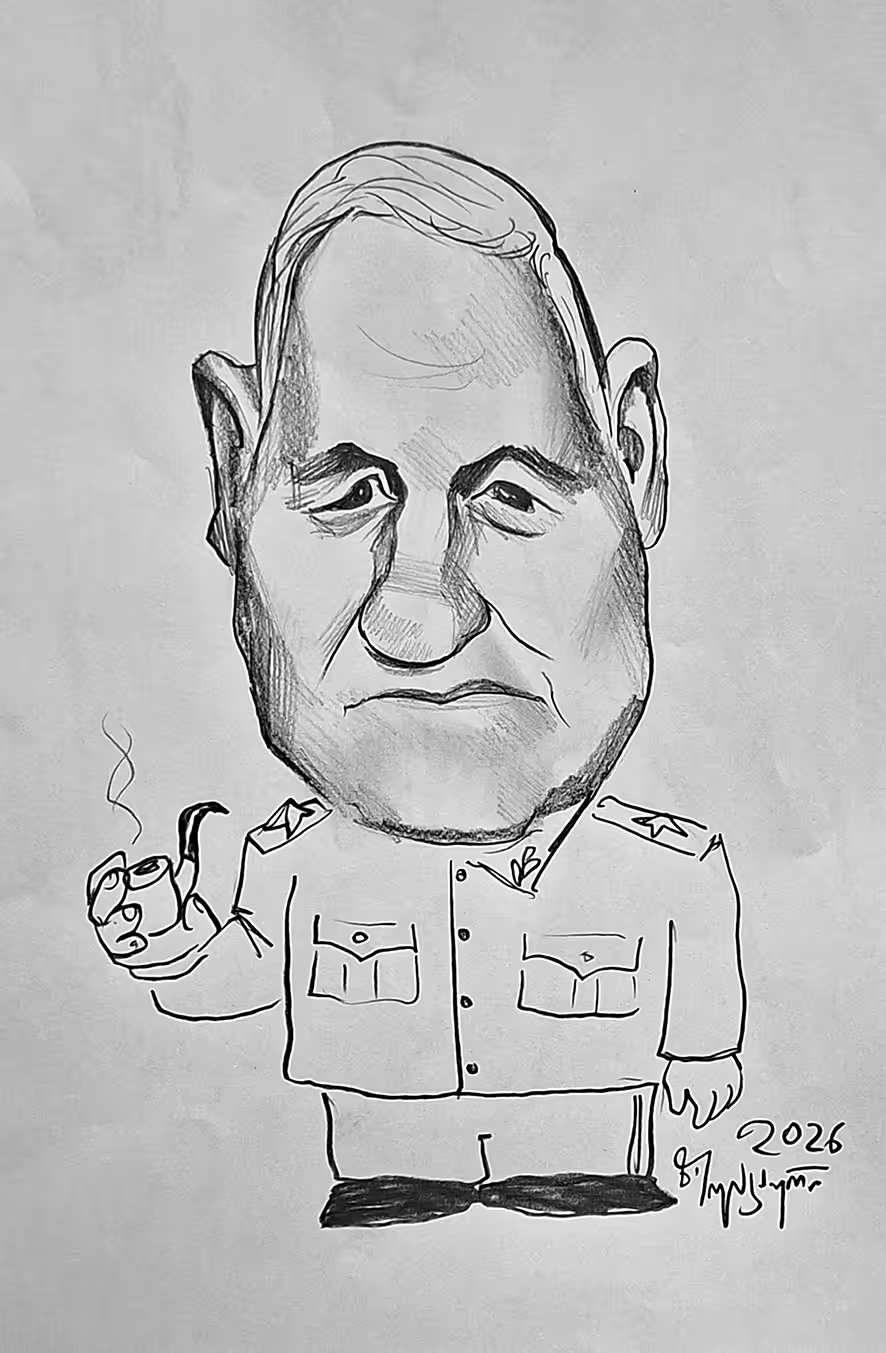
Blessedly, there is no shortage of newsy stories in Sakartvelo: Grigol (Grisha) Oniani, the well-known Georgian public figure and longstanding hardcore Stalinist, at the honorable age of 90, completed a doctoral dissertation, impressively titled Realpolitik as the Basis of the 20th-Century World Order, having dedicated the work to his nonagenarian jubilee.
The event took place on July 25 at the Georgian State Technical University, in the presence of about 200 invited attendees. The official supervisor of the thesis was Professor Tamar Kiknadze, and the opponents of the dissertation were Professors Edisher Gvenetdze and Vakhtang Guruli. As a result, Oniani was awarded a doctoral degree.
The whole process lasted about three hours, covering a heated discussion of the burning issues raised in the thesis, as well as challenging questions posed by members of the Dissertation Council and the audience. Opinions differed sharply. The discussion was truly public, and this is not surprising, because it was the first publicly heard positive word about Joseph Stalin in the period since his denunciation by Nikita Khrushchev at the 20th Congress of the Soviet Communist Party.
The determined elderly gentleman spoke resolutely, in an extremely balanced and academic style, using a clearly stoic and persuasive manner, patiently and confidently answering every question, in most cases intentionally harsh and tricky.
Frankly speaking, it is a delight to recognize that a 90-year-old man next door is capable of such a deed. A monumental deed! But an extraordinary thing is not just his age, but the outstanding continuity of his intellectual and political presence on the polemical stage of the country.
Oniani, like many of us, is a pure product of the Soviet educational and labor system, having endured every single phase of that peculiar regime without ever changing his political stance, especially in the face of varied interpretations of Stalin’s controversial figure across generations.
An agriculturist by profession, Oniani took to practicing political science while at the same time holding several managerial positions during the Soviet era, acquiring a clear identity as a staunch and convinced Stalinist with an extraordinarily active public cause. He founded and has incessantly chaired a nongovernmental organization called Stalineli.
Being extremely active in public life, he wrote articles for newspapers and magazines, gave interviews, campaigned for the dictator’s monuments, appeared on various radio and television shows, got into heated arguments with journalists, and took part in political demonstrations.
Believe it or not, Grisha Oniani keeps a large statue of his beloved Soviet ruler on his own property in Svaneti, northwestern Georgia, which is often visited by tourists interested in seeing it.
Isn’t it truly incredible that somewhere in the Georgian mountains, a 90-year-old man sits beside a statue of Stalin, erected in his own yard, and has just defended a doctoral dissertation about the famous Soviet dictator, as controversial as he is today all over the world?
Notably, he has been perseveringly trying to return the monument to where it came from: the center of the city of Gori, Stalin’s birthplace, where there is a large and rich museum of Stalin, the only functioning one in the entire world.
Mr. Grigol thinks that Stalin should not be ignored and forgotten, and he comes up with tons of arguments to corroborate his opinion. In his much-spoken-about thesis, he is trying to put forward arguments that make Stalin a genuine practitioner of realpolitik.
A certain number of elderly people nostalgically remember the Soviet period because of its almost universal employment, social security, cheap housing, education, stability, and what not. Oniani is more than that: he is not just an old man who likes Stalin; he is more serious about the issue, being an active Stalinist debater and defender.
He would never make a trivial statement like, “Life was better under Soviet rule.” His main argument is that Stalin was a great statesman and that Stalinism contains lessons for contemporary politics.
That said, it must also be clearly noted that Stalinism, so much praised and kept up by Grigol Oniani, does not fit comfortably into the system of modern Western political categories, and this is the contradiction that stands against our good old man Grisha.
Probably, we cannot and should not take Stalinism that easily. As I understand it, it is not simply the ideology of the former Soviet Communist regime which could be used in our complicated times, when almost everything could be subjected to doubt and controversy. Stalinism has intermingled with post-Soviet Georgian nationalism and traditionalist politics, and that is a considerable pain in the neck, which the younger generation finds difficult to put up with.
So, what to do?
The discussion on the topic could go on and on and on, and there is no genius who can solve it overnight. But it is good to be living in a country and in an epoch when a certain researcher, whether old or young, is free enough to raise issues of such content and magnitude, and drive his or her opinion home without any fear of being cut short or brought down.
I love it!
Blog by Nugzar B. Ruhadze