A routine infrastructure project in the heart of Tbilisi has opened a small window onto the city’s buried past.
Brick structures and ceramic vessels have been uncovered on the section of Rustaveli Avenue between Liberty Square metro station and the Georgian National Museum during ongoing rehabilitation works.
The precise date and function of the newly discovered remains have not yet been established, but the finds have been reported to the National Agency for Cultural Heritage Preservation of Georgia, whose specialists have inspected the site.
Tbilisi City Hall says work on the section will continue in accordance with the recommendations issued by the agency.
“During infrastructure projects carried out or currently underway in the capital, whenever archaeological layers and artifacts are discovered, Tbilisi City Hall closely cooperates with the National Agency for Cultural Heritage Preservation and makes subsequent decisions based on its recommendations,” the municipality said.
According to City Hall, information about the finds on Rustaveli Avenue was provided to the heritage agency immediately. Specialists then visited the site, examined the discoveries, and issued recommendations for the continuation of the works.
The discovery is particularly intriguing because the area around Liberty Square has undergone extraordinary transformations over the past two centuries.
Today, Liberty Square is regarded as the very center of Tbilisi. But until the early 19th century, much of the area lay outside the walls of the old city and was known as Garetubani, or “the outer district.” Historical sources describe gardens and vineyards in the area belonging to members of the Georgian royal family.
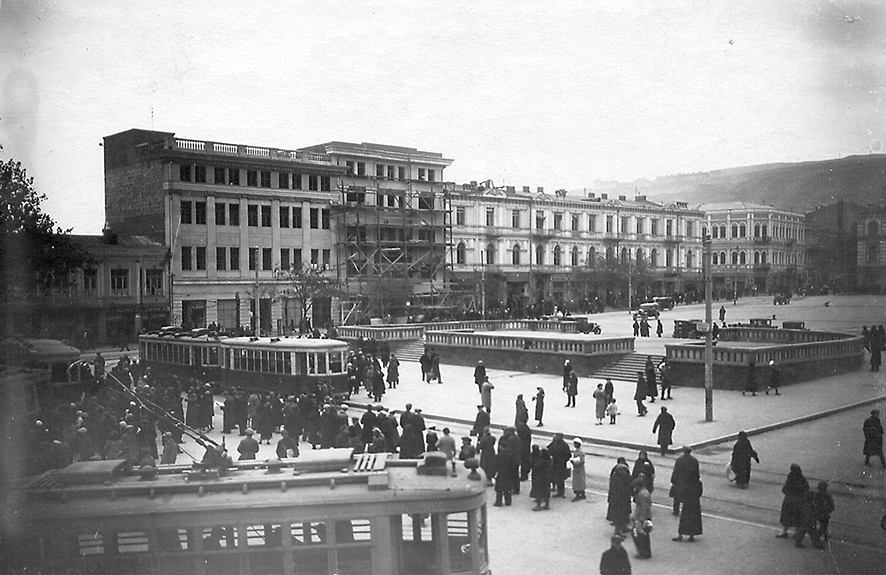
The landscape changed dramatically after the Russian annexation of Georgia. The square began to take shape in the early 19th century, with major government and military buildings appearing around it. By the 1840s, the area was being transformed into part of the city’s new administrative and cultural center, while the road that became Rustaveli Avenue developed into one of Tbilisi’s principal thoroughfares.
There was also water running through what is now one of the busiest parts of central Tbilisi. The Avanaantkhevi, a ravine or stream associated with the Sololaki area, crossed the vicinity of the present-day square. In the 19th century, it was enclosed and covered, and the ravine was subsequently filled as the area was levelled and developed.
The square itself was also once a very different place. In the mid-19th century, it contained a theater and caravanserai, while Sunday markets were held there. The theater was destroyed by fire in 1874, and the caravanserai survived until the major Soviet-era redevelopment of the square in the 1930s.
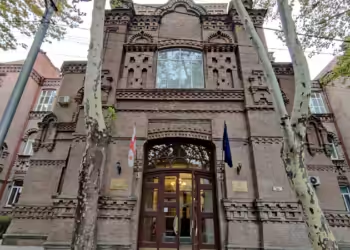
That long history of construction, demolition, filling and redevelopment means that the ground beneath the modern avenue may contain traces of several different periods of Tbilisi’s urban development. The present-day Georgian National Museum, meanwhile, stands in a part of the city that has long been associated with the preservation of archaeological material from across Georgia; its collections span the country’s material culture from the Bronze Age through the early 20th century.
The latest discovery therefore raises an obvious question: what exactly lies beneath one of Tbilisi’s most familiar streets?
For now, the answer remains open. The brick structures and ceramic vessels have been identified and inspected, but their age, purpose and relationship to earlier layers of the city have not yet been publicly established.
What is already clear is that the modern surface of Rustaveli Avenue conceals a landscape that has changed repeatedly: from gardens and vineyards on the outskirts of old Tbilisi, to a ravine and open ground, and eventually to the grand urban avenue that became the center of the modern city.
The excavation may yet reveal another piece of that transformation.
By Team GT