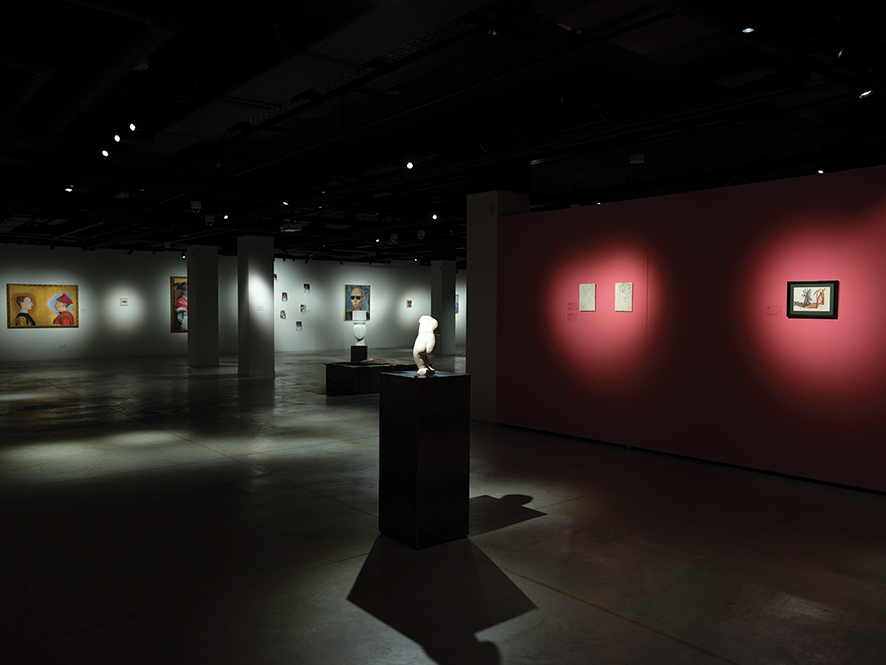
In Lia Bagrationi’s world, historical images are never entirely past, ordinary objects are never merely ordinary, and the things we leave behind may one day become the archaeology of our time. Her new exhibition, The Earth Is Female, brings ancient sculpture, Georgian frescoes, Renaissance painting, domestic objects and discarded plastic into a shifting landscape of memory and association, where the female emerges through the body, archetype, memory and force of creation.
We sat down with the artist to discuss the ideas, images and materials behind the exhibition. On view through early September at Art Foundation Anagi in Tbilisi, The Earth Is Female explores how images and objects accumulate memory, acquire new meanings and speak across time.
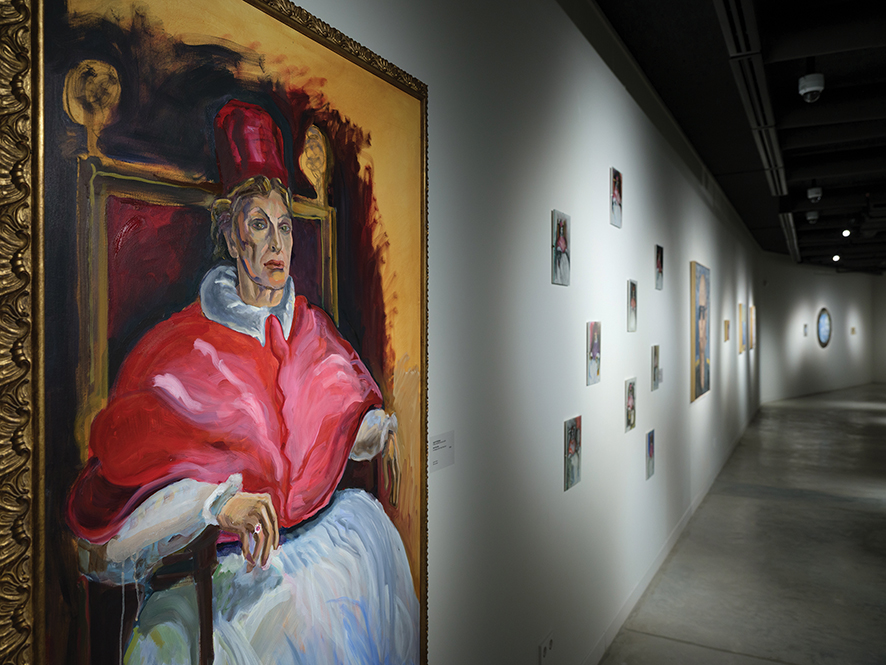
The title of the exhibition, The Earth Is Female, sounds rather categorical. How did the phrase come about, and when did you decide it should become the title of the exhibition?
I first came up with the phrase many years ago, while travelling in Tusheti. As I was looking at the utterly mesmerizing landscape, I remembered a line by the Georgian poet Vazha-Pshavela: “As pleasant a place to gaze on / As the breast of a woman.” At that moment, I decided that the Earth was undoubtedly female.
Later, when I began thinking about this exhibition, I realized that the phrase expressed precisely what I was doing. For me, woman and the Earth are connected not only metaphorically. Both hold memory; both give birth and transform; and both carry within themselves the traces of time.
I also like the categorical nature of the title. There is a challenge in it, as well as humor, irony and poetic freedom.
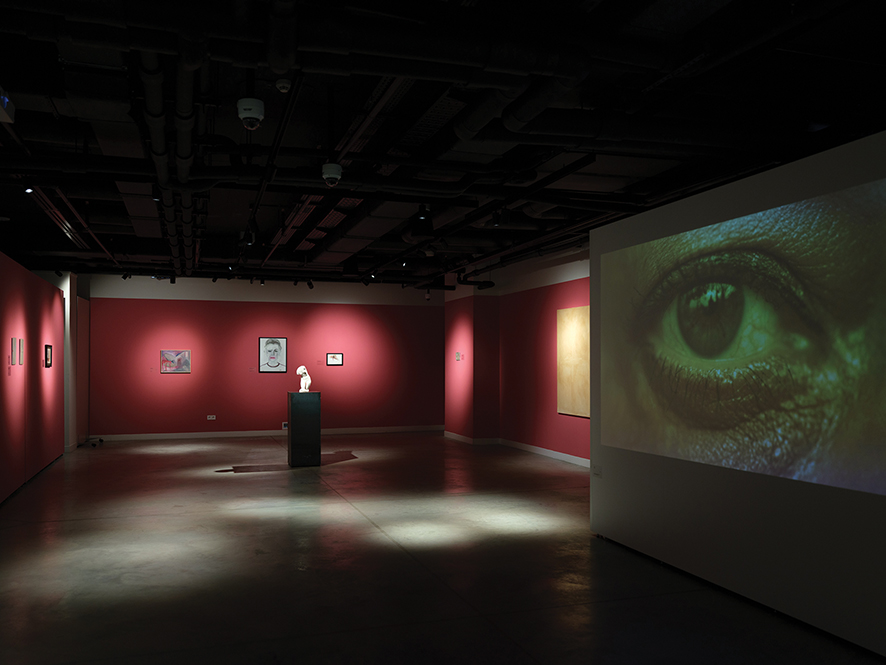
Your exhibition seems to take the viewer into a kind of archetypal unconscious, where personal memories, everyday objects and elements from different periods and cultures come together. What connects these seemingly disparate times and experiences?
I believe that what connects all of this is not time or culture, nor their functional purpose, but rather a deeper layer, something like an inner memory. For me, these things carry traces of human experience: touch, care, labor, birth, death, desire and everyday life.
I see the exhibition not as a collection of separate objects, but as a single, living space, where objects exist like fragments of dreams or archaeological discoveries emerging from a shared unconscious.
You often turn to existing, familiar historical images. How do you choose them? How would you describe this process, and when does an image begin a new life for you?
I probably don’t choose well known images so much as recognize the moment when they begin to resonate differently for me. I enjoy engaging with familiar cultural codes because they already carry a collective memory, and I am interested in what happens when I give that memory a chance to be born again.
For me, an image begins a new life when it is no longer simply an image of the past, but starts to speak about the present, and sometimes directly to me or to the viewer.
You have returned to archaic, prehistoric and ancient motifs: sculpture, architectural elements and writing, throughout your career. What is it about them that you still find inexhaustible?
I think I return to these images because I do not fully understand them. There is something mysterious about them that cannot be fully explained through history, archaeology or the meanings we assign to them today.
I see the exhibition not as a collection of separate objects, but as a single, living space, where objects exist like fragments of dreams or archaeological discoveries emerging from a shared unconscious.
For me, the value of these motifs lies precisely in the fact that they remain open. They allow me to connect a very distant past with the present and to discover something contemporary within the ancient – something that still speaks to us today.
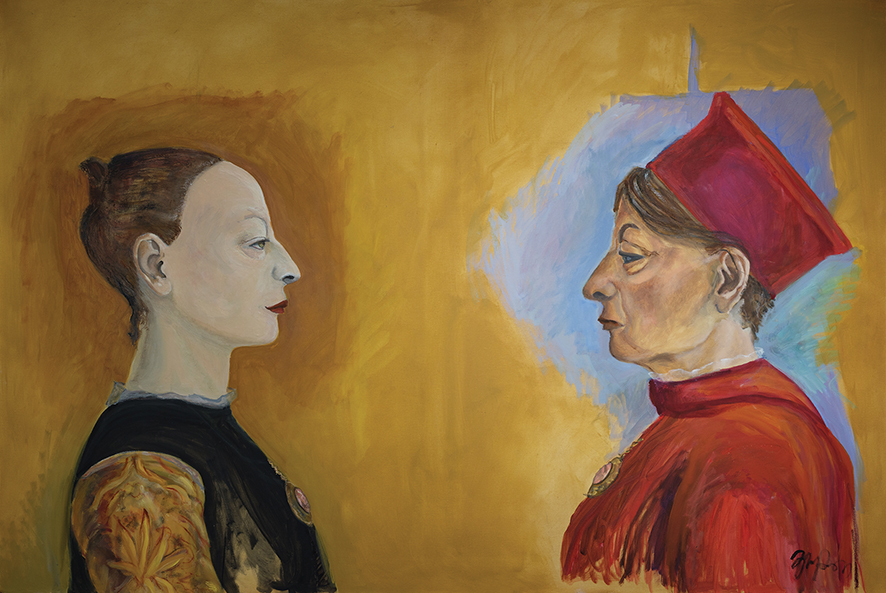
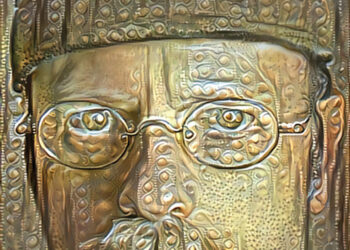
In your self portraits, you often place yourself within the worlds of great masters, with a distinctive sense of humor. How did this idea come about, and what does it mean to ‘write yourself into’ art history?
When I place myself in a work by Velázquez, Piero della Francesca or another master, it does not mean that I am literally trying to ‘enter art history’. Rather, it is a way of feeling that art history is not something frozen and distant, but a living world that anyone can enter.
Self-irony and humor help reduce the distance between us and these works, allowing us to see them differently. Of course, it is also a way of entering into dialogue with them, a game with time, with the female face, with the very idea of authorship, and with the way we look at works from the past today.
I like the idea that, through such encounters, old art can suddenly begin speaking to us in a contemporary language.
Several paintings in the exhibition draw on imagery from Georgian churches and frescoes. What do you see in these images, and what draws you back to them?
For me, the significance of the frescoes goes beyond their religious meaning. They are among the most important cultural codes of our civilization, an attempt by human beings to record their understanding of the visible and invisible worlds.
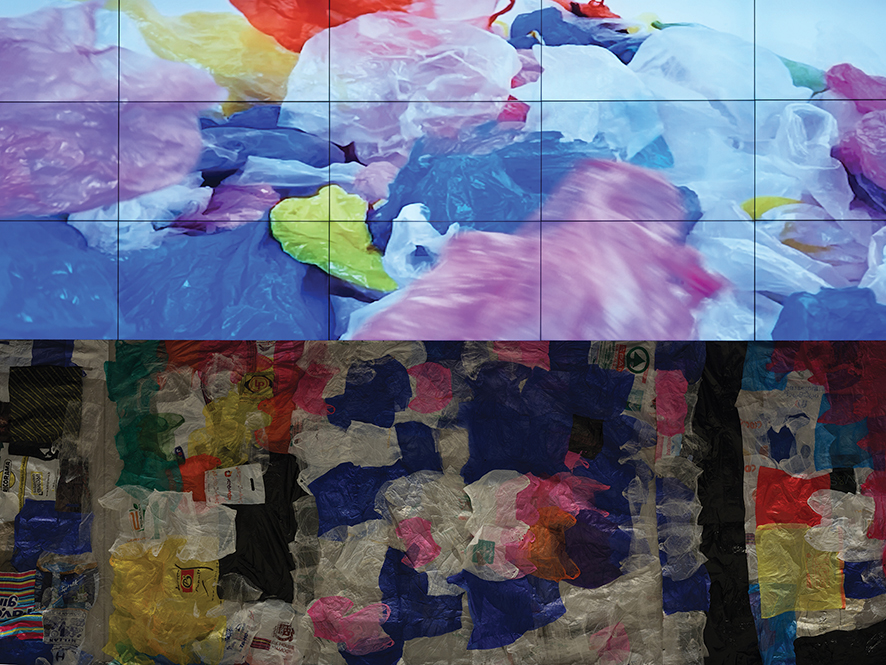
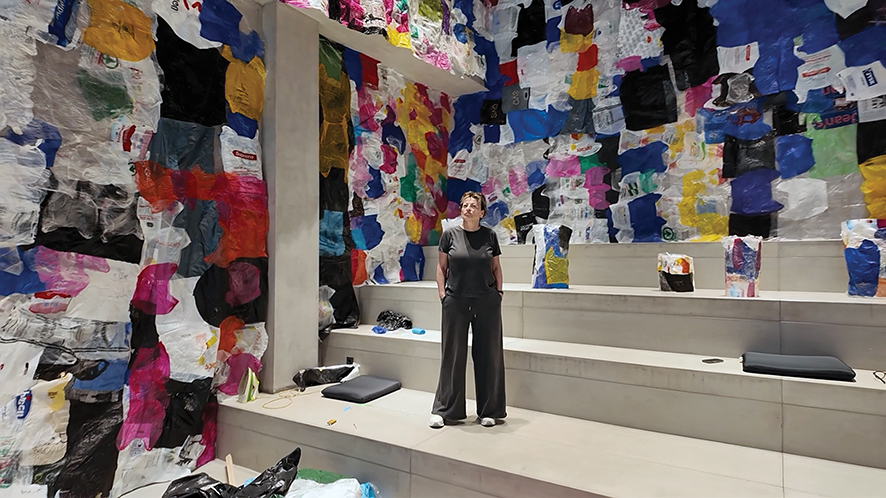
In the installation Futurist Fresco, which you also curated, you give plastic bags the form of a fresco. Which came first, the material or the idea? And if you could leave behind a single ‘trace’ of our own era, what would you choose?
In Futurist Fresco, the material came first, and then I decided to turn it into a monument. For several years, I kept collecting plastic bags instead of throwing them away. They are objects usually made for short term use and considered to have little or no value. Over time, though, they became a kind of archive of everyday life.
To create the installation, I ironed thousands of these bags and reassembled them into a single surface that covers the gallery walls like a fresco. For me, ironing becomes an artistic gesture in its own right. It is one of the most invisible forms of women’s domestic labour, connected to repetitive acts of care and to the traces of human existence. Within the exhibition, the Earth becomes a space of accumulated memory.
I imagine a future in which plastic becomes one of the key archaeological witnesses to our era. If today we read the histories of past civilizations through the material traces they left behind, perhaps one day, sadly, the history of our own time will likewise be read through layers of polyethylene.
As for leaving behind a single ‘trace’ of my own era, I find that difficult to answer. It would be hard to choose one particular object that could somehow serve as a symbol of myself or my time.
Interview by Team GT