On World Environment Day, UNDP, in partnership with the European Union and Denmark, highlighted how communities and businesses across Georgia are turning sustainability into action. From local green initiatives to circular business solutions, their efforts are driving meaningful environmental and economic change.
During a visit to western Georgia, Nils Christensen, UNDP Deputy Resident Representative, met with environmental activists, community groups, rural women, young innovators, persons with disabilities, and local entrepreneurs. Through the EU-funded Circular Economy project and the Denmark-funded Greening the Future initiative, UNDP is working alongside these inspiring changemakers to advance practical solutions that benefit both people and the planet.
Community Solutions for a Greener Future
On 3–4 June, Nils Christensen visited the municipalities of Khobi and Poti, where UNDP and Denmark are supporting community-led environmental initiatives.
In Khobi, he visited ‘Toliskuri’, the municipality’s only daycare centre serving up to 20 children with disabilities. With support from UNDP and Denmark, the centre installed solar panels for electricity and heating and equipped a 40-square-metre greenhouse with a rainwater-fed drip irrigation system. These practical green solutions have reduced energy costs, introduced energy-efficient technologies, and created a model of sustainable development for the wider community.
The UNDP Deputy Resident Representative also met young participants of the Green Startup Idea Lab, implemented in partnership with the Small & Medium Enterprise Development Association (SMEDA). Since 2025, the initiative has provided training and mentoring to 40 young people, supported the development of 17 business concepts, and awarded funding and coaching to the eight most promising teams.
From upcycling damaged clothing and greening schoolyards to promoting cycling and producing eco-friendly merchandise, these youth-led initiatives demonstrate how innovative green ideas can create both environmental and economic value.
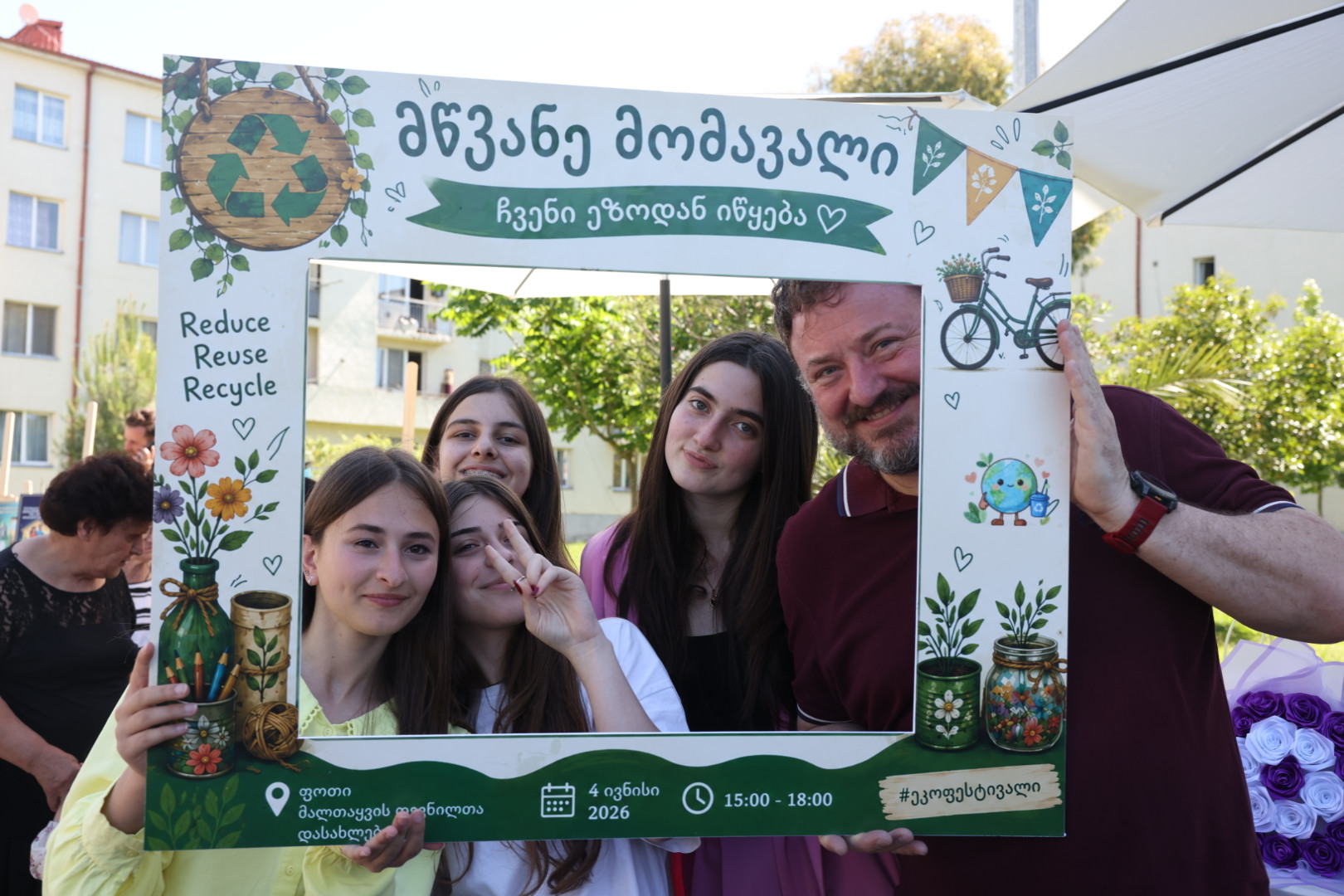
In the Maltakva settlement for people displaced by conflict, Nils Christensen joined a Green Transition Festival organised in partnership with the Charity Humanitarian Centre “Abkhazeti” (CHCA). Inspired by the work of local environmental champions, the festival showcased nature-based solutions and green technologies that strengthen climate resilience and improve the everyday life of one of Georgia’s most vulnerable social groups. Visitors explored a wide range of initiatives promoting sustainable mobility, waste reduction, environmental awareness, community engagement, and green learning.
Nils Christensen also met with students from Poti Public School No. 14, who are leading a local glass recycling campaign, and visited the EcoGuli education hub, which offers young people hands-on learning in recycling, reusing, and sustainable production. With support from UNDP and Denmark, in partnership with the Policy and Management Consulting Group (PMCG), EcoGuli received expert assistance and equipment, including 3D printers and scanners, to enhance their work.
“The green transition begins in communities,” noted Nils Christensen. “Across Georgia, we see how people are turning ideas into action and creating practical solutions for a cleaner, healthier, and more resilient future. Our partnership with Denmark helps make these local ambitions a reality.”

EcoGuli, Green Learning Hub in Poti
Turning Circularity into a Business Opportunity
The World Environment Day programme concluded on 5 June, in Batumi, where green community action was matched by discussions on how businesses can accelerate Georgia’s transition to a circular economy.
Nils Christensen and Annelies Vanwymelbeke, Team Leader for Green Deal, Connectivity, and Economic and Investment Plan at the European Union Delegation to Georgia, opened a Circular Business Forum organised with support from the European Union, in partnership with UNDP and the Caucasus Environmental NGOs Network (CENN).
The forum brought together Georgia’s four producer responsibility organisations alongside up to 100 representatives of businesses, academic institutions, industry experts, and international organisations to explore opportunities and address key challenges of Georgia’s circular transition.
Forum participants agreed that while Georgia has made important strides in advancing circular economy legislation and introducing Extended Producer Responsibility systems, significant opportunities remain. The country’s circularity rate stands at 1.48 percent, compared to the European Union average of 12.2 percent. Most materials are still used in a linear ‘take-make-dispose’ model, while approximately 88 percent of municipal waste continues to end up in landfills. These figures highlight both the scale of the challenge and the potential for circular solutions to create environmental and economic benefits.
Discussions focused on recycling technologies, the future of plastic packaging, waste prevention and resource efficiency across value chains, financing mechanisms, and the growing role of digital innovation and artificial intelligence in advancing circular business models.
“The European Union is proud to support Georgia’s transition towards a circular economy that benefits both people and the environment,” said Annelies Vanwymelbeke. “By strengthening waste management systems, promoting recycling, and improving resource efficiency, we help create new opportunities for sustainable growth. The active engagement of businesses will be essential to the success of this transformation.”
“Circularity is no longer simply an environmental choice. It is a business opportunity,” said Nils Christensen. “Companies that reduce waste, use resources more efficiently, and innovate their production models will be better positioned to compete and grow. UNDP remains committed to supporting Georgian businesses throughout this transition.”
Working Together for People and Planet
World Environment Day 2026 highlighted how partnerships, innovation, and local action can drive a greener and more sustainable future for all. Through its resources, expertise, and collaboration with communities, businesses, and development partners, UNDP helps advance practical solutions that protect the environment, strengthen the economy, and support a green and just transition.
World Environment Day 2026
World Environment Day 2026 (WED2026) is celebrated on 5 June under the global theme #NowForClimate. It highlights the urgent signals our planet is sending and the signals we choose to send in response. It also focuses on positive tipping points already shaping a greener future, from renewable energy and ecosystem restoration to circular economy solutions and sustainable redesign.
For more than 30 years, the European Union has built a close partnership with Georgia, supporting its development through knowledge, experience sharing, expertise, innovation, and financial aid. The relationship between the EU and the people of Georgia is based on shared values of peace, freedom, democracy, human rights, and inclusive economic growth. More about the EU’s support for Georgia: https://eu4georgia.eu/the-european-union-in-georgia
‘Green, Inclusive and Circular Economy: Waste Reduction and Recycling for Citizens’ Health’ is a UN joint programme funded by the European Union and implemented by UNDP, the United Nations Industrial Development Organisation (UNIDO), and the Environment Agency Austria (UBA), with additional expertise from Avfall Sverige. With EUR4.4 million in EU funding, the two-year project (2025–2027) brings together national actors, international partners, and private-sector stakeholders to strengthen circular economy systems, support waste reduction, boost recycling, and contribute to sustainable, green growth and a more resilient economy.
‘Greening the Future, Advancing Rights and Stability’ (2024-2027) is a regional project funded by the Government of Denmark and implemented by UNDP in Georgia and Moldova. With US$10.8 million shared between the two countries, the initiative aims to bolster environmental governance, foster a climate-sensitive economy, facilitate inclusive area-based development, and promote civic engagement and local solutions for green transition.