
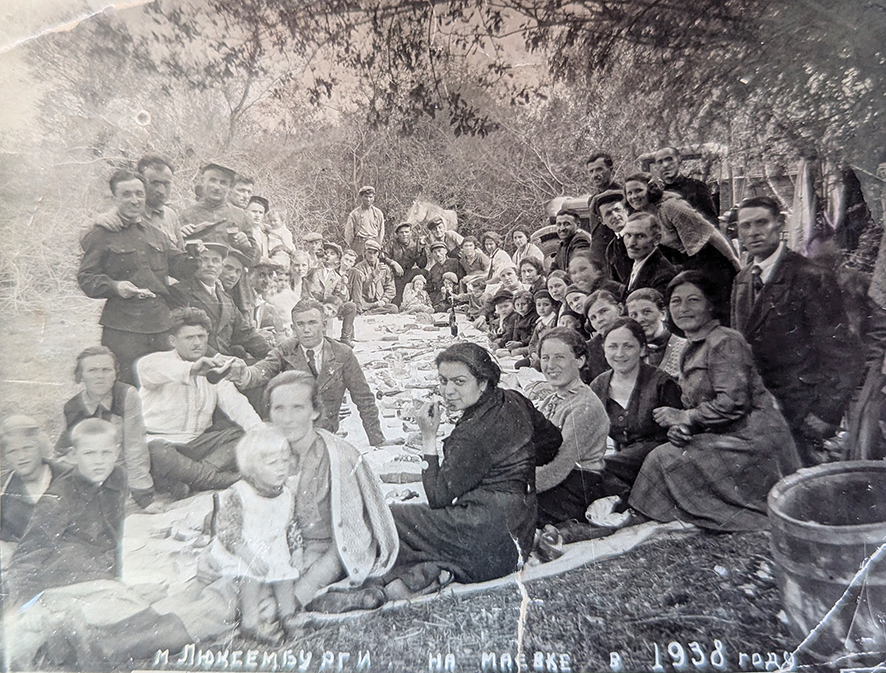
Did you know that Georgia once had its very own Luxemburg? Before receiving its Soviet-era name in 1921, this prosperous settlement was known as Katharinenfeld. It was founded in 1818 by Swabian colonists, and from 1941 onward, the location became known as Bolnisi. In total, there were 23 German settlements across the South Caucasus.
A Brief History of the German Settlers
The settlers from the Kingdom of Württemberg were, for the most part, devout Pietists, explains Oliver Reisner, a professor at Tbilisi State University. For several years, he has been teaching a course to Georgian students on the history of German colonists in Georgia.
Back home in Germany, they had practically broken away from the official church, establishing Bible study circles and electing their own spiritual mentors. When famine struck Württemberg, triggered by the eruption of Mount Tambora and the aftermath of the Napoleonic Wars, they chose a different path from many others: instead of migrating to America, they headed east. The Swabians answered the call of the Russian Tsar, who sought to fortify Christianity in the Caucasus, a region surrounded by Muslim lands. The imperial authorities recalled their positive experience with the Volga Germans and attempted to replicate it in the South Caucasus.
The South Caucasus: A Nineteenth-Century Hotspot of the Russian Empire
For the Russian Tsar, the Germans arrived at the most opportune moment. Until the late 1820s, the South Caucasus remained an arena of fierce geopolitical struggle among the Ottoman, Persian (Iranian), and Russian empires. Local peasants could not produce enough agricultural yields to sustain the growing needs of the imperial army, whereas the Germans were regarded as model farmers upon whom high expectations were placed.
However, a fundamental misunderstanding arose between the authorities and the German settlers. According to Johann Bengel, one of the primary preachers of Pietism, Jesus Christ was prophesied to return to Earth for the Last Judgment in the year 1836. Believers felt compelled to be physically present at the designated “place of judgment”—Jerusalem. Consequently, the Pietists were in no hurry to establish permanent roots in the South Caucasus; their ultimate destination was the Holy Land. Obsessed with the Second Coming, they did only the bare minimum required for immediate survival, fully intending to move onward at the first opportunity.
Yet, the Tsarist Cossacks barred their way. This is vividly documented in a fascinating exchange of correspondence among Russian officials compiled in the Acts of the Caucasian Archeographic Commission, preserved today in the National Library of Georgia.
Gradually, the religious fervor of the German settlers waned as their material prosperity grew. A popular saying eventually emerged regarding these migrants: “The first generation finds death, the second finds need, the third finds bread.” This meant that economic stabilization only arrived after three generations. Counting from the initial migration wave in 1817 and measuring three 15-year intervals, the beginning of their economic boom aligns precisely with the year 1845.
This socio-economic evolution can be traced directly through their architecture: while the earliest residential dwellings were rudimentary, the Germans later began erecting sturdy, two-story timber-framed (Fachwerk) houses complete with private courtyards and deep cellars, some of which descended several stories underground.
The Colonists’ Work Ethic
Tsar Alexander I’s calculations proved entirely correct: the South Caucasus witnessed the vivid manifestation of the classic Swabian character trait, encapsulated by the motto: “Schaffe, schaffe, Häusle baue” (“Work, work, build a little house”). While their Georgian neighbors excelled like no other in celebrating and enjoying the pleasures of life, everything within the Swabian colonies was subordinated to a rigorous work ethic.
In the Swabian colonies of the South Caucasus, such as Katharinenfeld (Bolnisi), Rosenfeld (Sartichala), and Elisabetthal (Asureti), German pragmatism and diligence yielded spectacular results. By applying advanced European agro-technologies to the region’s rich native soils, the colonists gathered record harvests year after year. The true triumph of the Swabians, however, was their winemaking. By blending the European tradition of aging wine in oak barrels with local viniculturee, they established the industrial production of high-grade wines that were supplied directly to the imperial court and shipped abroad for export.
Furthermore, the colonies were renowned for their breweries and the impeccable quality of their meat and dairy goods. German dry-cured sausages, smoked hams, and bacon were crafted according to traditional recipes and valued like gold throughout the entire region.
Following the establishment of Soviet rule in Georgia, the German settlements were converted into highly successful collective farms. The transition was seamless because, long before Soviet collectivization, the Germans had already organized themselves into tight-knit communes: a foundational structure that had governed their entire way of life for over a century. A documentary film from the late 1920s survives, showcasing the former village of Elisabetthal (by then renamed Asureti) as a model Soviet village.
Following Hitler’s invasion of the Soviet Union, all ethnic Germans were abruptly categorized as “enemies of the people.” The authorities initiated a hasty, sweeping deportation. The dragnet reached the South Caucasus on October 18, 1941. It was an absolute tragedy that left a deep, multi-generational trauma: families were forced to pack their lives into a single night, forbidden from taking almost any of their belongings.
In K. Bochorishvili’s book Voluntary Settlers, a dedicated chapter recounts the cruelty and injustice that shattered the peaceful lives of the residents of Luxemburg (present-day Bolnisi). The author highlights the recollections of an eyewitness to the events, an NKVD operative identified as O.M.:
“We did not think back then about whether it was fair or not. There was an order, and it had to be executed. Emotions were pushed to the background, even though many of us, myself included, were married to German women and had to participate in the expulsion of our own relatives. On the very first evening, we went to notify the families and brief them on the organizational matters: how much time was allowed for packing and what they could bring along. People were in absolute shock. A single question was on everyone’s lips: What for? Restrained by nature, they managed without hysterics or tears this time as well, but witnessing it was all the more difficult.
“And yet, there were those who could not withstand the psychological toll: Karl Heiter, the manager of the haberdashery store, a man described by those who knew him as possessing a crystal-pure soul, upon learning of the deportation, smashed his head against a wall, crying: ‘I was born here, I grew up here, I don’t want to leave! I have no one abroad, and I can betray no one! Why am I being driven out?!’ His sole guilt was his nationality. Those abandoning their ancestral homes were certain they were heading to death. And indeed, very few of them managed to survive and endure the grueling trials of exile and the labor army (Trudarmiya).”
Here is another eyewitness account from the same book, describing the scene in the former Katharinenfeld: “The NKVD men scurried from courtyard to courtyard. They shouted, threatened, struck people, hurried them along, and struck even more terror into the trembling souls of the frightened elderly. Many were well over 80 years old, and to die in their homeland was their final wish. Groans and weeping echoed all around. At the designated assembly point, not only did columns of trucks laden with people and their meager belongings line up, but a multitude of dogs came running as well. … They ran for a long time with their tongues out, breathing heavily, their eyes locked onto their masters. … They had never had to endure anything like this before. Their masters had never had to endure anything like this either. For several days following the evacuation of the Germans, the NKVD men shot the remaining dogs and cats. A dead silence descended upon the town.”
Natela: Living Testimonies
“When they were being loaded into the trucks, they screamed. They all screamed with one voice: ‘Farewell, homeland!’—with tears in her eyes,” recounts 83-year-old Natela. “They had lived here for so many years! Was that not a tragedy?”
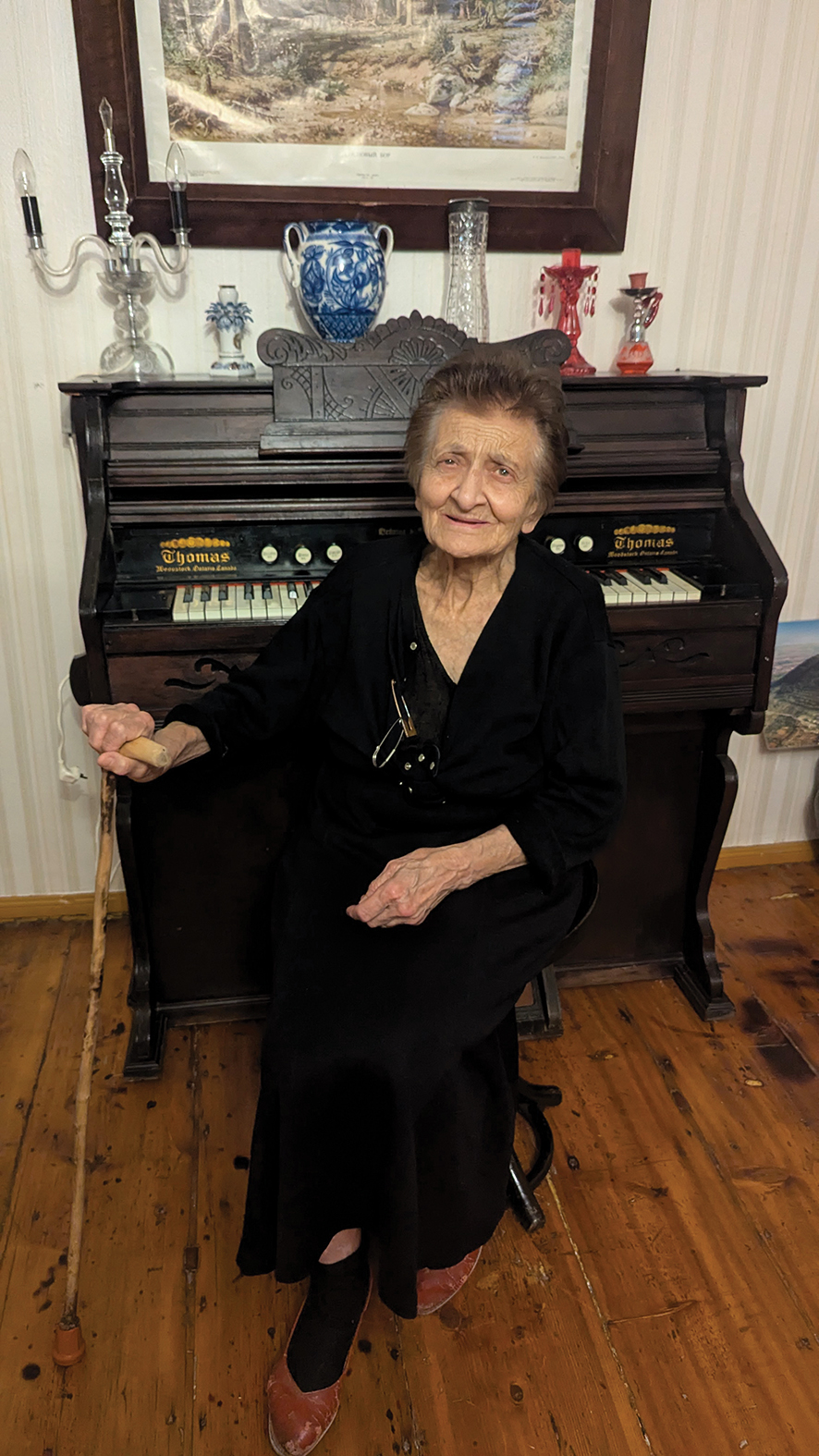
A native of Bolnisi, Natela Grigolia knows about the German settlers firsthand. Although the vast majority of the German population was deported to Kazakhstan in 1941, and Natela was born two years later, she grew up enveloped by German traditions and songs. As a young girl, she was surrounded by the love of her mother’s close friends, those German women who managed to escape exile by virtue of being married to Georgians, Armenians, or representatives of other local nationalities.
Despite her advanced age, Natela remembers all of these “German aunties” and their family members by name: Hanna Kurt, Alisa Walker, Lida Schnorr, Aunt Erna Speiser, Lisa Mayer. For the holidays, Natela recalls, people in Bolnisi continued to bake traditional German pies and cakes, Nusskuchen and Ribiselkuchen (redcurrant cake), and for the New Year, Lebkuchen, spiced Christmas cookies. Even pork was slaughtered and prepared according to German methods, with the meat entirely processed into sausages, smoked hams, and cold cuts. Smoked ham made according to German recipes was prepared by everyone in the area: both Armenians and Georgians alike.
Natela recalls that until the death of Stalin, the German women were terrified to speak German, let alone teach the language to their children. Only within a tight, trusted circle of friends did they allow themselves to softly sing songs in their native tongue.
“Little Europe” in Katharinenfeld
Natela’s mother, Anna, was a scholar of German studies. Born in 1915, she grew up in Katharinenfeld and graduated from the local German school, the only one in the settlement. Anna possessed an impeccable command of both standard literary German and the local Swabian dialect.
Her mother’s stories of a blissful childhood spent among the German colonists became permanently etched in Natela’s memory. “Whoever came here in the old days never wanted to leave,” she says with admiration. “We had a Little Europe right here! All the streets were paved with cobblestones. The Germans engaged in a wide variety of crafts: they built carriages, opened tailoring workshops, and ran antique shops. And they took their famous wine to Tbilisi to sell.”
“Our street was one of the very first in Katharinenfeld and was called Gartenstraße (Garden Street, or Bagis kucha in Georgian),” Natela notes. “The Walkers, the Allmendingers, and the Mayers lived here. My parents settled in with the Blinkenmayers.”
Natela receives guests in her old German house, a spacious, bright, and solidly built home that once belonged to Lydia Buchrer. The expansive living room features antique furniture, while the walls are adorned with paintings, reproductions, and an old tapestry. Resting against one wall is a harmonium. In the past, this musical instrument, a domestic reed organ, was found in almost every German home for weekly practices of sacred music.
“Unfortunately, the unique stove that heated several rooms simultaneously in our house, as in many others, was dismantled over time,” Natela laments. “Only in those families where the German housewives remained were the stoves left untouched: the women used to hide their homemade ham inside them.”
By Tatjana Montik
Tatjana Montik, journalist, author, and passionate admirer of Georgia, has spent the past 15 years living in and reporting on this captivating South Caucasus country. See more of her experiences in her new travel diary and cultural guide, Georgia: A Tapestry of Time and Space.









