As the war in Iran spreads beyond the Middle East, it is reshaping the South Caucasus, bringing rising proxy threats, refugee pressures, and shifting alliances to Georgia, Armenia, and Azerbaijan. In an interview with Radio Free Europe/Radio Liberty’s Georgian Service, Joseph Epstein, Director of the Turan Research Center and expert on Eurasia and the Middle East, explains that Azerbaijan faces direct attacks and pipeline threats, Georgia contends with pro-Iranian sentiment and security risks, and Armenia may gain room for Western-oriented initiatives. At the same time, Tehran’s regional aggression and Georgia’s pivot toward Russia, China, and Iran challenge US influence. Yet ongoing American engagement, sanctions, and strategic transit corridors give Washington leverage to shape Tbilisi’s decisions and protect its role in the Middle Corridor.
Let’s start with the regional picture. What impact is the Iran war having on the region, and on Georgia in particular? How much hinges on this war for the South Caucasus?
Quite a bit. The war is already having pretty big consequences: the region is no longer just a periphery of the conflict, but is actually in the spillover zone.
Azerbaijan, I would say, has felt it the most acutely. There was a drone strike on Nakhchivan airport, and there were plots against the Baku-Tbilisi-Ceyhan pipeline and Jewish targets in the country which were foiled. For Georgia specifically, I would say the risks are a bit different, but still serious.
There is the proxy risk. Iran has spent years building networks of influence among the ethnic Azerbaijani Shia in Georgia, particularly in the south of the country. And since the war broke out, we’ve seen pretty acute displays of pro-Iranian sentiment. We saw the imam in Marneuli come out and call the US a terrorist and display portraits of Khamenei, as well as protests at the Iranian embassy after the elimination of Khamenei, with a group of Georgian citizens saying that they were ready to follow the orders of Iran.
Baku has been warning Tbilisi about this problem for years, and the Georgian government hasn’t been taking it seriously. Although, that being said, credit where it’s due, very recently security services opened up an investigation into the Georgian branch of Al-Mustafa University. So that’s a sign that maybe things are changing.
I think in Georgia, you definitely have the risk of some sort of attack against Jewish and Israeli targets. That has happened in the past during non-war times, and I think the risk is even higher now. But beyond the proxy threat, an unstable Iran could also trigger refugee outflows that affect all three Caucasus states.
What about Armenia, which also shares a border with Iran. How profound is the Iran war’s impact going to be, especially with the TRIPP (The Trump Route for International Peace and Prosperity) project in mind?
In the past, Iran has been an ally of Armenia. But in a way, a weakened Iran could actually be helpful for Prime Minister Pashinyan’s objectives in the region, especially considering that Iran was dead set against TRIPP. We’ve seen threats. The Supreme Leader specifically said that he didn’t want TRIPP. His senior advisor Ali Velayati said that he was going to turn TRIPP into a graveyard for the mercenaries of Donald Trump. So, in a way, this does possibly give Armenia a little bit more room to move towards the West.
Is there a scenario where a weakened Iran, after the US leaves, tries to re-establish its credentials, re-impose itself on the region by lashing out at weaker neighbors?
Indeed. We’ve already seen that Iran is perfectly comfortable deploying the wounded animal strategy, where it will just strike out at everyone. We’ve seen that happen in the Middle East, as well as in the South Caucasus region, with Azerbaijan. So yes, a weakened Iran that isn’t quite weakened enough will bring its own dangers.
Following US Secretary Rubio’s call to PM Kobakhidze, the Iranian ambassador’s remarks were widely seen as thinly veiled threats, warning that no country is immune to regional crises and that “those who supported Donald Trump yesterday now pay the price.” Your thoughts?
Well, Iran is a regional bully. It tries to impose its will on the countries around it through strength. The message is quite clear: don’t collaborate with the US or you will become a target for us. What’s surprising about it is that this isn’t usually done through official channels. They typically like to do it through the IRGC or Tasnim, or some other government media outlet, so that they still have the ability to deny it. But the fact that the ambassador said it is a much stronger statement. This shows Iran is a lot more serious.

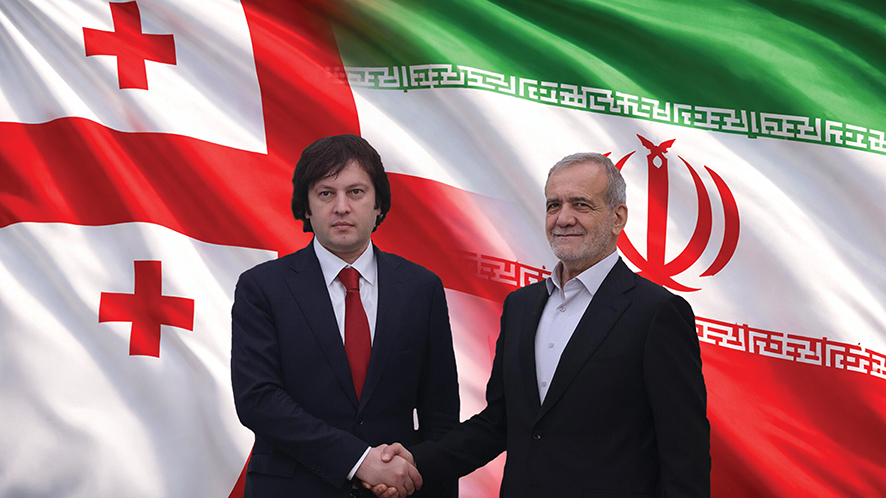
The remarks were directed at a government with pro-Iran leanings—Kobakhidze was one of few leaders to visit Iran after Raisi’s death, and Georgian Dream has faced criticism for cozying up to Tehran. Why wasn’t this handled through back channel diplomacy?
I think it shows the sort of belligerence that you see in the Iranian regime. Iran is kind of similar to Russia in the sense that it doesn’t actually have allies, only vassals and proxies. In Iran’s case, it only has proxies that it can depend upon. And so, despite the fact that Georgian-Iranian relations have gotten better, despite the fact that we’ve seen the whole scandal about Iran opening up a bunch of businesses to evade sanctions in one Georgian village, despite Kobakhidze visiting and everyone being buddy-buddy, there isn’t trust there.
Trump is taking a Kartlis Deda approach to Georgia: he has a bottle of wine in one hand and a sword in the other
And so Iran feels that it has to achieve its way through threats of force to put Georgia in its place. It’s something of a cautionary slap, so to say, and not even on the wrist.
While Iran Georgia ties seemed to have warmed, the US Georgia relationship has clearly worsened. How deep and irreversible is that decline, and what effects might it have?
It’s no secret that Georgia has drifted from both the US and Europe since Georgian Dream came to power. And I would say that their surface logic for this actually does make some sense. They say that they want to practice multi-vector foreign policy, similar to Azerbaijan and Central Asia. However, multi-vectorism is all about balancing between power centers, not choosing a side. But what we see in practice is a lot more of a deliberate turn towards Russia, China, and increasingly Iran.
I think it was a pretty big wake-up call when Vance came to the South Caucasus, and Georgia, once the most pro-US country in the post-Soviet space, was the only country left off his visit.
What will the costs be of such policies? What will Georgia and the Georgian people have to pay for that?
That’s a good question. I think we know that European integration, joining NATO, was probably not on the cards anyway. Not necessarily because of the United States, but more because of Germany. That being said, if you look at the allies of Russia, Iran, and China, these are countries that don’t necessarily seek to empower their allies. They seek to control them. And so I think, ultimately, the cost here could be sovereignty.
Since the start of the Iran war, however, we’ve seen some new reciprocity. For example, we’ve got high-ranking US officials visiting the Anaklia port. Does that signal renewed American interest?
I think it does signal something real. Georgia remains a key node of the Middle Corridor, especially as long as TRIPP is not yet operational. And so the Vance visit does show that Washington is not yet prepared to cede this strategic transit infrastructure to China. Washington doesn’t see it as a done deal that they’ve lost Georgia. With TRIPP on the cards, this offers an alternative for the Middle Corridor, meaning Georgia does not have a monopoly on it anymore. This could actually then push Georgia towards more cooperation with Washington or risk becoming more irrelevant.
Secretary of State Rubio’s call to Kobakhidze sparked debate. Some see it as the US engaging Georgia, a win for Georgian Dream; others view it as Washington reacting to Tbilisi’s turn toward Russia and China. Which do you think it is?
I think the truth kind of sits between both interpretations. The Georgian government has clearly stepped up its outreach to Washington, especially after Vance’s trip in February, which I think was a wake-up call, because it’s not only that Georgia wasn’t included: it was barely even mentioned. Kobakhidze has been mentioning this potential reset ever since. And the fact that Rubio took the time, especially during an active war with Iran, does suggest that Washington still sees value in engaging Tbilisi.
Is it because of the war in Iran that Rubio found the time, or despite it?
I’m not sure, to be honest. The US readout mentioned security in the Black Sea region, so they might have discussed the war, but it’s unclear exactly what role. But what is interesting here is that the US and Georgian readouts told a diverging story. Kobakhidze, of course, declared it as a victory. He said it was productive, that they discussed resetting the partnership, reinforcing Georgia’s regional role. But the US readout was a lot more restrained. They talked about areas of mutual interest. And then, crucially, on the same day, President Trump signed an extension of Biden-era Russia waivers that also included the sanctions on Ivanishvili. So it’s definitely not a clean reset. I think it’s more like a signal of continued engagement, simultaneous with continued pressure.
Could Georgia follow a Lukashenko-style model, like the Trump administration did with Belarus, where the US engages an undemocratic government if it makes concessions, such as releasing political prisoners?
Some sort of arrangement like that is possible. I wouldn’t really call it a Lukashenko or Belarus model, because Belarus at this point is essentially a vassal of Russia. Its sovereignty is nominal. And that’s not where Georgia is, at least not right now. The Trump administration in general has moved past this post-Cold War framework where democracy promotion and human rights were central pillars of US engagement with the region. What today’s Washington does care about is Tbilisi’s foreign policy and how it engages with the world. So if there are places where Georgian Dream is willing to cooperate on transit, on connectivity, on the Middle Corridor, BTC, I think there’s a basis for engagement, even without democratic credentials. But it’s also going to be crucial how much Georgian Dream continues to work with and enable America’s adversaries.
So, if Georgian Dream tries to balance its foreign policy, the US might overlook its domestic missteps. Am I reading that right?
Yeah, I think so. Because we’re seeing them work with these Central Asian governments, with Azerbaijan, even Armenia. I mean, its democracy is really nascent, and that’s not an issue there. Some of its closest allies in the Middle East, the UAE and Saudi Arabia, are far from democracies. Democracy is kind of falling off as a criterion for engagement.
If Georgia refuses to align on foreign policy, how much leverage does the US still have? Could Washington use sanctions on Ivanishvili, prolonged or lifted, as a tool to influence Tbilisi to do what it wants?
I think it’s totally possible. Washington no longer has the leverage of the Euro-Atlantic integration path. But there are still meaningful pressure points. The TRIPP corridor, once built, could diminish Georgia’s transit relevance. As for the Biden-era sanctions on Ivanishvili, yes, obviously the picture got more complicated after Trump extended them on the same day as Rubio’s call with Kobakhidze. I think essentially Trump is taking a Kartlis Deda approach to Georgia: he has a bottle of wine in one hand and a sword in the other. But the difference, I would say, is that he’s holding out both, he’s extending both simultaneously, and giving the Georgian government a constant choice.
Interview by Vazha Tavberidze